Category: legends

Born with a Veil

Born with a Veil

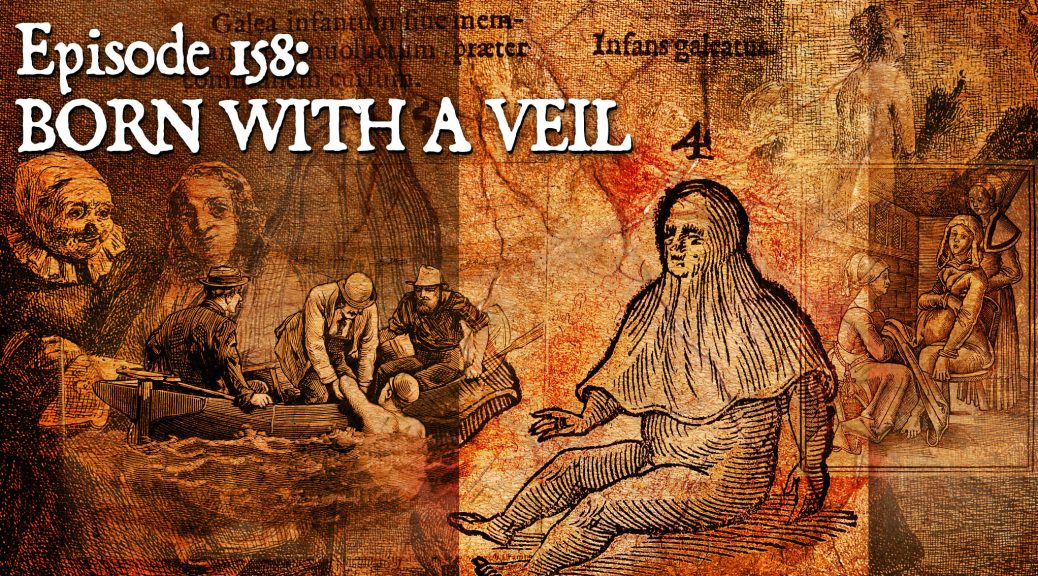
To be “born with a veil” (or caul) was once regarded as far more than an unusual circumstance of birth. Being born with a caul—a portion of the amniotic membrane adhering to a newborn’s head or face—is exceedingly rare, but across centuries of European folklore it has been interpreted as a visible mark of destiny. Those born with one might be exceptionally lucky, possess healing powers or second sight, or enjoy supernatural protection. In darker traditions, however, the same sign could mark a future witch, vampire, or uncanny wanderer between worlds.

We  begin with a quoted passage from Stephen King’s The Shining, in which it’s revealed that the psychically gifted boy, Danny, is born with a veil and then go on to explore the colorful vocabulary once used to describe the caul. Across Europe, the membrane was imagined as a cap, hood, helmet, veil, cloak, or even a “shirt.” Such expressions as the Scottish “sely hoo,” or blessed hood, and various European equivalents of “lucky cap” and “victor’s cloak” reveal how closely the caul became associated with good fortune.

Next, we explore the earliest written references to caul superstition. A fourth-century biography of the short-lived Roman emperor Diadumenian claims that he was born with a strange membrane resembling a diadem. The same source remarks that midwives sold preserved cauls to lawyers who believed they would bring success in court. Medieval clerical writings likewise condemn officials who carried cauls as charms to silence their opponents.

From there, the episode turns to the long practice of preserving cauls as family treasures. Surviving examples include a fragment enclosed in a locket made for John Monson in 1597 and the caul of King Frederik III, kept in a silver casket in the Danish royal collections. Seventeenth-century wills describe cauls mounted in jeweled gold settings and passed down as heirlooms believed to ensure a family’s continuing prosperity.

We then address the caul’s most famous power: protection from drowning. By the eighteenth century, cauls were carefully dried on paper and sold to sailors. Newspaper advertisements addressed “gentlemen of the Navy” and offered them as proven safeguards for long voyages. Dickens satirized the trade in the opening of David Copperfield, whose caul attracts only one bidder—an attorney offering cash and sherry, but refusing to pay enough to guarantee himself against drowning.
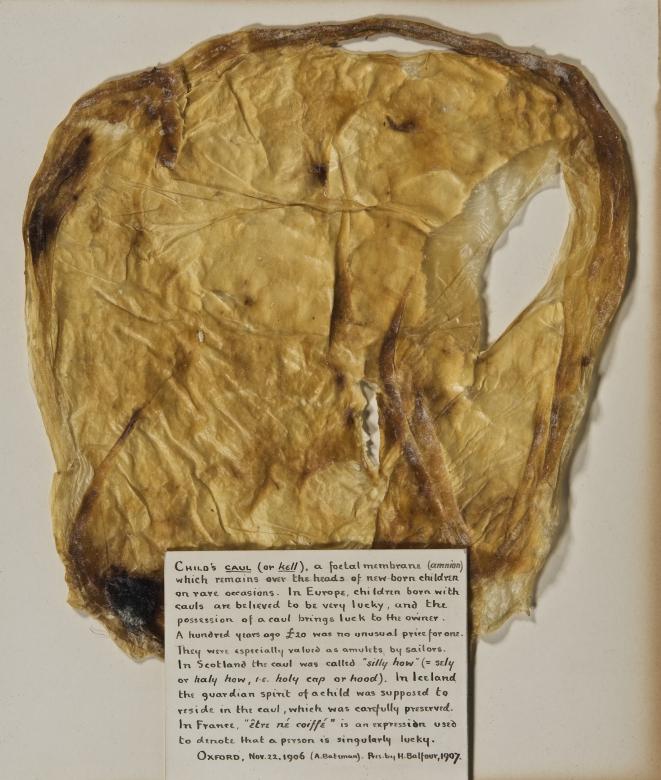
Caul kept as sailor’s charm displayed at Pitt Rivers Museum, Oxford.

Mrs. Karswell then shares some amusing 19th-century anecdotes found in the long-running Oxford University publication, Notes and Queries. One report has a caul-bearing child who hild floated like a cork whenever his mother tried to bathe him. Another describes a prognosticating caul that physically transformed in sympathy to events unfolding in the life of the person consulting it.

We then travel to Iceland, where fetal membranes were associated with the fylgja, a guardian spirit or external portion of the soul. The afterbirth could not safely be discarded, exposed to animals, or burned, lest the child lose this spiritual companion. Yet the caul’s magical potential also made it dangerous: witches were said to use it in love potions, and a seventeenth-century French royal midwife warned her colleagues never to preserve one because sorcerers might obtain it.

The episode then moves eastward, where caul folklore grows considerably darker. In Romania and Poland, those born beneath the membrane might be destined to become strigoi or other vampiric beings after death. In Slovenia, Croatia, and Serbia, however, caul-born men could become supernatural defenders known as Krsniki or Zduhaći. Their spirits left their bodies at night to battle dragons, witches, night-hags, and rival spirit warriors threatening the community’s health, weather, and harvest.

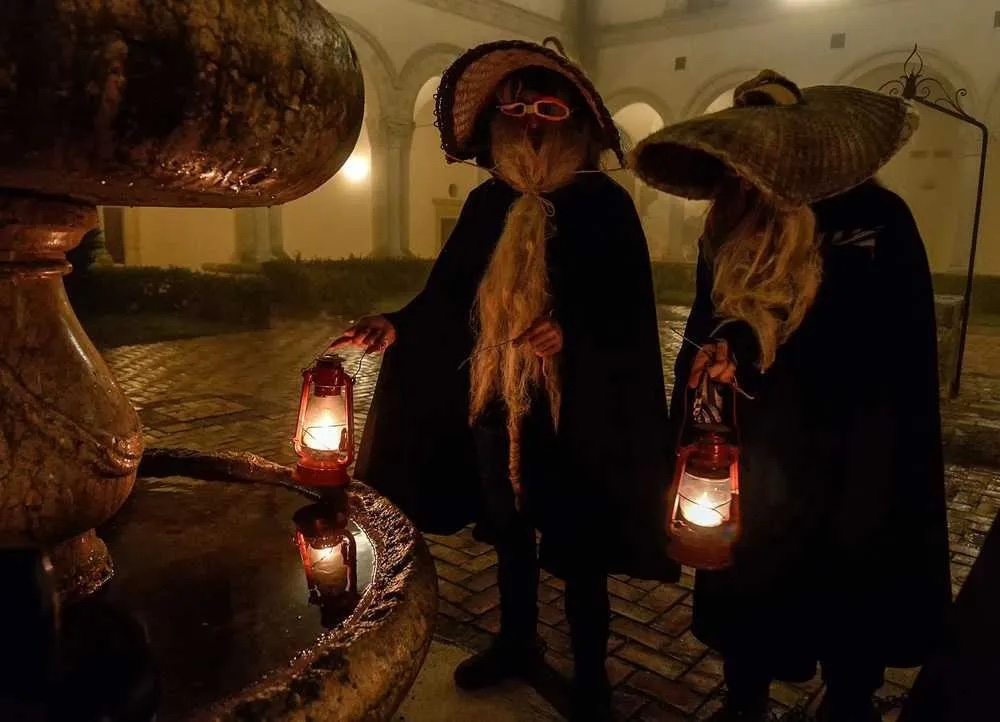
Next, we encounter their Italian counterparts, the Friulian Benandanti, or “good walkers.” Sixteenth- and seventeenth-century inquisitorial records describe men and women who claimed that everyone born with a caul was summoned in adulthood to fight witches during nocturnal spirit journeys. Their preserved “little shirts” were worn around the neck, blessed with prayers and Masses, and believed to protect soldiers or help lawyers win cases.

Finally, we return to the sea with the curious modern discovery of a preserved caul purportedly belonging to a survivor of the the sinking of the Titanic. Its provenance may be uncertain, but the topic at least provides an excuse to close out with a snippet of the uniquely grim yet lighthearted folk song, “When the Great Ship Went Down.”
The Dog-Head Saint

The Dog-Head Saint

Today he’s known mainly as a figure from medals carried to insure safe travels, but that image of a giant carrying the Christ Child across a dangerous river represents only the final stage in the long and strange evolution of the saint’s legend. Earlier or forgotten aspects of his story describe Christopher as a ferocious soldier, the Devil’s servant, a cannibal, and even a dog-headed monster.

Our episode begins with the best known version of the tale recorded in The Golden Legend, the classic collection of hagiographies written in 1260 by Jacobus de Voragine, a Dominican friar in Genoa. Here Christopher begins as Reprobus, a fearsome giant determined to serve the most powerful master in the world. He first serves a king but abandons him after discovering that the king fears the Devil. Reprobus then serves the Devil, only to discover that the Devil fears Christ.

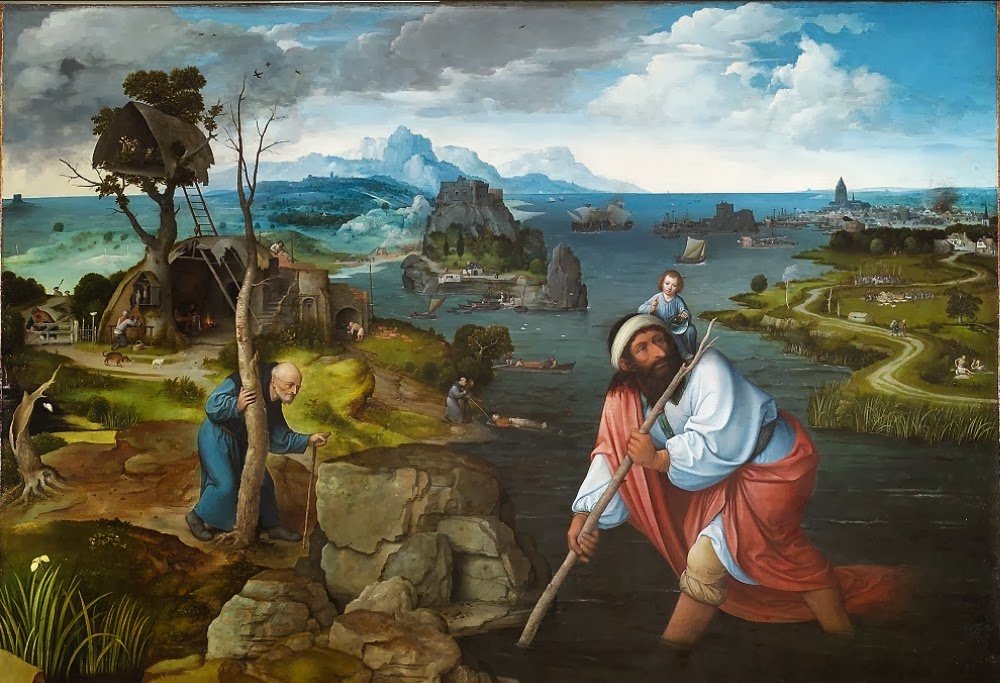
Seeking Christ, Reprobus encounters a hermit who suggests that the giant use his great strength to carry travelers across a dangerous river. One night, a mysterious child asks to be carried across. As Reprobus struggles through the rising water, the child becomes impossibly heavy. Upon reaching the opposite bank, the child reveals himself as Christ and explains that Reprobus has carried both the Creator of the world and the weight of the world itself. Reprobus thus becomes Christopher, the “Christ-bearer.”

St. Christopher Joachim Patinir, ca1522

After this, comes the lesser known portion of his tale, in which Christopher runs up against Roman authorities thanks to his Christian faith. As a sign that God will be with him throughout this, his staff planted in the earth breaks for in blooms, and he’s preserved through numerous tortures and attempts to execute him after his refusal to worship the pagan gods. Tortures fail to harm him, arrows miraculously stop in midair, and Christopher eventually converts the king responsible for his execution.

But earlier versions of the legend are considerably stranger. Around 986, the German poet and bishop Walter von Speyer composed two Latin hagiographies, one in prose and the other in verse. Each tells the same story, describing Reprobus as a dog-headed cannibal who could only bark before his conversion.  The struggle through the river in de Voragine 13th-century tale is prefigured as a spiritual transformation in the waters of baptism.

An even older narrative is found in the apocryphal Acts of Andrew and Bartholomew.  Pieced together from parchments dated to the fifth and seventh centuries, merging stories, which originated in Coptic communities of Syria and Egypt. We hear extensive passages from this particularly fantastical tale read by Mrs. Karswell.

In this  which the apostles encounter a terrifying dog-headed cannibal named “Bewitched.” He’s been sent to them by an angel, who first removes his appetite for human flesh and grants him the ability to speak. Renamed  “Christian,” (though still referred to in the text as “Dog’s Head”) the creature accompanies the apostles on their missionary adventures to the city of Barbaros in Parthia. When they are sentenced to death by  lions and tigers , Dog’s Head is divinely granted a temporary return to his original ferocity, and slaughtering and devouring the beasts. Walls of fire, flying idols, miraculous floods, and more grisly tortures and martrydoms, round out the narrative.

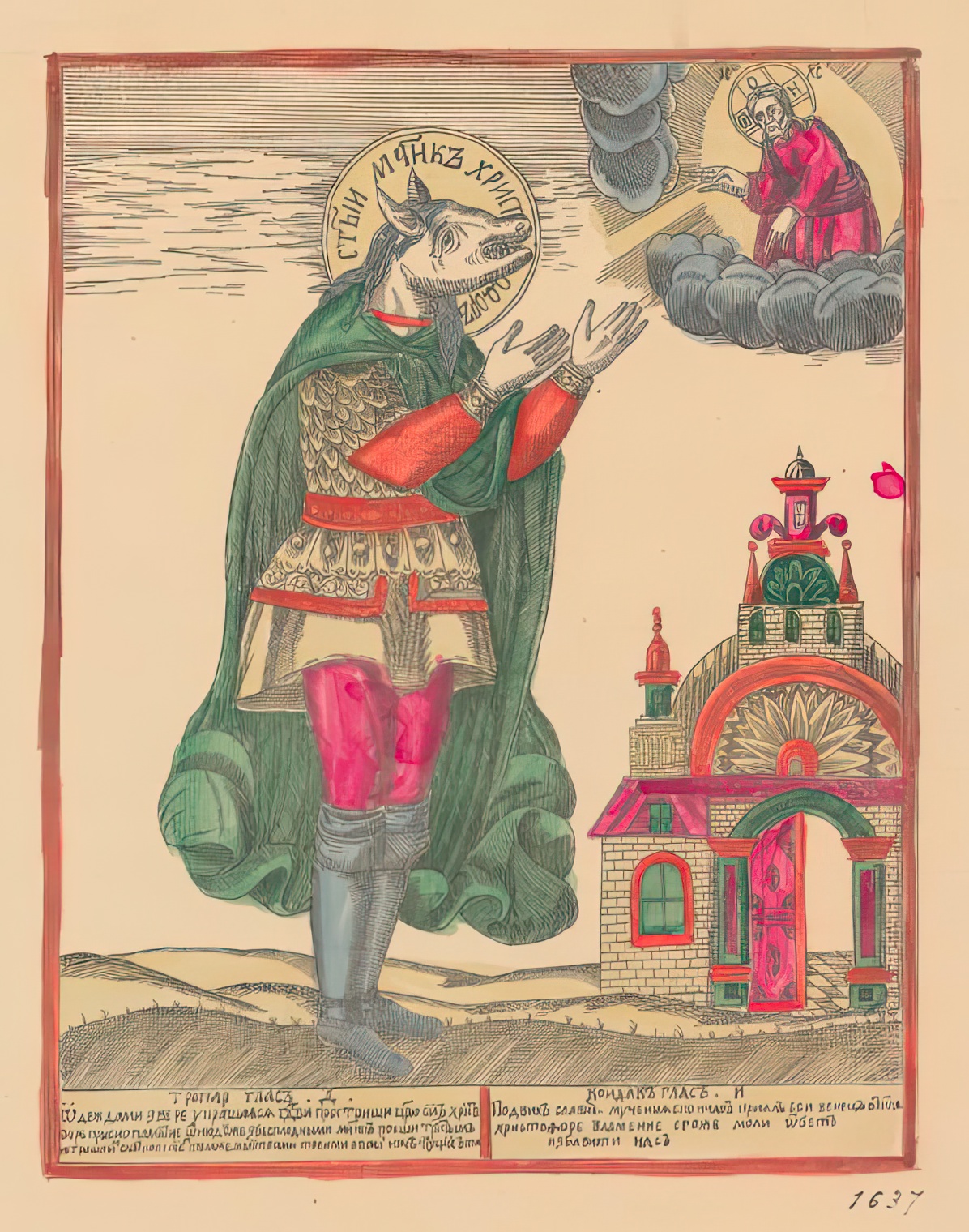
St. Christopher in 18th-century Russian lubok print

A slightly later Greek text, The Martyrdom of Christophoros, brings the legend closer to its later form. Reprobus remains a dog-headed member of a cannibalistic race but is now a soldier and Christian. After receiving the miraculous ability to speak, he converts fellow soldiers, survives numerous tortures, and is eventually martyred by beheading. Several elements later incorporated into the Golden Legend—including his flowering staff, conversion of prostitutes, and miraculous survival of torture—already appear here.

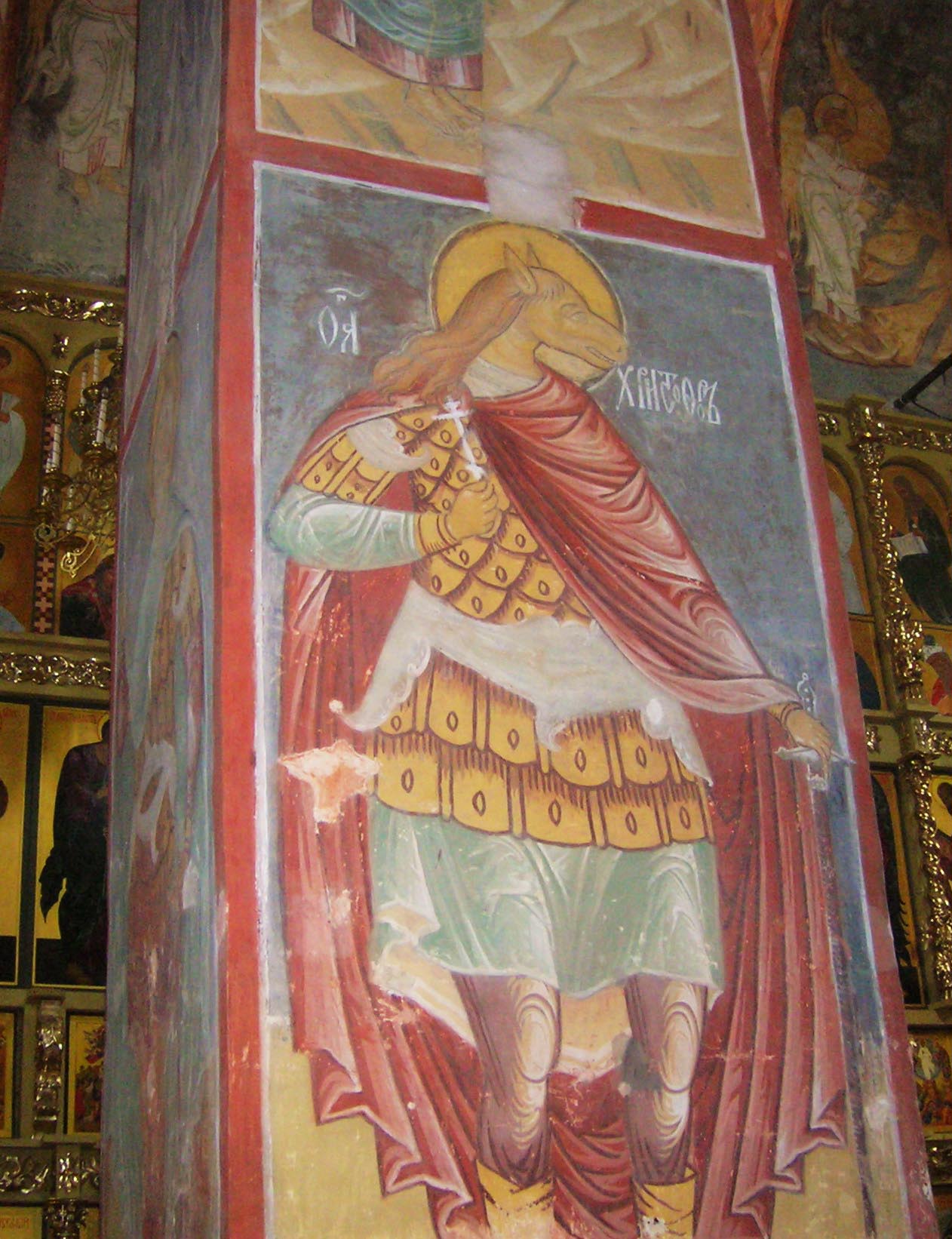
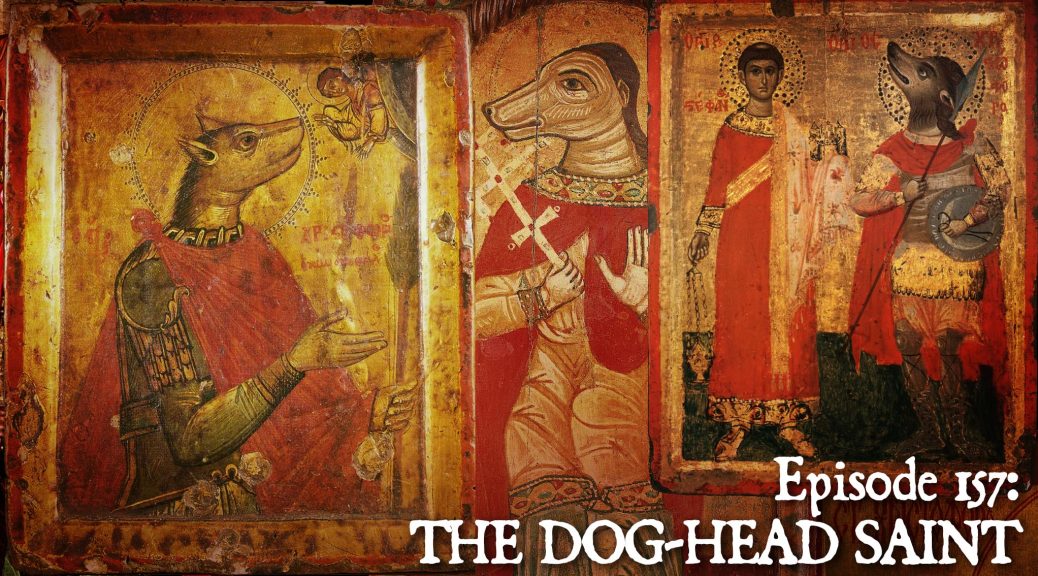
A number of images of St. Christopher as a dog-headed man (Greek: cynocephalus) can still be seen  in Orthodox churches and monasteries in Greece and Russia.  While Peter the Great sought to suppress this portrayal of the saint in 18th-century Russia, his efforts were not entirely successful, and cynocephalus icons are produced by the sect known as the Old Believers to this day.

Christopher’s monstrous appearance was intended to highlight both a pre-conversion savagery and extreme foreignness. Ancient and medieval writers from Herodotus to Marco Polo repeatedly placed imaginary races of dog-headed humans in distant, unexplored lands. Armenian illustrations of Pentecost similarly included cynocephali to symbolize the remotest peoples reached by Christianity.

We end the episode with a nod to St. Christopher’a identity as the patron saint of surfers, and a bit of music from that unlikely nexus of Catholicism and surfdom.  It’s a snippet from the 1999 album by the Malibooz, Living Water:The Surfer’s Mass.

“Horse-head” St. Christopher from Assumption Cathedral, Sviyazhsk, Russia.


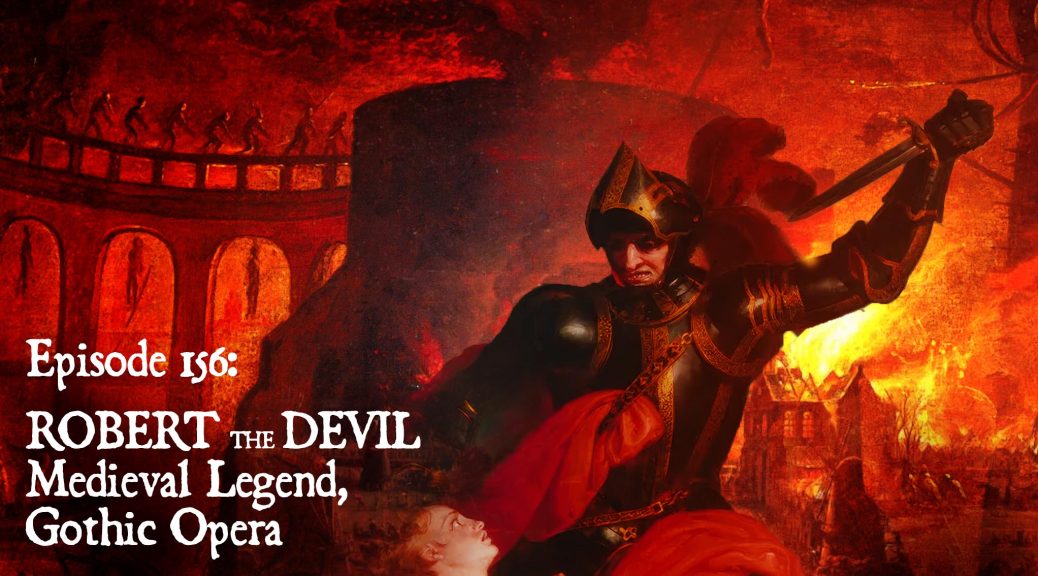
Robert the Devil: Medieval Legend, Gothic Opera

Robert the Devil: Medieval Legend, Gothic Opera

Robert the Devil is a supernatural medieval legend that inspired a 19th-century French opera, which incorporates key elements from a seminal Gothic novel.  The opera and legend are substantially different but both interesting.

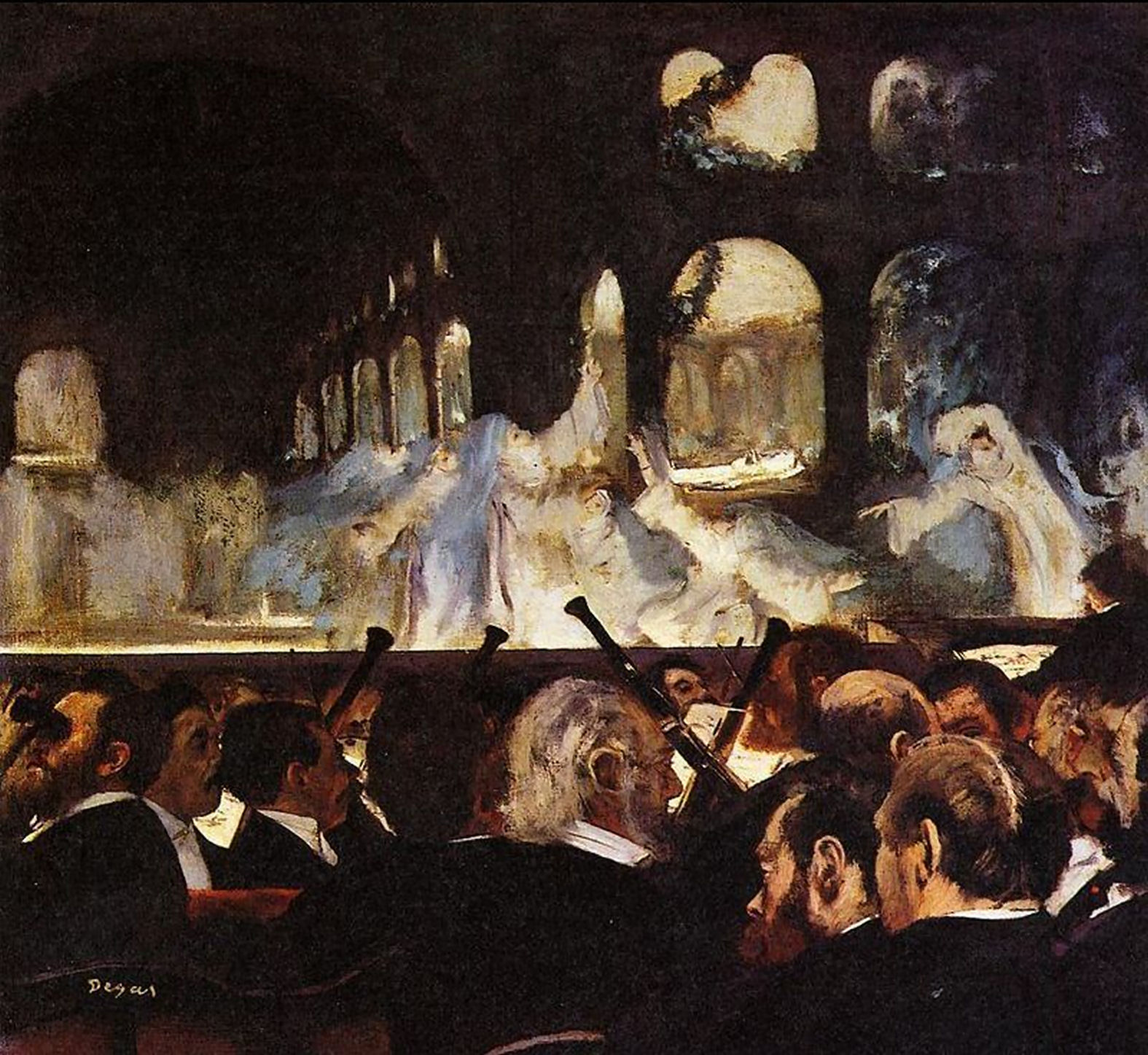
We begin with Giacomo Meyerbeer’s 1831 opera, Robert le diable, which gained notoriety for a ballet sequence in Act III, which portrays an attempted seduction of the hero, Robert, Duke of Normandy, by the ghosts of corrupted nuns, freshly risen from their crypts. The scene is not found in the original legend, but as we learn, was borrowed from a particularly sensationalistic early Gothic novel,The Monk, written by Matthew Gregory Lewis in 1764.   We also learn that Meyerbeer’s chief librettist, Eugène Scribe later went on to crib another storyline from Lewis’ The Monk for the 1854 opera by composer Charles Gounod, La nonne sanglante (“the bloody nun”).

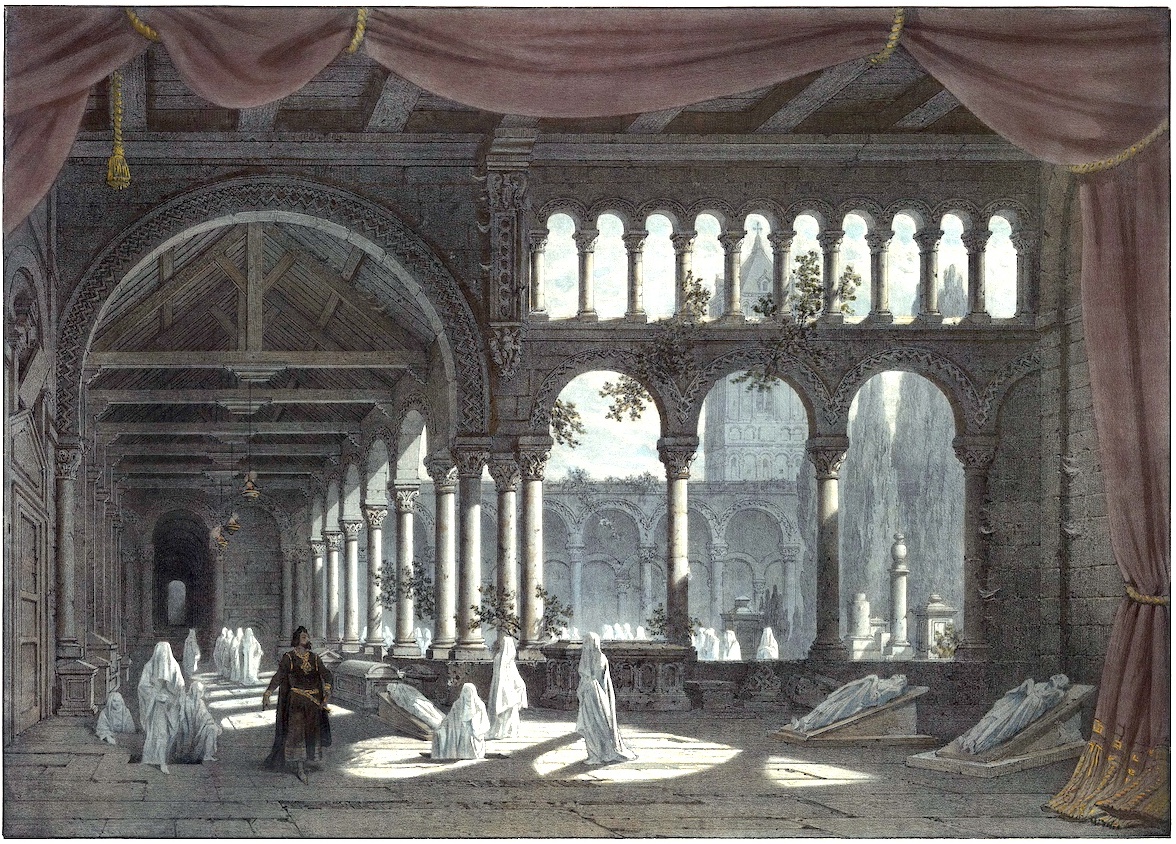
Rendering of cloister set for Paris Opera premiere.

Along the way, we learn how Robert le diable helped save the financially imperiled Paris Opera after its royal subsidy had been withdrawn following the July Revolution of 1830.  Along with public curiosity about the scandalous ballet, ticket sales owed much to the 19th-century equivalent of special effects — flashy and innovative stagecraft (new gaslight design, trapdoors, floating will-o-the-wisps, etc.) and a spectacular set replicating a ruined gothic monastery. Hans Christian Andersen, George Sand and Frédéric Chopin lavishly praised the production. Honoré de Balzac and Alexander Dumas worked mentions of the opera into their novels. Edgar Degas painted not one but two renderings of the Ballet of the Nuns.

Edgar Degas’ rendering of the “Ballet of the Nins”

The opera also gave birth to a new style of ballet, one linked to Romanticism’s interest in the supernatural: ballet blanc, “white ballet” named for the innovative long, flowing skirts that lent themselves to wafting movements suggestive of misty wisps moving in the darkness. The opera’s 1847  London premiere was attended by Queen Victoria and featured superstar soprano Jenny Lind as Robert’s sister.  Traffic came to a standstill as unruly spectators mobbed the streets hoping for  glimpse of either celebrity.

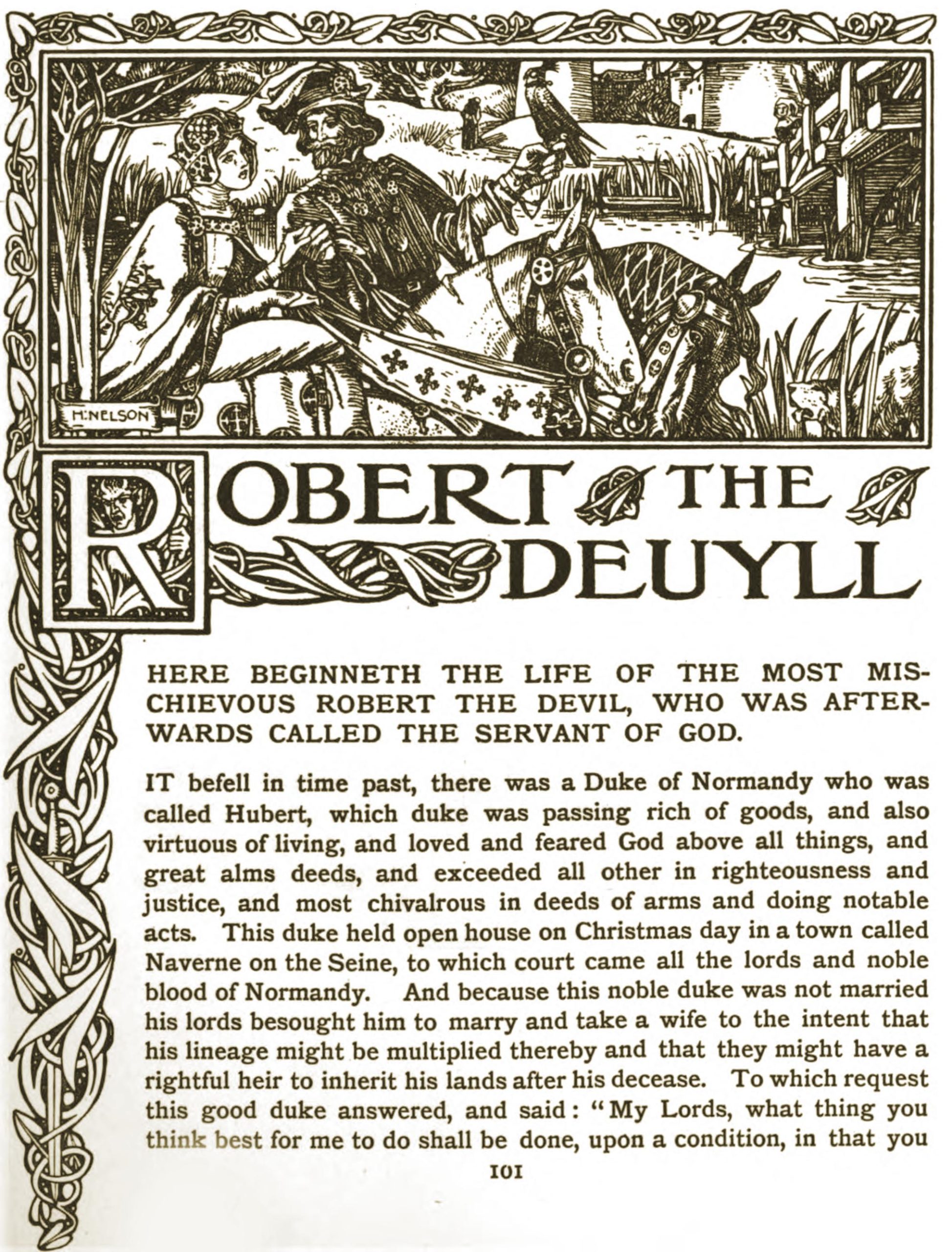
The second half of our episode tells the original story of Robert the Devil.  It first appeared around 1250, sketched out in short form by the Dominican monk, Étienne de Bourbon, in a collection of exempla, or moral tales intended to be used by priests in their homilies.  A couple decades later, details were filled out in a longer, anonymous  poem, preserved in France’s National Library. Then by the late 14th century, it was rendered as a miracle play in “Forty Miracles of Our Lady,” commissioned by a guild of Parisian goldsmiths. By 1500, the story had arrived in Britain. That year, Wynkyn de Worde, assistant to pioneering London printshop owner Thomas Caxton, issued a chapbook prose translation hewing close to the French 14th-century poem.

I found the Wynkyn de Worde text reproduced in a handsome 1904 volume complete with line illustrations, decorative initials, and borders reminiscent of the Arts and Crafts books of William Morris.  As promised in the episode, here is the link to that book: Robert_the_Deuyll.pdf.  (Visit the show notes on the Bone and Sickle website if you can’t click link).

As for the  story itself, it’s best you enjoy it without spoilers as told by Mrs. Karswell.  It’s full of demonic wrath, battles, court intrigue, miracles, pathos, and a very and prolonged peculiar penance.  All told in charming 16th-century language with all the little sound-design extras you’ve come to expect from Bone and Sickle.

Trolls in Medieval Literature

Trolls in Medieval Literature

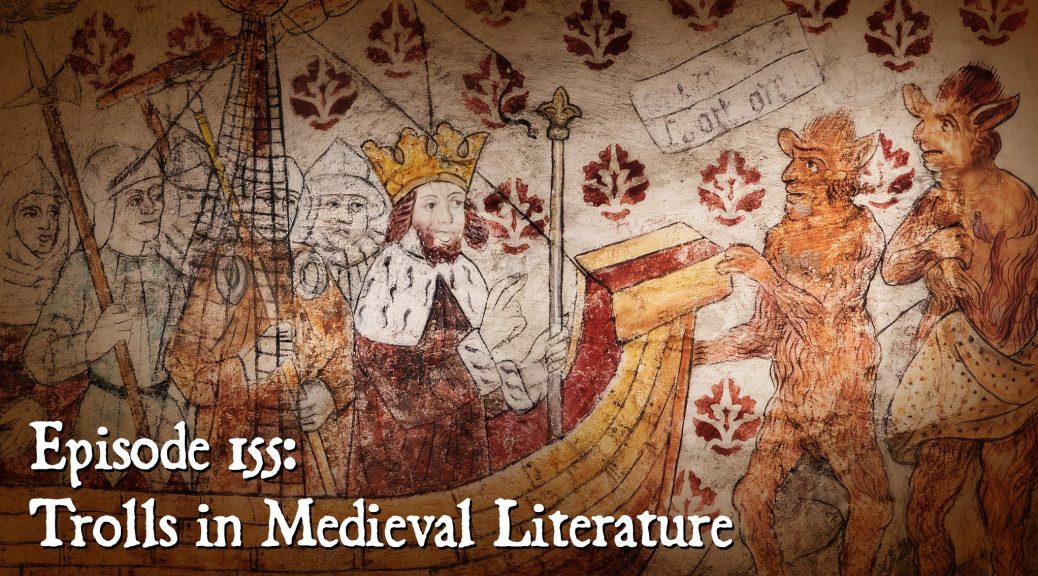
Trolls, as presented in medieval literature, are vastly different from the creatures we encountered in our last episode’s collection of 19th-century Norwegian folktales. These Viking Age trolls are more vividly and gruesomely described, and the “troll-women,” who frequently appear, are akin to witches.

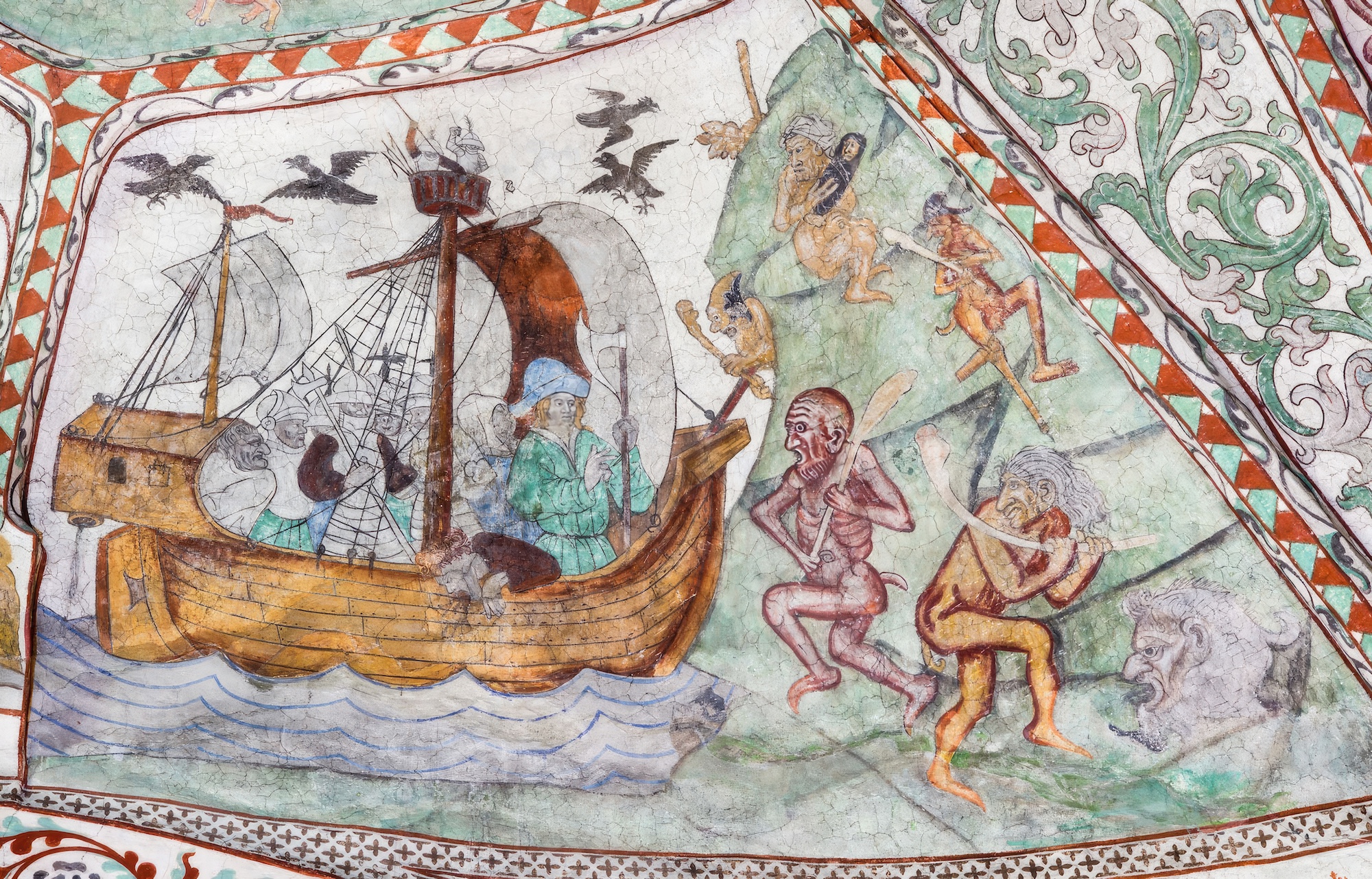
We begin the show with a traditional song from the Faroe Islands, “Trøllini í Hornalondum,” telling the story of St. Olaf battling trolls on the coast of Norway. While the ballad presumably originated in Norway, it was first recorded by the Danish priest and historian, Anders Sørensen Vedel, in his 1591 publication, Hundredvisebogen, (the Book of 100 Ballads.”)

While St. Olaf (King Olaf II) is regarded as the saint who drove paganism from Norway, but this struggle was ongoing with trolls continuing to embody the old pagan world as belied by various tropes — their dislike of church bells, and fear of crosses. We’ll next look at an interesting case from Iceland presenting a direct conflict between a church and troll.  It was collected by the “Grimm of Iceland, Jón Árnason, a librarian and museum curator who published several collections of folktales, beginning in 1852. This one’s from his second volume of Icelandic Folktales, published in 1864.

Encountering trolls -- St. Olaf's Journey, fresco by Albertus Pictor, ca 1470, Dingtuna Church, Västerås, Sweden
Encountering trolls — St. Olaf’s Journey, fresco by Albertus Pictor, ca 1470, Dingtuna Church, Västerås, Sweden

After this, we have some general comments on the historical relationship between trolls and giant (jötunn, Þurs and risi) as well as trolls and witches or sorcery (trollldom). Our remaining four stories (the medieval ones) present trolls of the Icelandic saga, epic stories written in Old Norse and relating the adventures of ancestral heroes or rulers, usually with some connection to history but with certain creative embellishments. A subset of the sagas, which take place in their own mythic timeline, the fornaldarsögur were simply written with entertainment in mind and more oriented toward magic and folklore – and trolls, so we’ll lok at a couple of those. And then there’s the þáttr, a sort of short story, sometimes folded into sagas, but often reproduced independently.

As this is a storytelling episode, we won’t spoil the tales with plot outlines, but the sources (in order) are:

  1. The 14th-century þáttr of Thorstein Ox-leg as translated in William Craigie’s 1896 compilation called Scandinavian Folk-lore: “The Trolls in the HeidarWoods.”
  2. A portion of the 16th-century Illuga Saga, translated by Philip Lavender of the Viking Society for Northern Research.
  3. The 14th-century Saga of Grim Shaggy-Cheek as translated by Peter Tunstall.
  4. The Saga of Orm Stórolfsson, as retold by William Craigie in Scandinavian Folk-lore – under the title: “The Giant on Sauðey” (Saudey).

We end with a song “Trøllini Trampa,” (“Trolls’ Tramp”) by the Faroese band, Spælimenninir

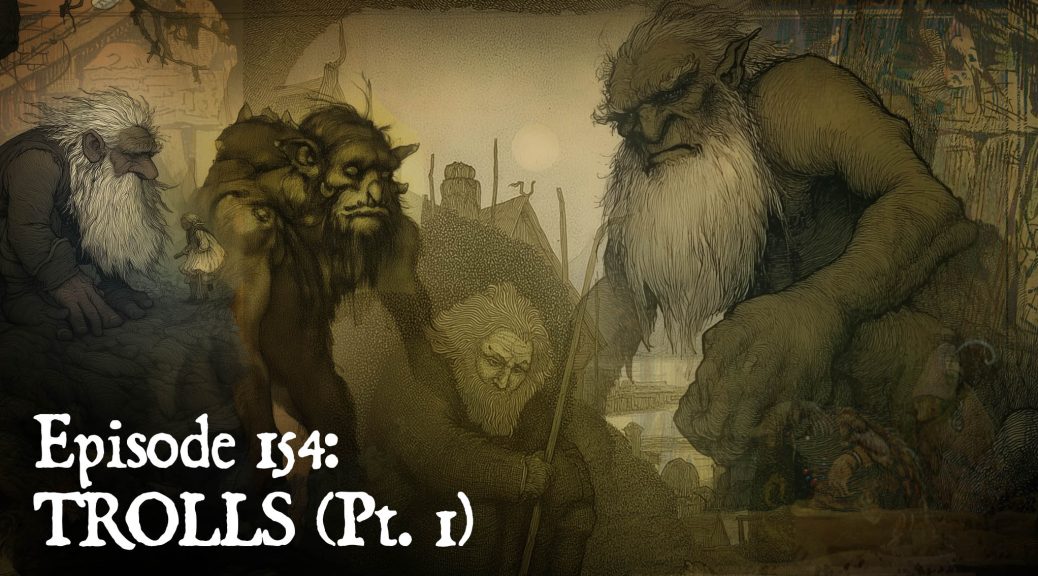
Trolls (Pt. 1)

Trolls (Pt. 1)

Trolls in Scandinavian folklore can be a little different from what’s imagined in the rest of the world.  We begin our show with a montage of clips from recent movies, Trollhunter (2010), Troll (2022), and Troll 2 (2025) — the latter two being Netflix productions that have rekindled interest in the subject while reimagining trollsin a way that does not always conform to the folklore. While all Scandinavian countries have their share of troll lore, this episode focuses specifically on Norway, the country with the most compelling collection of troll folklore.

The first portion of our show looks at the Norwegian writer Henrik Ibsen’s play along with  incidental music composed for the play by his associate Edvard Grieg. Introducing this topic is a clip from the 1970 musical Song of Norway, a fanciful Edvard Grieg biopic that garnered particularly bad reviews.  We learn a bit about why Grieg hated his well-known “Hall of the Mountain King,” a composition which accompanies Peer Gynt’s encounter with trolls inside a mountain in the Dovre mountain chain. We also learn what Ibsen hoped to achieve in telling the story of his antihero Peer Gynt, and how he wrestled with the movement known in Norway as Romantic Nationalism.

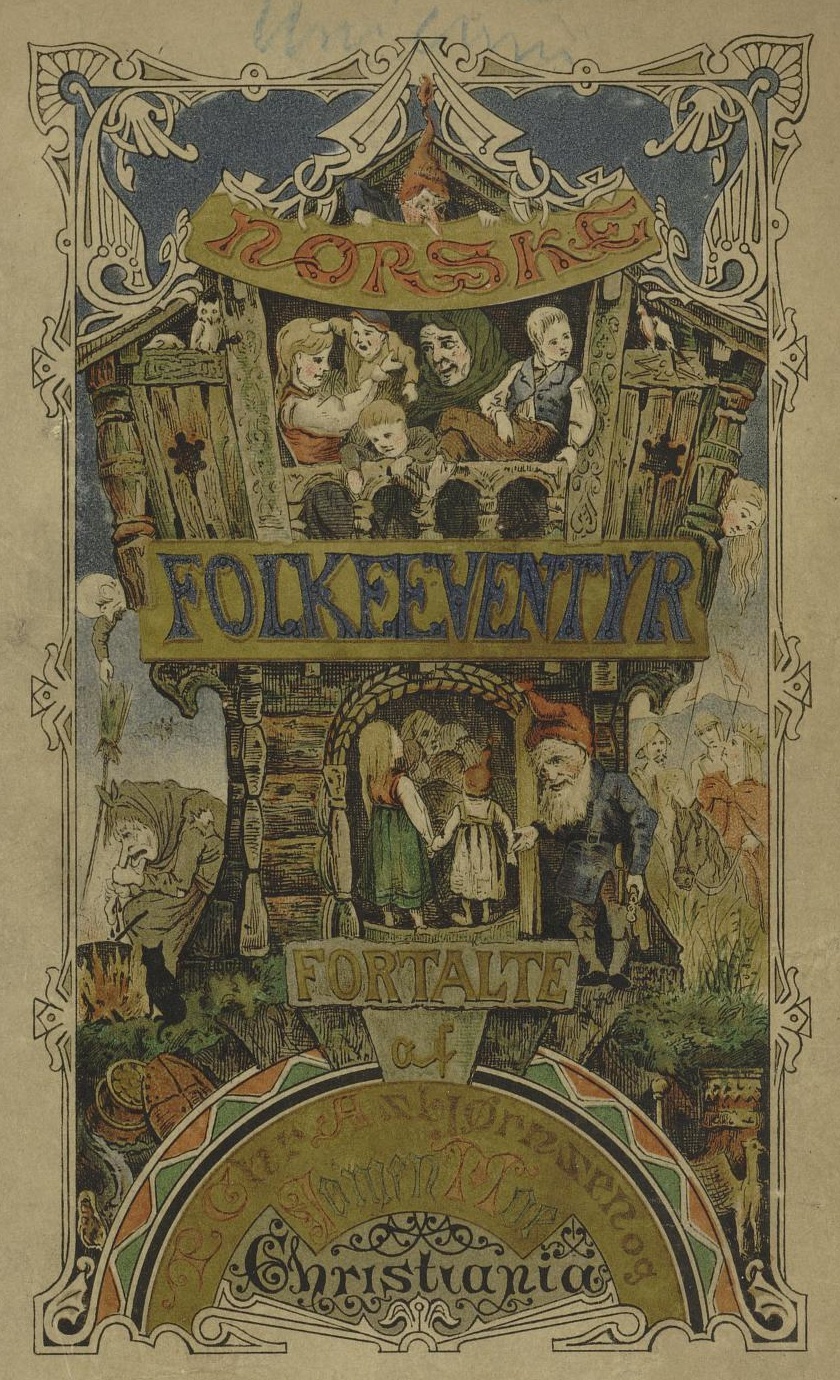
Next we look at two figures integral to this movement, Peter Christen Asbjørnsen and Jørgen Moe, a pair of folktale collectors often described as the “Brothers Grimm of Norway.”  Their 1841 publication, Norwegian Folk-Tales, along with updated volumes published in 1844, 1845, and  1871, provide most all the troll tales with examine in this episode. An exception to this is a book authored by Asbjørnsen alone, High Mountain Scenes, volume 2, Reindeer Hunt at Rondane. Published sometime before 1846, it’s the only volume referencing tales told about Peer Gynt, those being very loosely represented in Ibsen’s play.

Asbjørnsen & Moe’s “Norwegian Folk Tales”

The first of these we retell concerns a creature known as “the Bøyg,” something referred to as a type of troll in the story is described more  as a giant serpent of sorts. We follow this with more Peer Gynt episodes involving male trolls flirting with human females and a troll poking his enormous nose through a cabin window and suffering the consequences inflicted by Gynt.  The final story, “The Cat on the Dovre-Mountain,” takes place at Christmas, a time when troll encounters are particularly prevalent, and involves Gynt outsmarting a group of bothersome trolls via a peculiar stratagem.

Next, we run through some lesser-known details of the best-known troll tale “The Three Billygoats Gruff.”  We follow this with another well-known (in Norway) story, “The Boy Who Had an Eating Match with a Troll.” It involves a youth outwitting a troll with a particularly gruesome ruse It was familiar enough to Norwegian audiences to be referenced in Trollhunter.

Next we look at a character Askeladden, who is pitted against trolls in several of Asbjørnsen & Moe’s stories.  He’s usually describing the good-for-nothing youngest brother of a trio, an underdog who surprisingly achieves great things. His name (literally “ash lad”) referenes his stay-at home habits, in particular, sitting by the hearth playing in the ashes. We learn of several characters with related names and habits in Scandinavian literature and a more insultingly rude nickname for such characters, one which Asbjørnsen & Moe chose to censor from their stories.

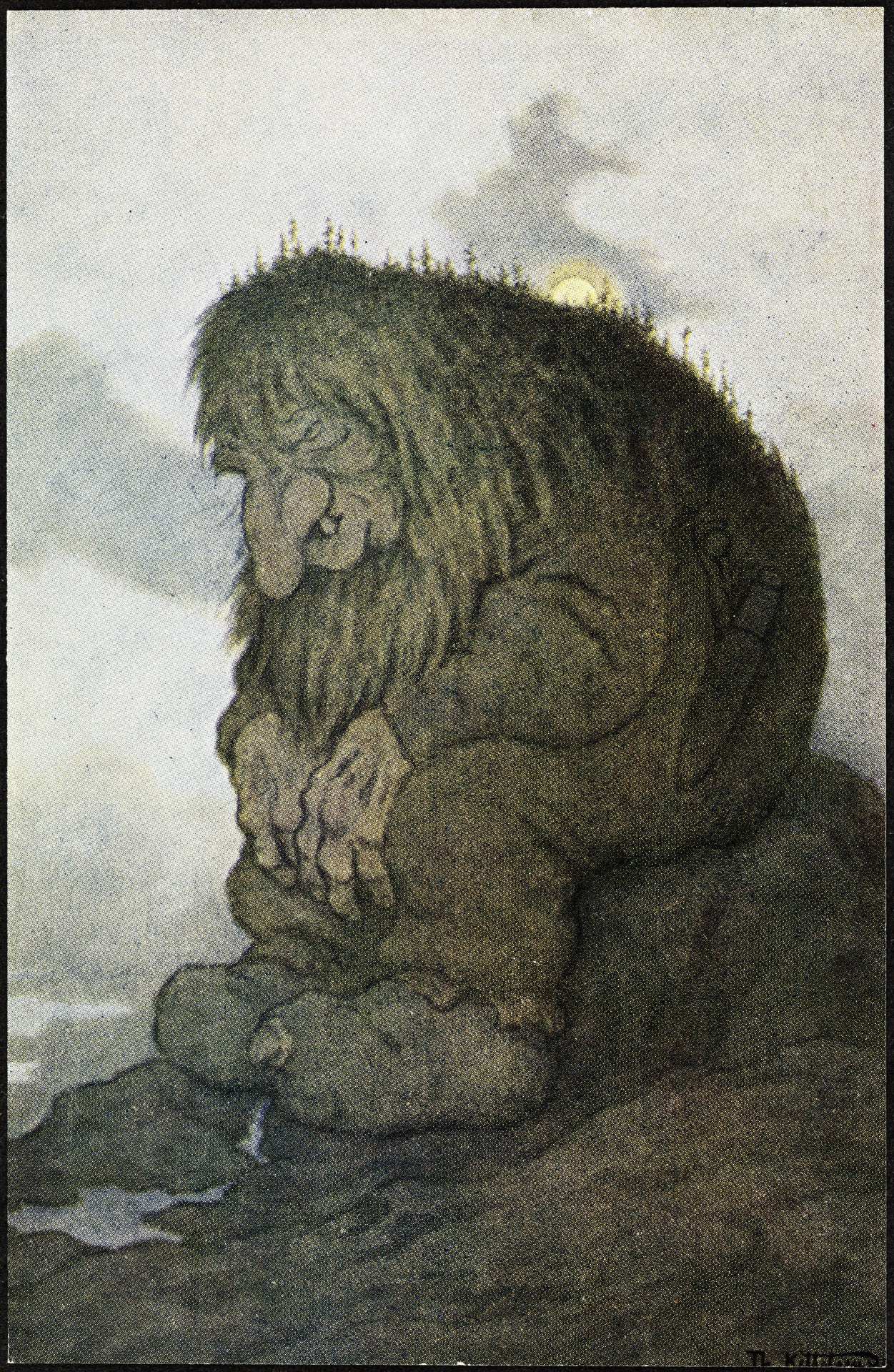
Theodor Kittlesen, “Troll Pondering How Old iIt Is” (1911)

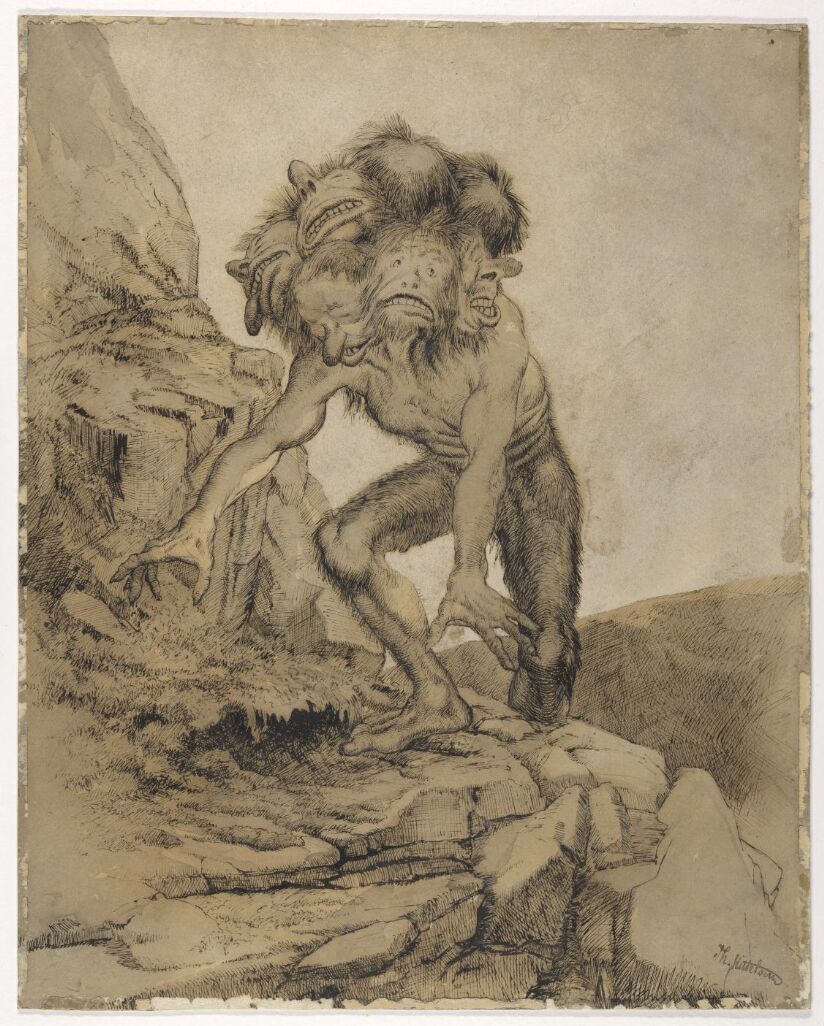
Our next troll tale, “The Lads who Met the Trolls in the Hedale Woods,” gives us particularly monstrous trio of trolls sharing a single eyeball.  While this is atypical, we also encounter here the common trope of trolls sniffing the air for “Christian blood,” a suggestion that their kind of an older pre-Christian order.  A reference to trolls using magic is also contained in this story, something we’ll run into in other tales.

We then hear some clips from a couple of Asbjørnsen & Moe-inspired films, the 2017 Norwegian film Ash Lad: In the Hall of the Mountain King and its 2019 follow-up, The Ash Lad: In Search of the Golden Castle.  The “Golden Castle” in Norwegian film title and  the title  of the relevant Asbjørnsen & Moe story is “Soria Moria Castle.” This one also features trolls, but in a peripheral role.  It’s a longer legend quest rather than a short folk tale in which we encounter three multi-headed trolls holding human women captive in three different castles.

Our last story, “The Hen is Trips in the Mountain,” takes its  weird title from a strange phrase uttered to open a door into a mountain, like “Open Sesame.” When a young woman enters theis particular mountain looking for a lost hen, she meets an unpleasant end, as does her younger sister, but when the youngest of the three enters, she manages not to repeat the mistakes of her two siblings and later discovers that trolls can explode when touched by the first rays of dawn (as well as turning to stone, another common folklore trope).

We wrap up the show with some interesting stats regarding the fascination trolls exert over the heavy metal subculture.

Theodor Kittlesen, “Mountain Troll” (1887)


Urban Legend

Urban Legend

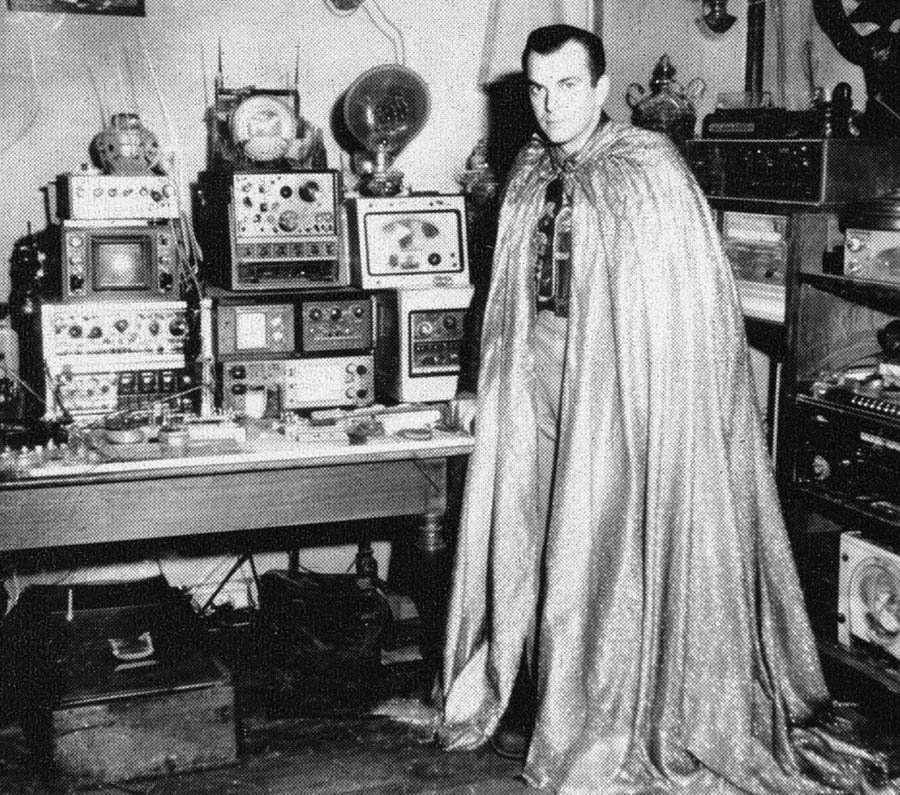
A 1968 Halloween “Spook Show” in the Midwest left an unsettling heritage of urban legends possibly rooted in even more unsettling facts.  What little is definitively known regarding this event comes from the newspaper archives of the Danville News-Gazette, in which we find a short October 28  promo piece in the “Entertainment” section featuring this photo presumed to be of the impresario behind it all, J. Jolly.

“Dr. Killer Hertz” will speak to “Space Spirits” (courtesy News-Gazette).

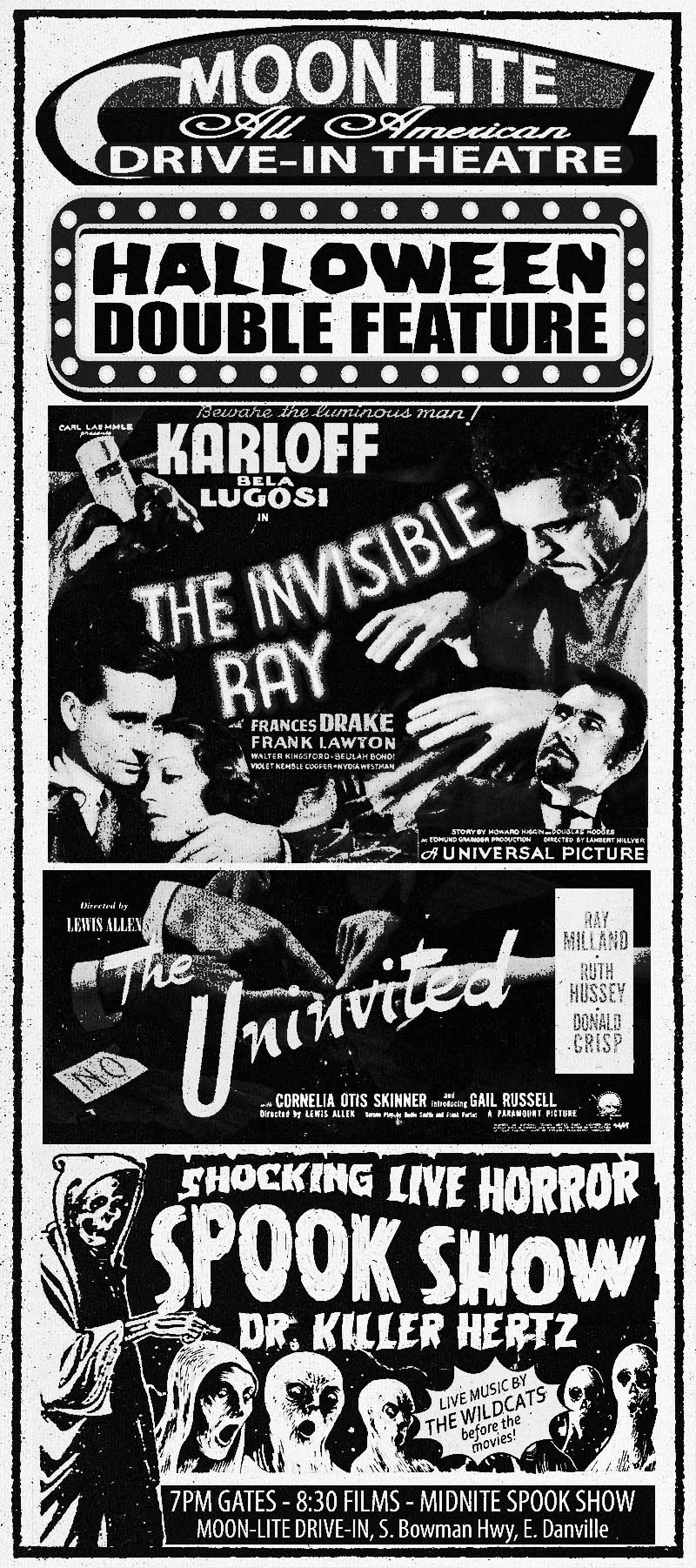
There is also this advertisement for the event:

Courtesy News-Gazette.

That’s all the story you need for now.  You can form your own opinions as we grope our way between fact and fiction. Headphones and lights out for best results!

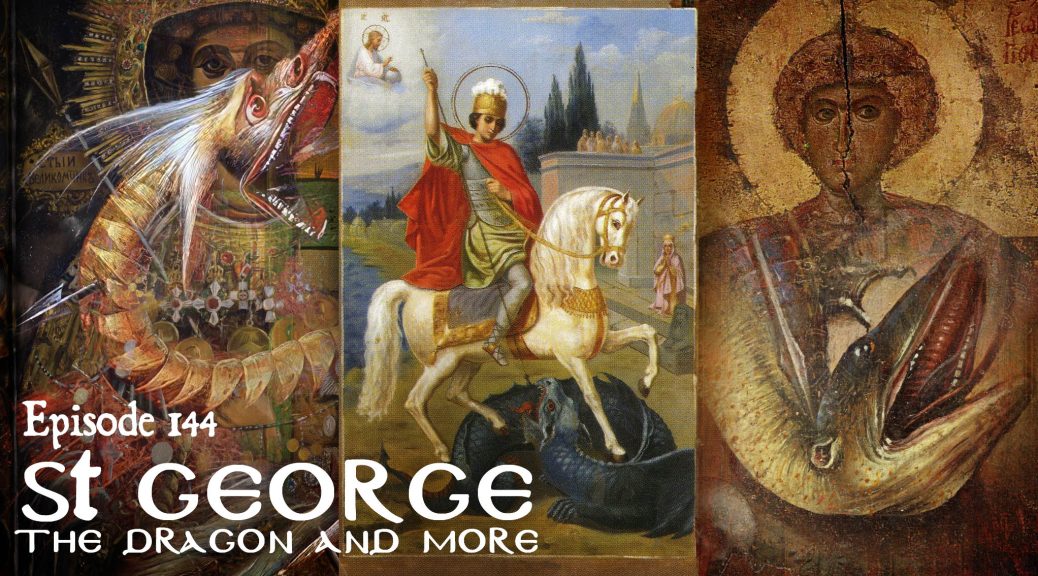
St. George, the Dragon, and More

St. George, the Dragon, and More

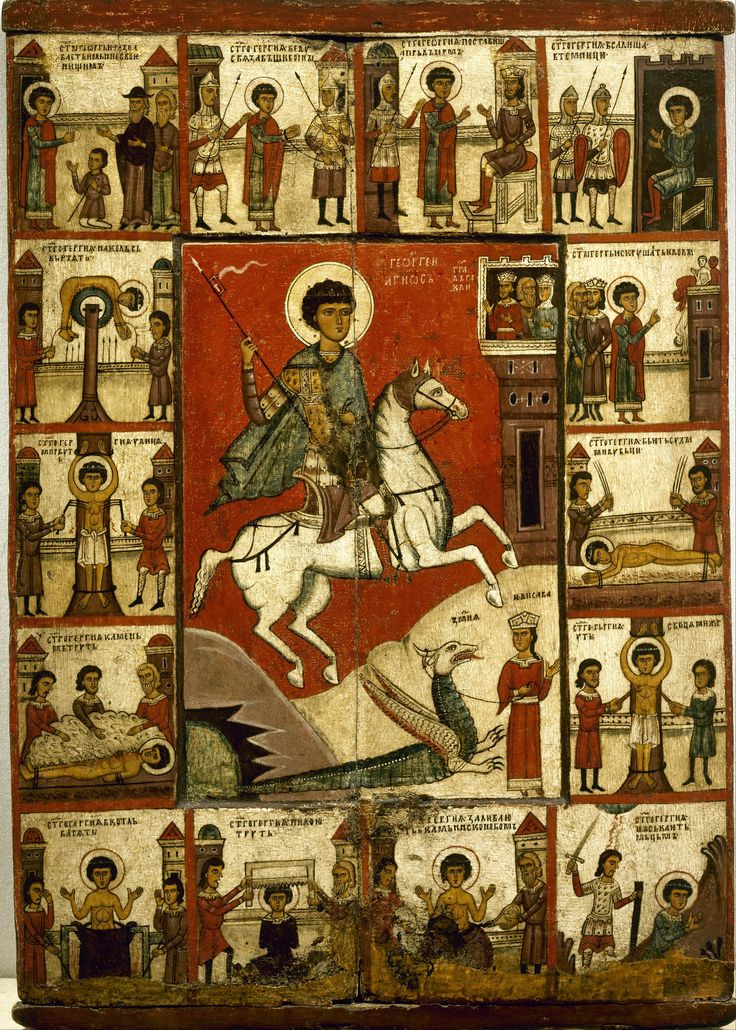
There’s so much more to the figure of St. George than his battle with a dragon. Legends also tell of his grisly martyrdom, capture of a demon, and postmortem abilities to cure madness through contact with his relics. In the Holy Land, there is even a tradition syncretizing St. George with a a supernatural figure of Muslim legend.

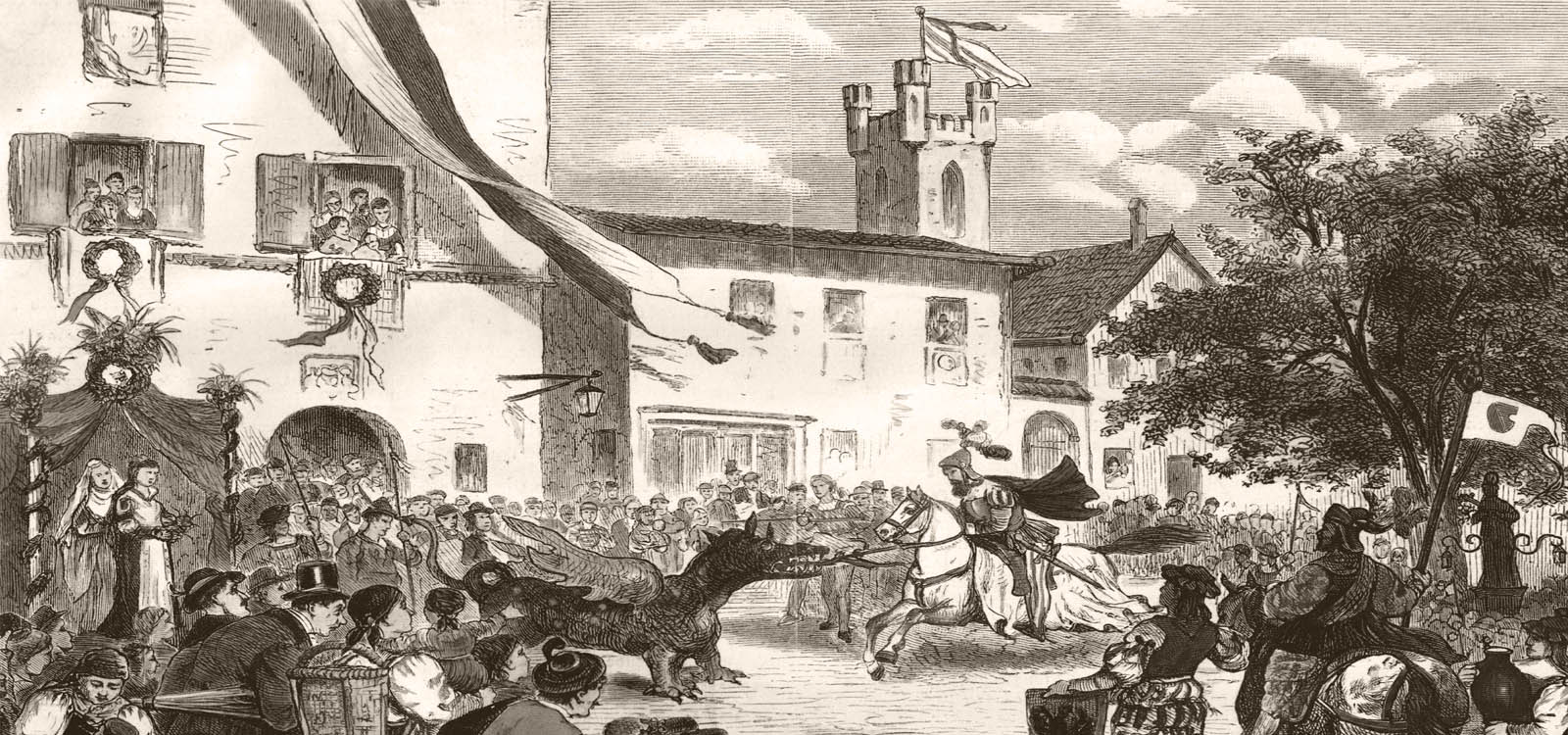
We begin with a look at a modernized take on the St. George legend, the annual Drachenstich, or “dragon-stabbing,” held in the Bavarian town of Furth im Wald. Beginning in 1590 with a performer representing the saint riding in a church procession, George was soon joined by a simple, canvas dragon, which over time evolved into the the world’s largest 4-legged robot used in the event today.

19th-century Drachenstich in Furth im Walld

Mrs. Karswell  next reads for us the primary source for the dragon story, Jacobus de Voragine’s collection of saint stories compiled around 1260, known as the Golden Legend. It popularized the tradition that George was a Christian soldier in in the Roman (Byzantine) army, born in Cappadocia, in central Turkey, and executed for refusing to bow to Imperial gods.  There is also a princes to be rescued from the dragon but no king gives George her hand in marriage, as you might expect.  Though Voragine set this episode in Libya, this setting  was not really retained i the  tradition.

As one of early Christianity’s “soldier saints,” George held particular appeal for soldiers of the Crusades. We hear of two incidents of George leading Crusaders to victory as recounted in the Golden Legend and the Gesta Francorum (deeds of the Franks).

When in 1483  William Caxton’s English translation of the Golden Legend appeared, anecdotes of British interest were added, including George’s connection to English knightood and The Order of the Garter. Elizabethan writer Richard Johnson featured George in his 1596 volume, Seven Champions of Christendom, elements of which were borrowed into mummers plays in which George became a hero.  We hear snippets of these.

Returning to Germany, we learn how George was also said to have encouraged the armies of Friedrich Barbarossa at the Battle of Antioch during the Third Crusade. We then delve a bit more into the history of the Drachenstich performances. Some folksy details from 19th-century newspapers documenting the tradition are also provided.

We then return to the Golden Legend for an account of George’s martyrdom.  The location of this episode is not specified, but George’s pagan nemesis here can be identified with Dacianus, the Roman prelate who governed Spain and Gaul. The tortures endured run the gamut from rack to hot lead, all of which are supernaturally endured until the saint is ultimately beheaded. Divine retribution in the form of fire falling from heaven is also included.

Next, we investigate earlier sources adapted into Voragine’s dragon story, the first known being an 11th-century manuscript written by Georgian monks residing in Jerusalem. George’s background as a soldier from  Cappadocia is identical, as is the endangered princess, though the victory over the beast lacks elements of swordplay and is largely accomplished through prayer.  In this version, George is also responsible for the founding of a church complete with healing well.

From the same manuscript, we hear a few more miracle stories, the “Coffee Boy” legend, George’s defeat of a loquacious demon, a cautionary tale of a murderous and greedy hermit ostensibly, and a charming story involving a unhappy boy, George, and a pancake.

We then take a look at the oldest St. George text probably written in Syria around the year 600. It’s known as the “Syriac Passion of St. George,” and details an extraordinary series of tortures so fantastical as to be declared heretical by the Church in the Decretum Gelasianum, probably within a century of the story’s composition.

14th-cent Russian depiction of St. George’s Martyrdom

Digging a little deeper, we then consider the Greek myth of Perseus and his rescue of the princess Andromeda, who is offered by her father as a sacrifice to a sea-monster. It’s certainly a striking parallel to the saint’s dragon legend, but the historical connections seem less profitable to trace than visual evidence found in a cave in George’s legendary homeland of Cappadocia.

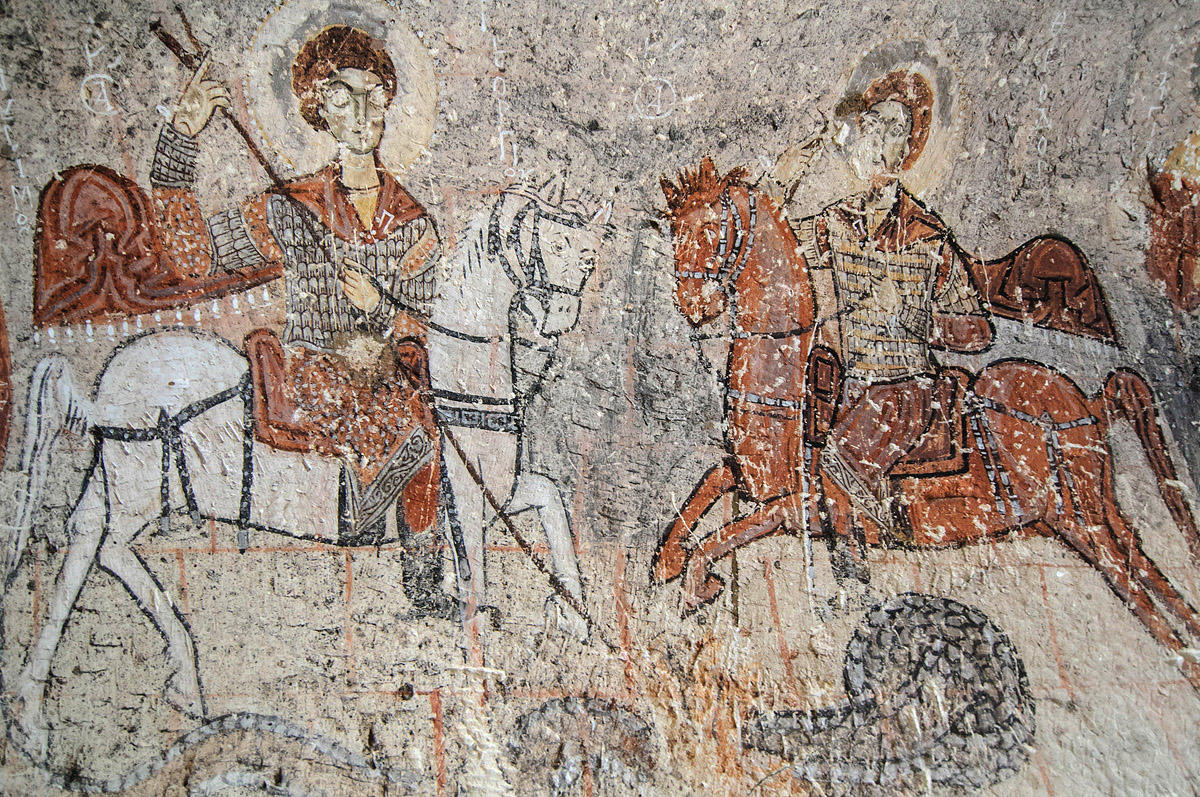
There, around the town of Göreme, one can find 9th- and 10th-century “cave churches” excavated by Byzantine Christians. One site known as the “Snake Church,” is named for its murals of serpents being speared and trampled by two soldiers on horseback. One rider has been identified as St. George. The other, St. Theodore, is another 4th-century martyr and soldier-saint with parallel story elements, including calling down fire on a pagan temple and destroying a dragon.  We then hear a bit more about Theodore and his connection to Constantinople and Venice.  The images of George and Theodore combatting dragons, significantly pre-date the earliest manuscript narrative of George and the dragon by perhaps a century, and it’s suspected that Theodore’s killing of a dragon may be an even older story. We also hear a bit about the St. Agapetus, whose legend offers further parallels and of the Christian mystic Arsacius, of which the same could be said.

Cave Church image

Visually, images of Christian soldier saints and dragons, such as those painted in Göreme, resemble an artistic motif of the Roman era known as the “Thracian Horseman” —  representations of a mounted warrior armed with a downward pointed spear. Under his horse’s legs is usually a boar, depicted as prey.  The image appears in various contexts, employed toward diverse magical purposes, which we discuss.

Also discussed is related iconography of a Byzantine (and later Carolingian) motif,  “Christ in Triumph”or“Christ Trampling the Beasts,” along with images of St. George on horseback slaying a human figure believed to represent his nemesis, a pagan ruler, who in the Syriac Passion is identified as “the dragon of the Abyss.”  As these predate the more literal dragon combat, an evolution from allegorical to more literal representation is suggested.

We end with stories of miracles associated with the relics of St. George, particularly chains said to have been worn by the saint in prison before his martyrdom.  Preserved in a convent church in Al-Kidr, a town on the West Bank, near Bethlehem, they are said to be particularly efficacious in curing madness in those who touch them — a belief held by local Christians and Muslims alike, We also encounter the supernatural figure of Muslim legend after whom the town is named. “Al-Kidr” — translated as the Green One — who has been syncretized in local tradition with St. George.


The Fates

The Fates

The Fates of Classical Antiquity not only survived in the form of related fairy-tale figures but also as the object of superstitions and rituals associated with newborns. In South Slavic and Balkan regions particularly, these customs represent a surprisingly long-lived and genuine case of pagan survival.

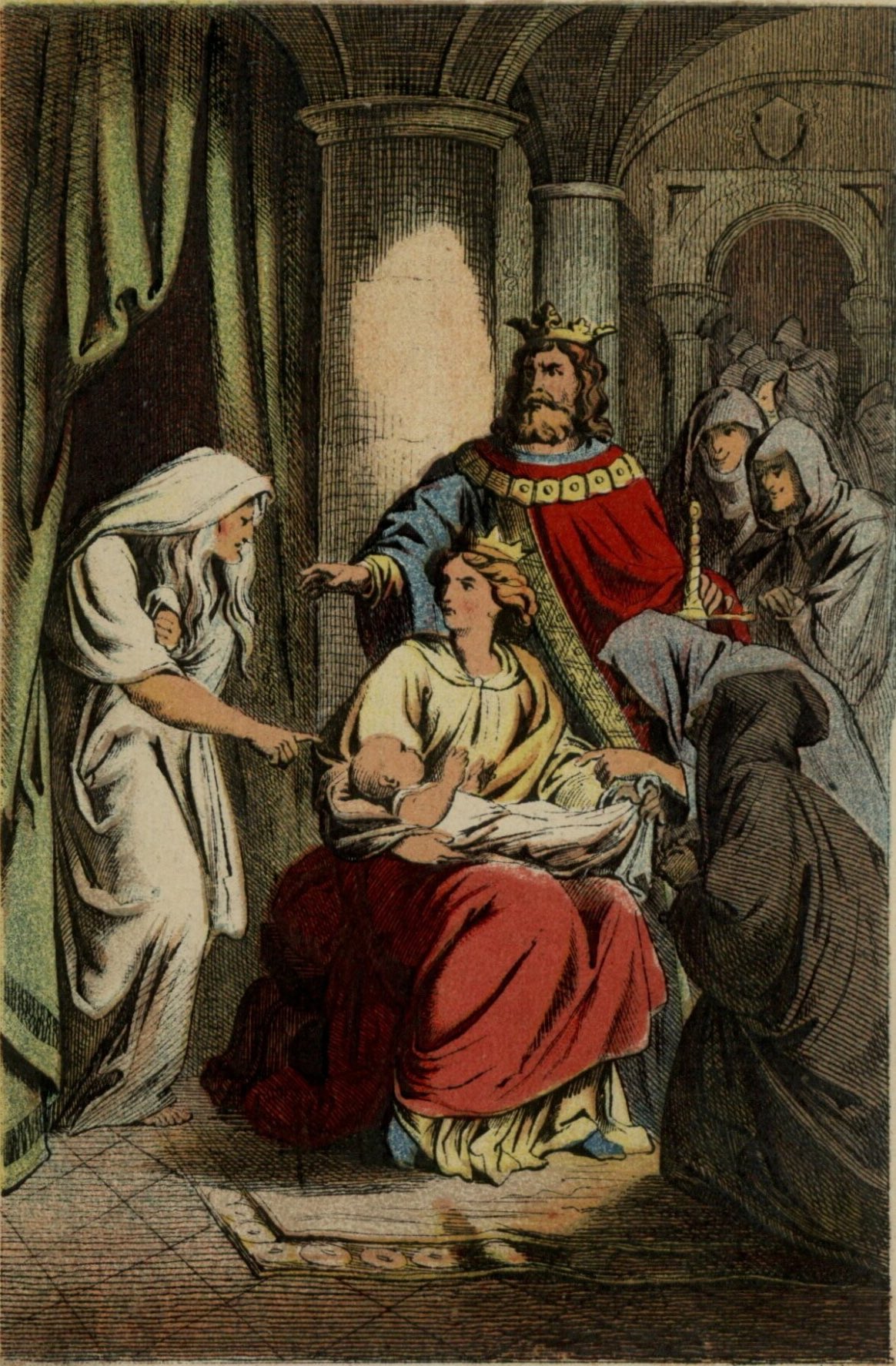
We begin our episode examining the fairy godmothers of “Sleeping Beauty” as embodiments of the Fates.  Mrs. Karswell reads a few key passages from the definitive version of the story included in Charles Perrault’s 1697 collection, Histoires ou contes du temps passé (“stories of times gone by.”) We learn how the fairies fulfill the historical role of godparents at the newborn’s christening. We also note the peculiar emphasis on the quality of what’s set before the fairies at the christening banquet, observing how a failure there leads the wicked fairy to curse the Sleeping Beauty.

Czech illustration
1874 illustration by František Doucha for a Czech edition of Sleeping Beauty

We then explore antecedents to Perrault’s tale, beginning with the 14th-century French chivalric romance, Perceforest.  A peripheral story in this 8-volume work is that of Troylus and Zeelandine, in which the role of Sleeping Beauty’s fairy godmothers are played by Greek and Roman deities, with Venus as supporter of Princess Zeelandine (and her suitor Troylus) and Themis cursing Zeelandine to sleep in a manner similar to Perrault’s princess.  A failure to correctly lay out Themis’ required items at the christening banquet is again again responsible for the curse, though the awakening of Zeelandine by Troylus awakens is surprisingly different and a notorious example of medieval bawdiness.

Preceding Perceforest, there was the late 13th-century French historical romance Huon of Bordeaux, in which we hear of the newborn fairy king Oberon being both cursed and blessed by fairies attending his birth.  From around the same time, French poet and composer Adam de la Halle’s Play of the Bower describes a banquet at which fairy guests pronounce a curses and blessings on those in attendance prompted again by their pleasure or displeasure at what’s set before them at a banquet. We also  hear of the Danish King King Fridlevus (Fridlef II) bringing his newborn son to a temple of “three maidens” to ascertain the  destiny pf the child in Gesta Danorum (“Deeds of the Danes”).written around 1200 by Saxo Grammaticus. And lest listeners think such appeals to the Fates were strictly a literary motif, we hear Burchard of Worms, in his early-11th-century Decretum, condemning the not uncommon among the Germans of his region of setting up offering tables for the Fates.  By this point, the connection between how fairy godmother types are served at a banquet and offerings made to the Fates to ensure a cild’s fortune should be clear.

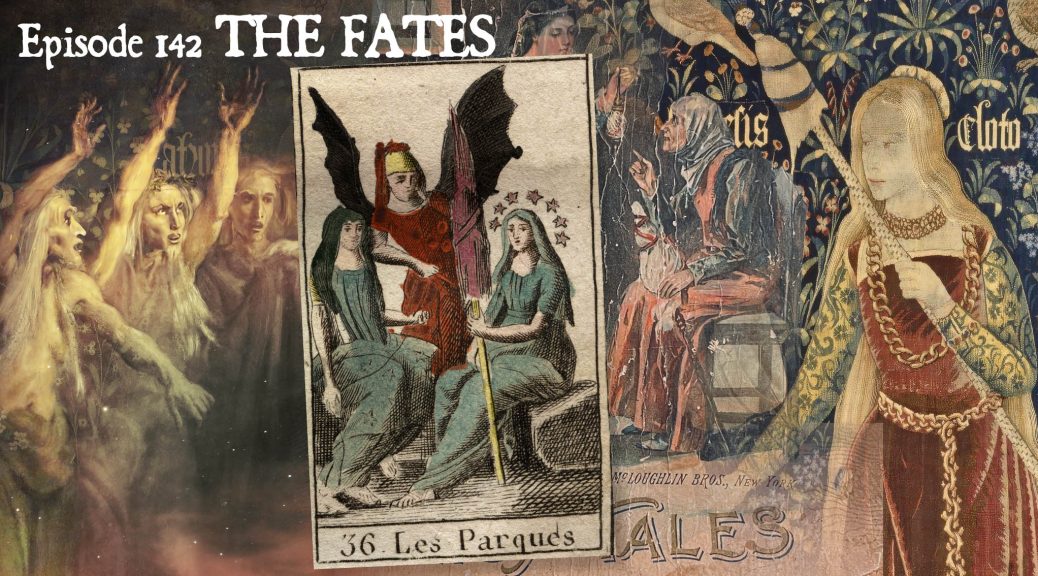
We then turn back to the Greek Fates, the Moirai (Clotho, Lachesis, and Atropos) and the Roman Parcae (Nona, Decuma, and Morta). Particularly in the case of the Parcae, we hear examples of their connection to the newborn’s destiny in the celebration nine or ten days after the birth of the dies lustricus, during which offerings were made to the Fates.

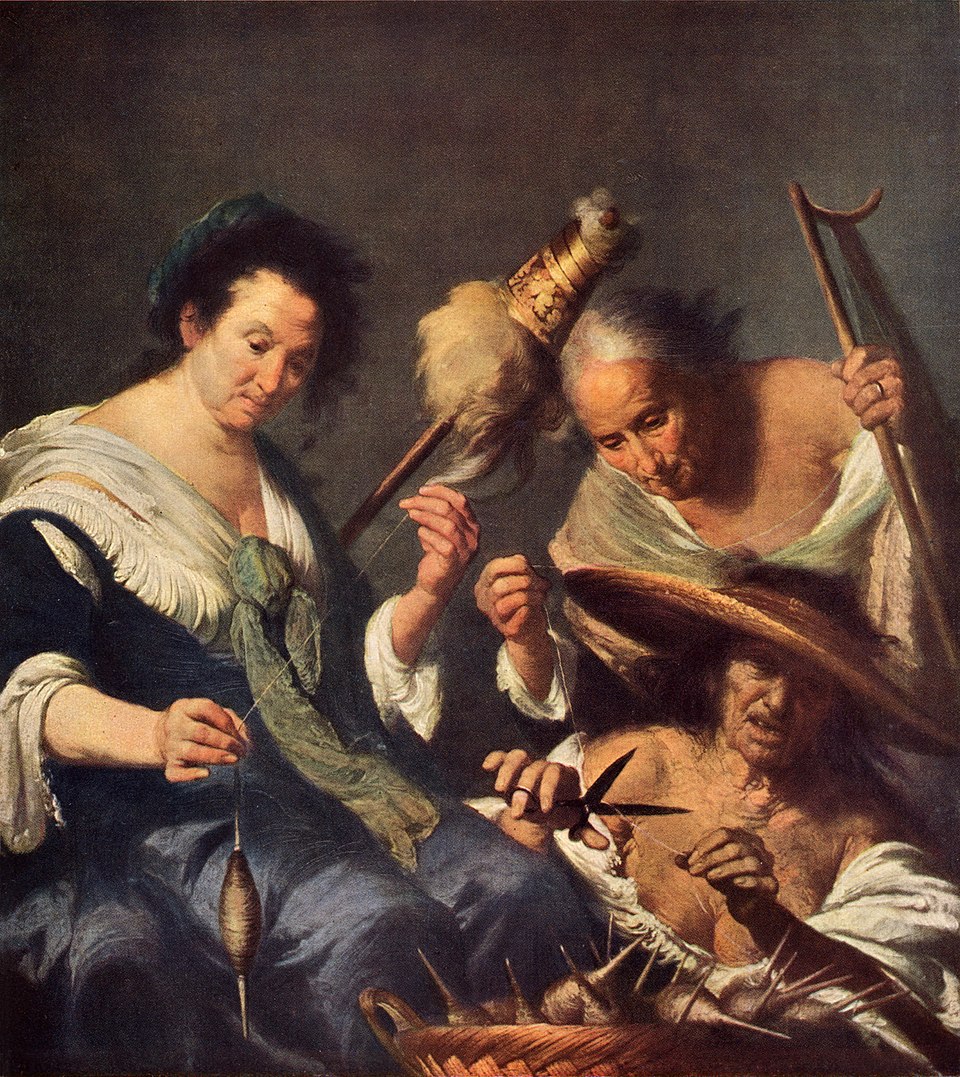
The Three Fates by Bernardo Strozzi, late 17th c

We make a brief side-trip to discuss the Norns (Urðr, Verðandi and Skuld), the Germanic equivalent of the Fates.  These are more distant cousins, not strongly associated with the newborn and his destiny, though we do hear a passage from the Poetic Edda, in which the Norns are  present birth of the hero Helgi. We also hear a gruesome passage from the 13th-century Njáls Saga, in which the Valkyries weave out the fate of those who will die in the Battle of Clontarf.

The Anglo-Saxon equivalent of the Fates, the Wyrds, are also discussed, and we hear how the  witches in Macbeth partook in this identity as the “Weird Sisters,” an association Shakespeare inherited from his source material, the 1587 history of Great Britain, known as Holinshed’s Chronicles.

We then turn our attention the Fates in Slavic and Balkan lands — the Rozhanitsy in  Russia and Ukraine, the Sudičky among West Slavs, the Orisnici in Bulgaria, and the Ursitoare in Romania. As these customs survived into more recent times, there is a vast body of folklore to describe —  much of it revolving around the setting up of offering tables and the communication of newborn’s destiny through dreams sent to mothers and midwives and confirmed by  marks (visible or invisible)  left upon the infant during their nocturnal visits on the third night after birth.

We also enjoy a couple entertaining folktales about Romania’s Ursitoare collected in the early years of the 20th century by folklorist Tudor Pamfile.

While such customs have since died out in Greece, customs related to the Moirai preserved into the early 20th century, as we hear in passages  of John Lawson’s Modern Greek Folklore and Ancient Greek Religion: A Study in Survivals, written in 1900.

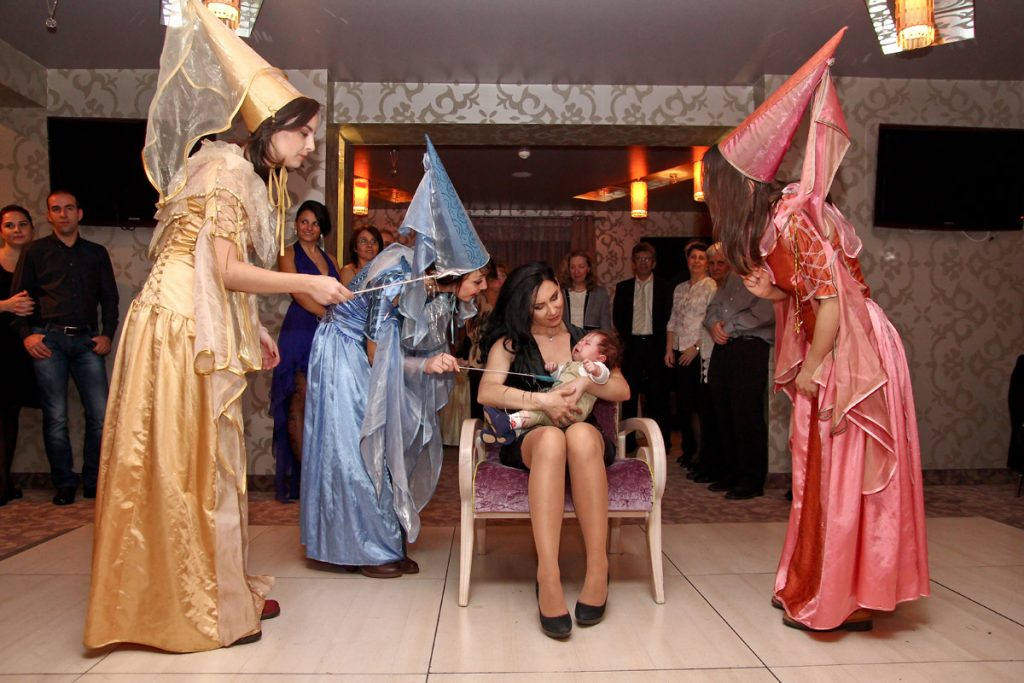
We end with a brief look at christening parties in modern Romania, at which costumed Ursitoare play an increasingly major role, this paired with an introduction to the popular song  “Ursitoare, Ursitoare.”

Romanian Fates attend a christening party. Ursitoare show by FormatiiNunta
Mélusine, the Serpent Fairy

Mélusine, the Serpent Fairy

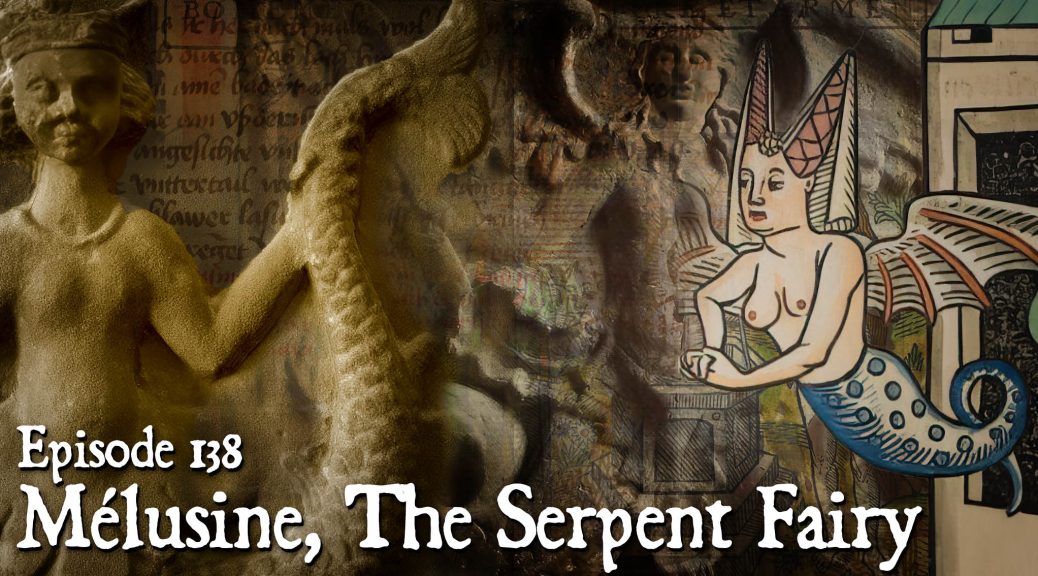
Mélusine is a female fairy of medieval legend. who suffers under a curse transforming her once weekly into a monstrous form. In various tales she becomes either a serpent or fish from the waist down, or fully transforms into a dragon. Mélusine can only break this curse via marriage to a mortal who is obliged to allow her certain secret freedoms.  In return, her husband enjoys magical assistance and sees his fortunes flourish, at least until that day pact is broken.

The most famous version of this story, and the one to which we devote the bulk of the show is a French tale set down in 1387 by Jean d’Arras, Mélusine or the Noble Story of the Lusignans. The patron for whom he wrote, Duke Jean de Berry, belonged to the House of Lusignan, whose ancestral claims to the lands around Poitiers were portrayed by Arras as a matter of supernatural destiny involving the fairy.

We learn how Jean de Berry’s ancestor, Raymondin (Raymond) became engaged to Mélusine after a meeting at an enchanted fountain. Raymond is unaware that this encounter, and all that follows, is the subject of a prophecy set in motion by his accidental killing of his uncle. We hear the curious way in which this transpires, of Raymond and Mélusine’s wedding attended by a multitude of fairy folk, and of the building of Château de Lusignan through a sly collaboration of fairy magic, ingenuity, and human agency.

We then learn of  Mélusine’s and Raymond’s offspring, all of whom are  handsome and strong yet also betray their supernatural parentage via certain disfigurements —  strange birthmarks, enormous stature, huge jutting teeth, or additional eyes.  Much of Arras’ narrative is devoted to the sons’ heroic exploits, particularly as Crusaders in the Middle East, where the historical Lusignans gained lands and reputations, but our episode, focuses only only two sons, “Geoffroy Big-Tooth” and Fromont, whose stories are more intertwined with that of Mélusine herself.

Next comes the central drama, the breaking of the secret pact between Raymond and his fairy wife, which I’ll leave for you to enjoy without spoilers. Mrs. Karswell delivers a fine dramatic reading of this lengthier passage.

While that  situation simmers, we hear how Geoffroy has returned from a giant-slaying adventure to discover that his brother, Fromont, is about to enter a monastery rather than devote himself to expanding the Lusignan empire.  This doesn’t sit well with Geoffroy, whose disproportionately wrathful response is at once horrible and comic.

Reacting to the tragic fall-out of Geoffroy’s rampage, Raymond himself flies into a rage, accusing  Mélusine of producing offspring supernaturally inclined toward evil. Cruel as his words may be, Mélusine seems to validate them, assuming a diabolical presence as she abandons their marriage,  flying away from Castle Lusignan in the form of a dragon.

Finally, we  examine the origins of the curse upon Mélusine, a strange backstory revealed through the discovery of a tablet in fantastic subterranean tomb, one which relates how she imprisoned  her human father inside a mountain and installed  there a giant as jailer.

Our episode then considers some folkloric parallels to the figure of  Mélusine, a possible kinship with the Irish Banshee, the Scottish Bean-nighe or the Lavandières (“midnight washer women) of Brittany as well as earlier 13th-century literary sources for Arras’s tale including works by Gervase of Tilbury, Marie de France, Walter Map, and others.

By the late 15th century, the story by Arras had been retold by the French author Coudrette in a version that became broadsheet fodder for German publishers.  We also hear how the tale  was embraced in Luxembourg, where it attached to Siegfried, Count of the Ardennes, and the magical construction of Luxembourg Castle.

Finally, we look at some  19th-century retellings of the legend as German folktales, some of which made their way into Czech lands, where Meluzina’s doleful howling at her fate is heard in the moaning of winter winds.  The show closes with a snippet of a modern Czech children’s song mentioning Meluzina, as an embodiment of the wind –“Vitr fouka do komina”  (The wind blows in the chimney).

La Befana, the Witch of Twelfth Night

La Befana, the Witch of Twelfth Night

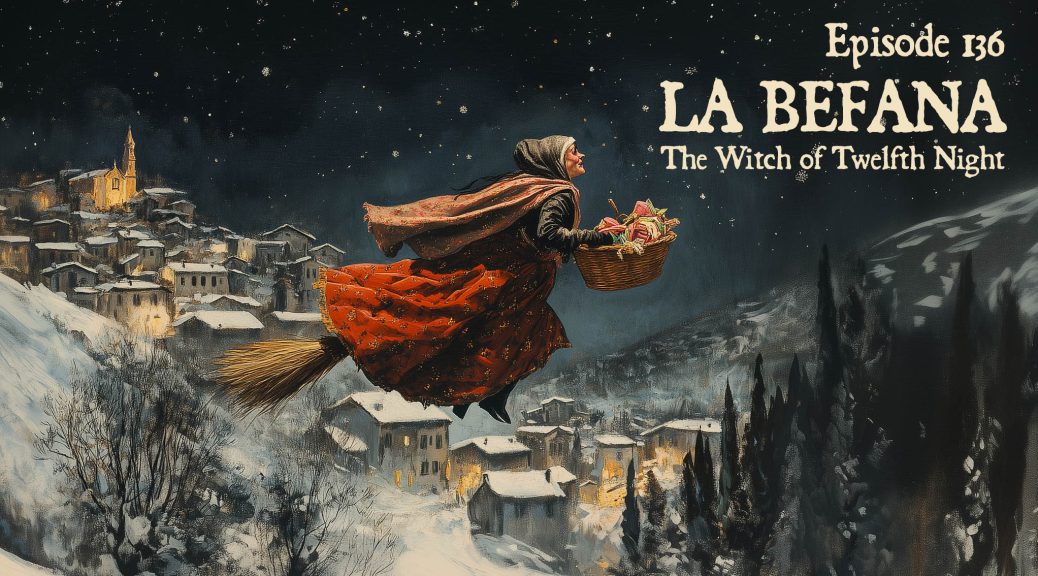
A short extra episode on Befana, the gift-bringing Italian witch associated with Twelfth Night, the end of the Christmas season.  Included in the show is material from the book, “The Krampus and the Old, Dark Christmas,” traditional music of the season, audio from actual celebrations, and a few pop songs associated with la Befana.

Befana on the Piazza Navona, Rome.
The Cucibocca of Montescaglioso