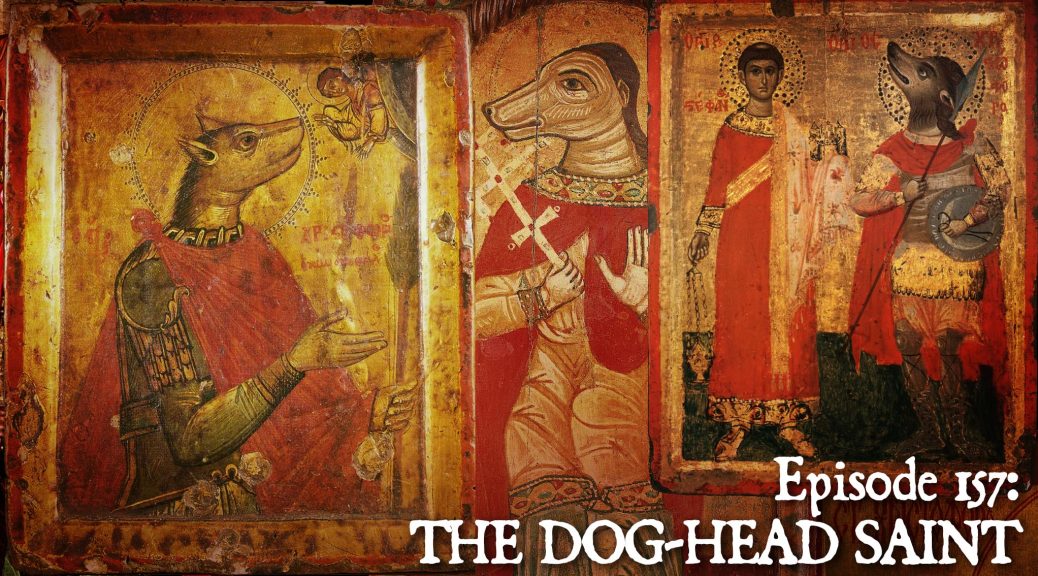
The Dog-Head Saint
Podcast: Play in new window | Download (Duration: 40:21 — 46.2MB)
Subscribe: Apple Podcasts | Spotify | Android | Podchaser | RSS | More
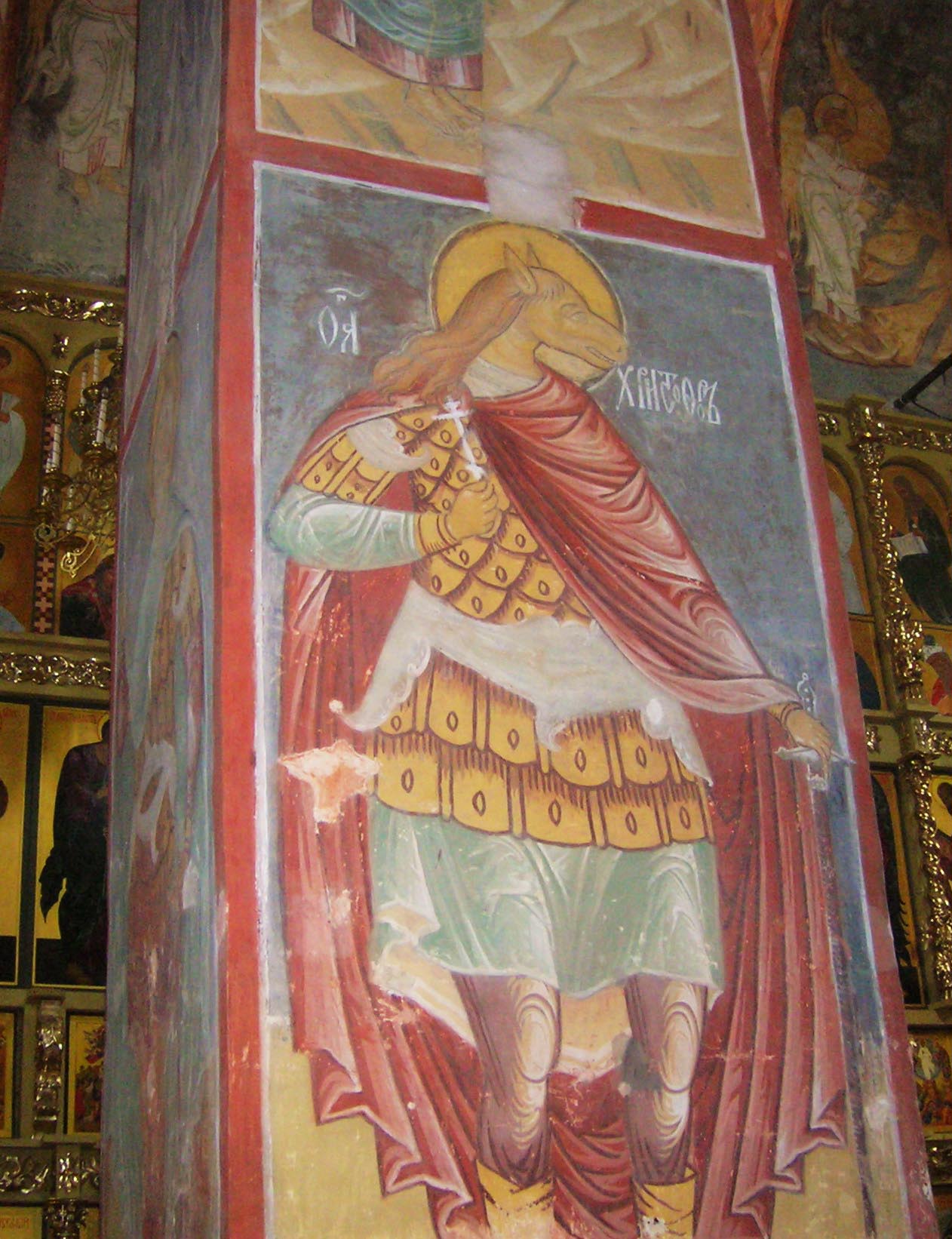
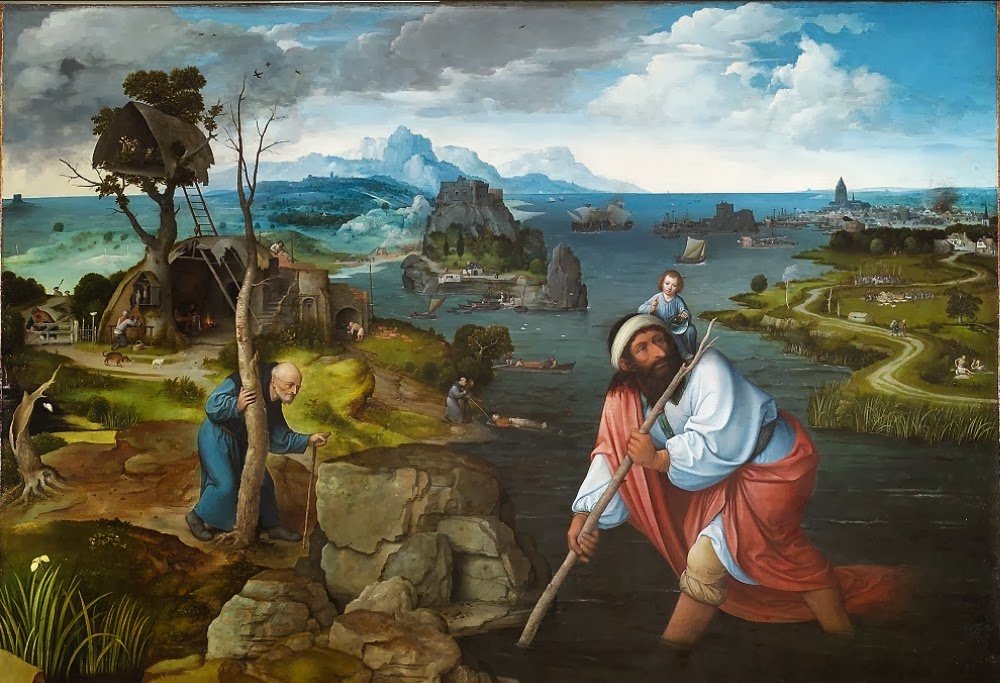
Today he’s known mainly as a figure from medals carried to insure safe travels, but that image of a giant carrying the Christ Child across a dangerous river represents only the final stage in the long and strange evolution of the saint’s legend. Earlier or forgotten aspects of his story describe Christopher as a ferocious soldier, the Devil’s servant, a cannibal, and even a dog-headed monster.
Our episode begins with the best known version of the tale recorded in The Golden Legend, the classic collection of hagiographies written in 1260 by Jacobus de Voragine, a Dominican friar in Genoa. Here Christopher begins as Reprobus, a fearsome giant determined to serve the most powerful master in the world. He first serves a king but abandons him after discovering that the king fears the Devil. Reprobus then serves the Devil, only to discover that the Devil fears Christ.
Seeking Christ, Reprobus encounters a hermit who suggests that the giant use his great strength to carry travelers across a dangerous river. One night, a mysterious child asks to be carried across. As Reprobus struggles through the rising water, the child becomes impossibly heavy. Upon reaching the opposite bank, the child reveals himself as Christ and explains that Reprobus has carried both the Creator of the world and the weight of the world itself. Reprobus thus becomes Christopher, the “Christ-bearer.”
After this, comes the lesser known portion of his tale, in which Christopher runs up against Roman authorities thanks to his Christian faith. As a sign that God will be with him throughout this, his staff planted in the earth breaks for in blooms, and he’s preserved through numerous tortures and attempts to execute him after his refusal to worship the pagan gods. Tortures fail to harm him, arrows miraculously stop in midair, and Christopher eventually converts the king responsible for his execution.
But earlier versions of the legend are considerably stranger. Around 986, the German poet and bishop Walter von Speyer composed two Latin hagiographies, one in prose and the other in verse. Each tells the same story, describing Reprobus as a dog-headed cannibal who could only bark before his conversion. The struggle through the river in de Voragine 13th-century tale is prefigured as a spiritual transformation in the waters of baptism.
An even older narrative is found in the apocryphal Acts of Andrew and Bartholomew. Pieced together from parchments dated to the fifth and seventh centuries, merging stories, which originated in Coptic communities of Syria and Egypt. We hear extensive passages from this particularly fantastical tale read by Mrs. Karswell.
In this which the apostles encounter a terrifying dog-headed cannibal named “Bewitched.” He’s been sent to them by an angel, who first removes his appetite for human flesh and grants him the ability to speak. Renamed “Christian,” (though still referred to in the text as “Dog’s Head”) the creature accompanies the apostles on their missionary adventures to the city of Barbaros in Parthia. When they are sentenced to death by lions and tigers , Dog’s Head is divinely granted a temporary return to his original ferocity, and slaughtering and devouring the beasts. Walls of fire, flying idols, miraculous floods, and more grisly tortures and martrydoms, round out the narrative.
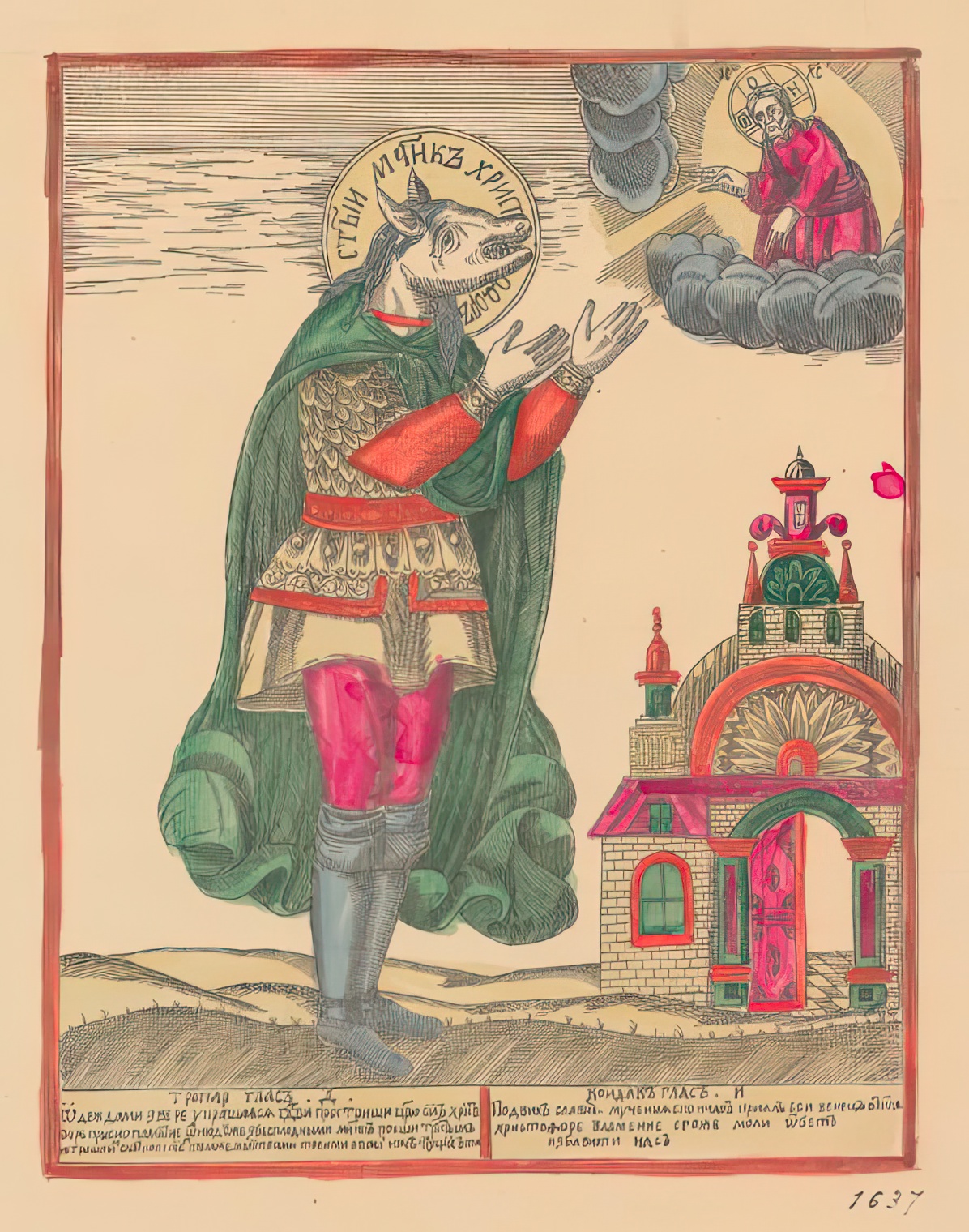
A slightly later Greek text, The Martyrdom of Christophoros, brings the legend closer to its later form. Reprobus remains a dog-headed member of a cannibalistic race but is now a soldier and Christian. After receiving the miraculous ability to speak, he converts fellow soldiers, survives numerous tortures, and is eventually martyred by beheading. Several elements later incorporated into the Golden Legend—including his flowering staff, conversion of prostitutes, and miraculous survival of torture—already appear here.
A number of images of St. Christopher as a dog-headed man (Greek: cynocephalus) can still be seen in Orthodox churches and monasteries in Greece and Russia. While Peter the Great sought to suppress this portrayal of the saint in 18th-century Russia, his efforts were not entirely successful, and cynocephalus icons are produced by the sect known as the Old Believers to this day.
Christopher’s monstrous appearance was intended to highlight both a pre-conversion savagery and extreme foreignness. Ancient and medieval writers from Herodotus to Marco Polo repeatedly placed imaginary races of dog-headed humans in distant, unexplored lands. Armenian illustrations of Pentecost similarly included cynocephali to symbolize the remotest peoples reached by Christianity.
We end the episode with a nod to St. Christopher’a identity as the patron saint of surfers, and a bit of music from that unlikely nexus of Catholicism and surfdom. It’s a snippet from the 1999 album by the Malibooz, Living Water:The Surfer’s Mass.