Category: folklore

The Dog-Head Saint

The Dog-Head Saint

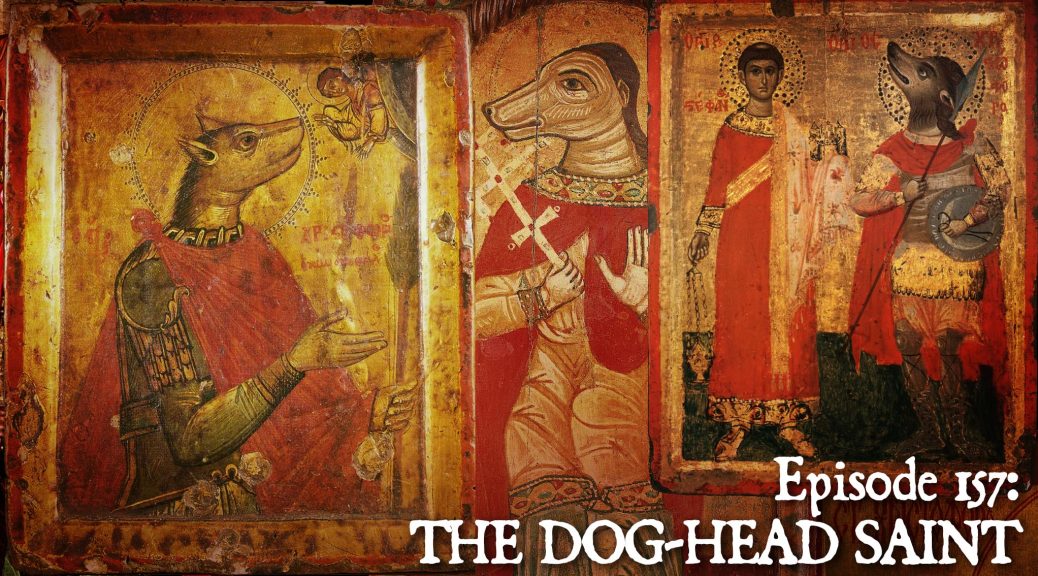
Today he’s known mainly as a figure from medals carried to insure safe travels, but that image of a giant carrying the Christ Child across a dangerous river represents only the final stage in the long and strange evolution of the saint’s legend. Earlier or forgotten aspects of his story describe Christopher as a ferocious soldier, the Devil’s servant, a cannibal, and even a dog-headed monster.

Our episode begins with the best known version of the tale recorded in The Golden Legend, the classic collection of hagiographies written in 1260 by Jacobus de Voragine, a Dominican friar in Genoa. Here Christopher begins as Reprobus, a fearsome giant determined to serve the most powerful master in the world. He first serves a king but abandons him after discovering that the king fears the Devil. Reprobus then serves the Devil, only to discover that the Devil fears Christ.

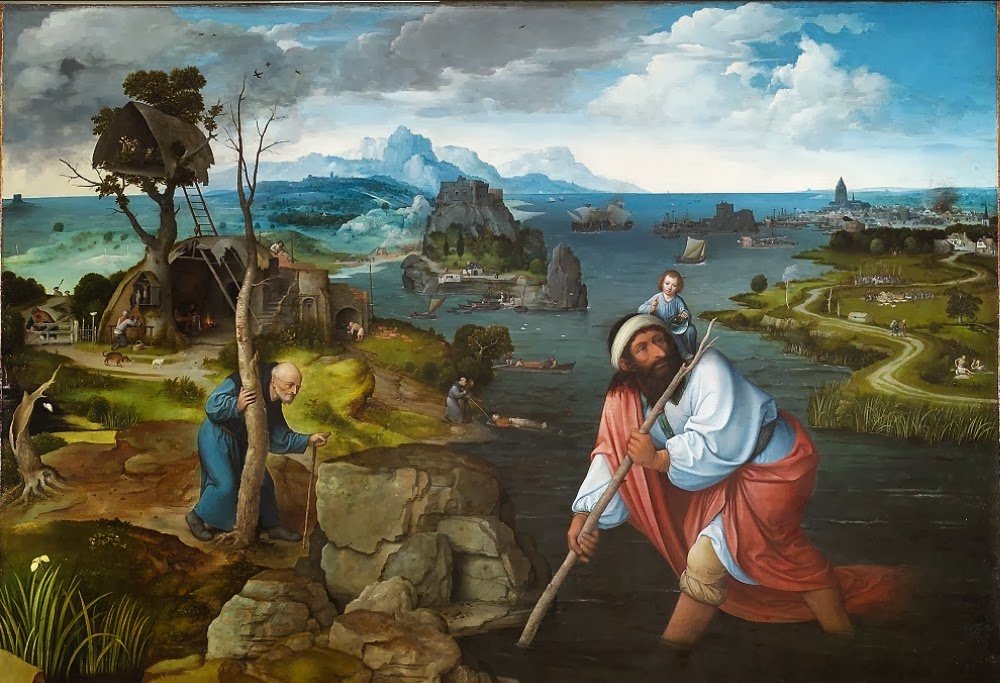
Seeking Christ, Reprobus encounters a hermit who suggests that the giant use his great strength to carry travelers across a dangerous river. One night, a mysterious child asks to be carried across. As Reprobus struggles through the rising water, the child becomes impossibly heavy. Upon reaching the opposite bank, the child reveals himself as Christ and explains that Reprobus has carried both the Creator of the world and the weight of the world itself. Reprobus thus becomes Christopher, the “Christ-bearer.”

St. Christopher Joachim Patinir, ca1522

After this, comes the lesser known portion of his tale, in which Christopher runs up against Roman authorities thanks to his Christian faith. As a sign that God will be with him throughout this, his staff planted in the earth breaks for in blooms, and he’s preserved through numerous tortures and attempts to execute him after his refusal to worship the pagan gods. Tortures fail to harm him, arrows miraculously stop in midair, and Christopher eventually converts the king responsible for his execution.

But earlier versions of the legend are considerably stranger. Around 986, the German poet and bishop Walter von Speyer composed two Latin hagiographies, one in prose and the other in verse. Each tells the same story, describing Reprobus as a dog-headed cannibal who could only bark before his conversion.  The struggle through the river in de Voragine 13th-century tale is prefigured as a spiritual transformation in the waters of baptism.

An even older narrative is found in the apocryphal Acts of Andrew and Bartholomew.  Pieced together from parchments dated to the fifth and seventh centuries, merging stories, which originated in Coptic communities of Syria and Egypt. We hear extensive passages from this particularly fantastical tale read by Mrs. Karswell.

In this  which the apostles encounter a terrifying dog-headed cannibal named “Bewitched.” He’s been sent to them by an angel, who first removes his appetite for human flesh and grants him the ability to speak. Renamed  “Christian,” (though still referred to in the text as “Dog’s Head”) the creature accompanies the apostles on their missionary adventures to the city of Barbaros in Parthia. When they are sentenced to death by  lions and tigers , Dog’s Head is divinely granted a temporary return to his original ferocity, and slaughtering and devouring the beasts. Walls of fire, flying idols, miraculous floods, and more grisly tortures and martrydoms, round out the narrative.

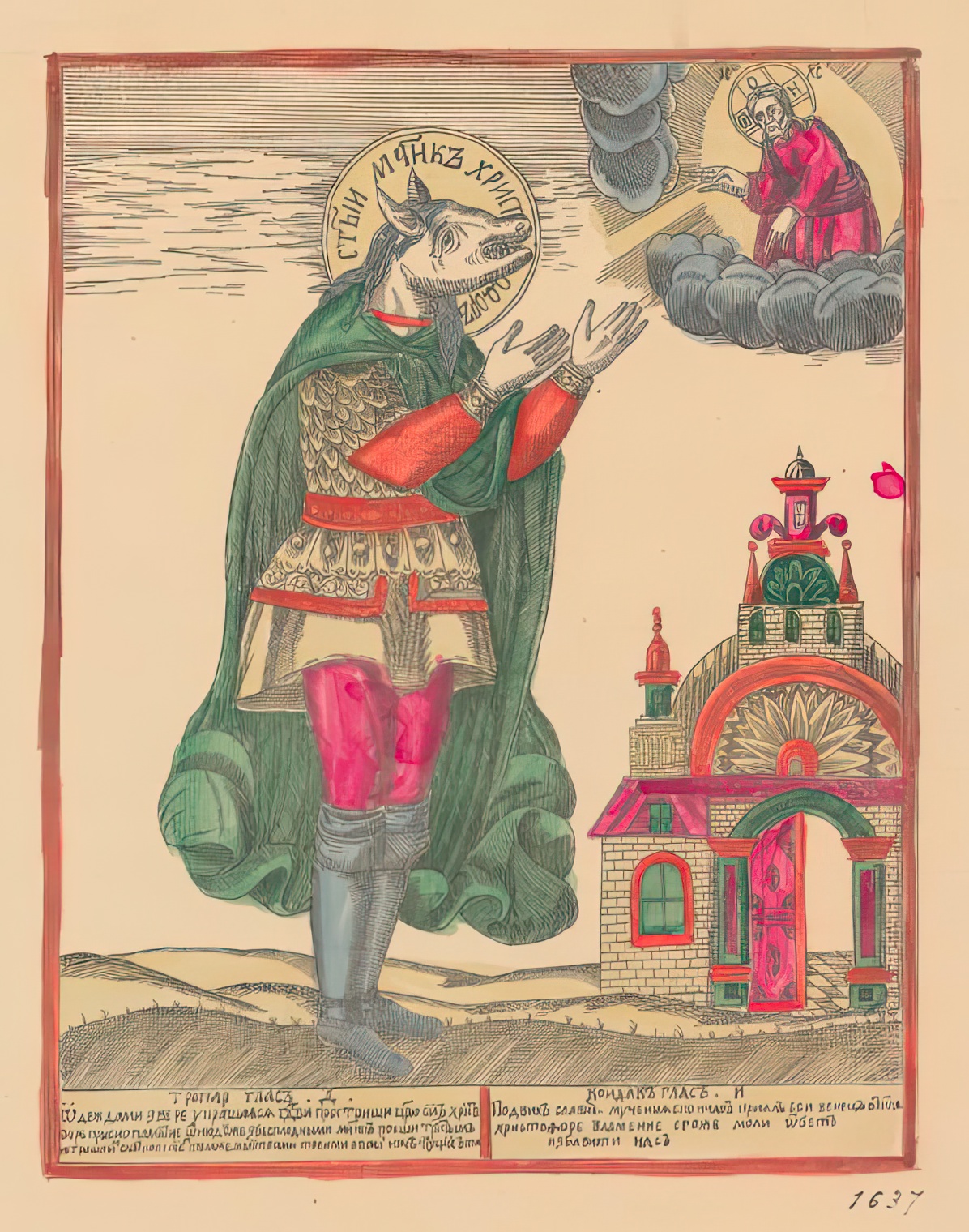
St. Christopher in 18th-century Russian lubok print

A slightly later Greek text, The Martyrdom of Christophoros, brings the legend closer to its later form. Reprobus remains a dog-headed member of a cannibalistic race but is now a soldier and Christian. After receiving the miraculous ability to speak, he converts fellow soldiers, survives numerous tortures, and is eventually martyred by beheading. Several elements later incorporated into the Golden Legend—including his flowering staff, conversion of prostitutes, and miraculous survival of torture—already appear here.

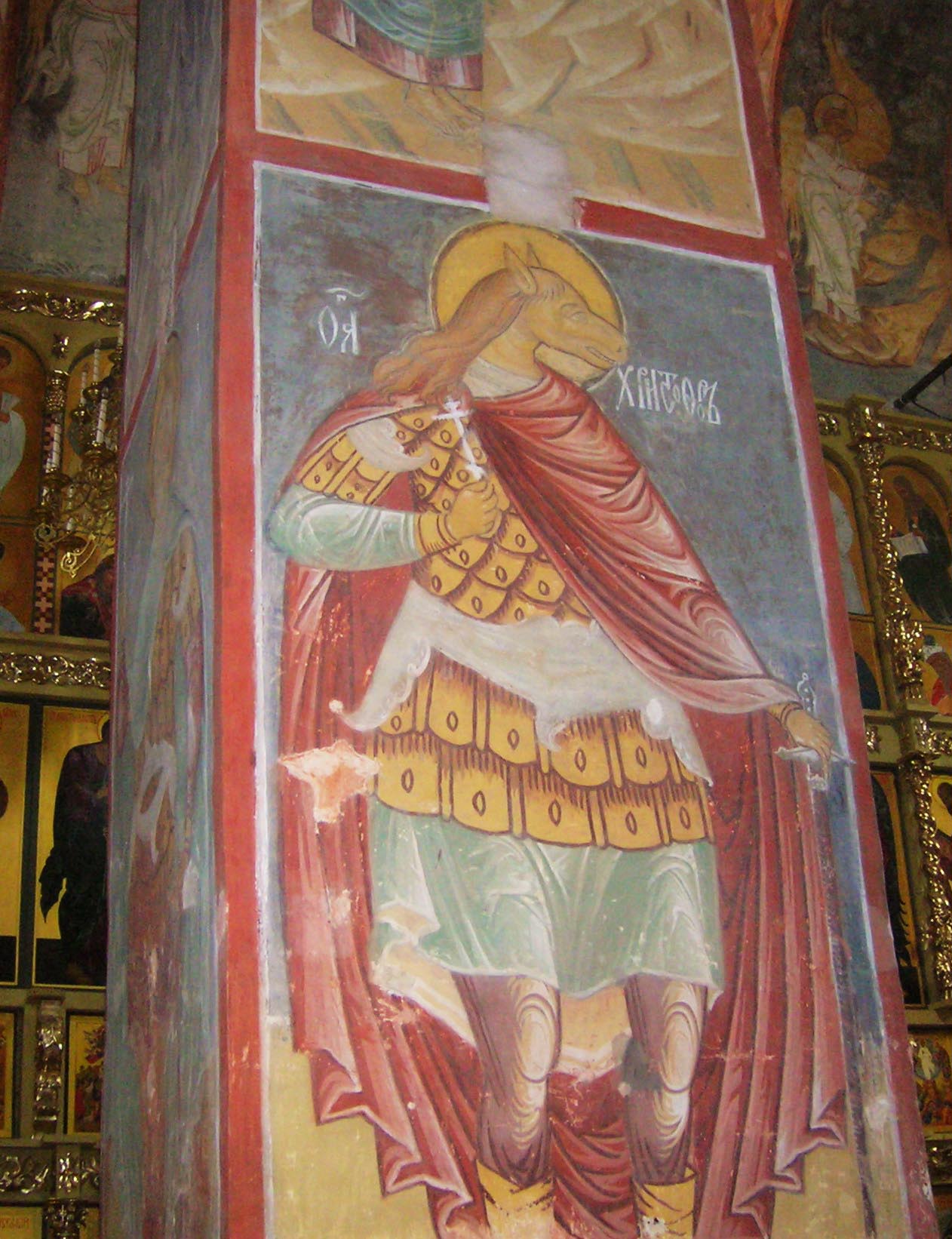
A number of images of St. Christopher as a dog-headed man (Greek: cynocephalus) can still be seen  in Orthodox churches and monasteries in Greece and Russia.  While Peter the Great sought to suppress this portrayal of the saint in 18th-century Russia, his efforts were not entirely successful, and cynocephalus icons are produced by the sect known as the Old Believers to this day.

Christopher’s monstrous appearance was intended to highlight both a pre-conversion savagery and extreme foreignness. Ancient and medieval writers from Herodotus to Marco Polo repeatedly placed imaginary races of dog-headed humans in distant, unexplored lands. Armenian illustrations of Pentecost similarly included cynocephali to symbolize the remotest peoples reached by Christianity.

We end the episode with a nod to St. Christopher’a identity as the patron saint of surfers, and a bit of music from that unlikely nexus of Catholicism and surfdom.  It’s a snippet from the 1999 album by the Malibooz, Living Water:The Surfer’s Mass.

“Horse-head” St. Christopher from Assumption Cathedral, Sviyazhsk, Russia.


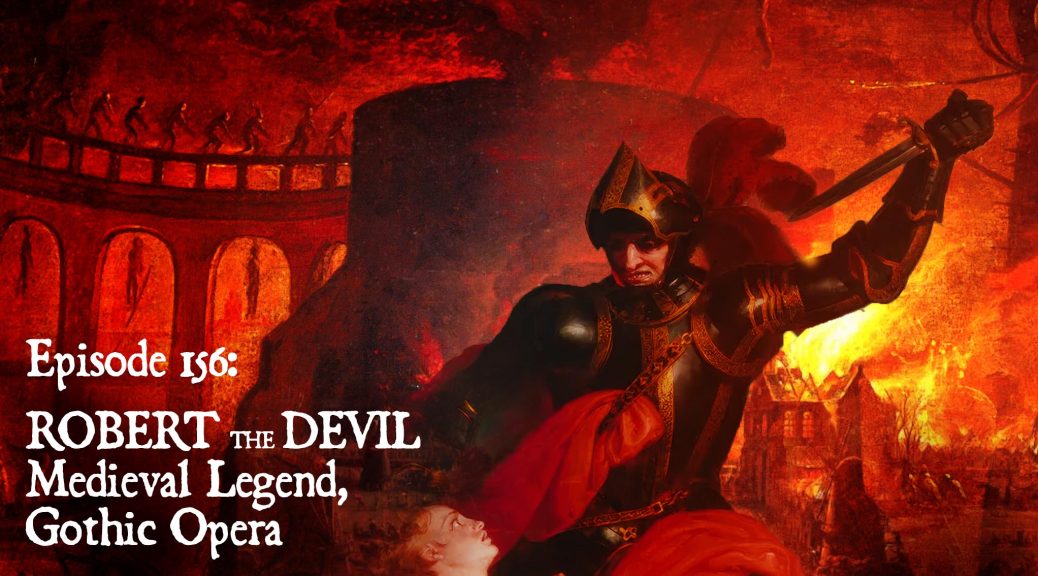
Robert the Devil: Medieval Legend, Gothic Opera

Robert the Devil: Medieval Legend, Gothic Opera

Robert the Devil is a supernatural medieval legend that inspired a 19th-century French opera, which incorporates key elements from a seminal Gothic novel.  The opera and legend are substantially different but both interesting.

We begin with Giacomo Meyerbeer’s 1831 opera, Robert le diable, which gained notoriety for a ballet sequence in Act III, which portrays an attempted seduction of the hero, Robert, Duke of Normandy, by the ghosts of corrupted nuns, freshly risen from their crypts. The scene is not found in the original legend, but as we learn, was borrowed from a particularly sensationalistic early Gothic novel,The Monk, written by Matthew Gregory Lewis in 1764.   We also learn that Meyerbeer’s chief librettist, Eugène Scribe later went on to crib another storyline from Lewis’ The Monk for the 1854 opera by composer Charles Gounod, La nonne sanglante (“the bloody nun”).

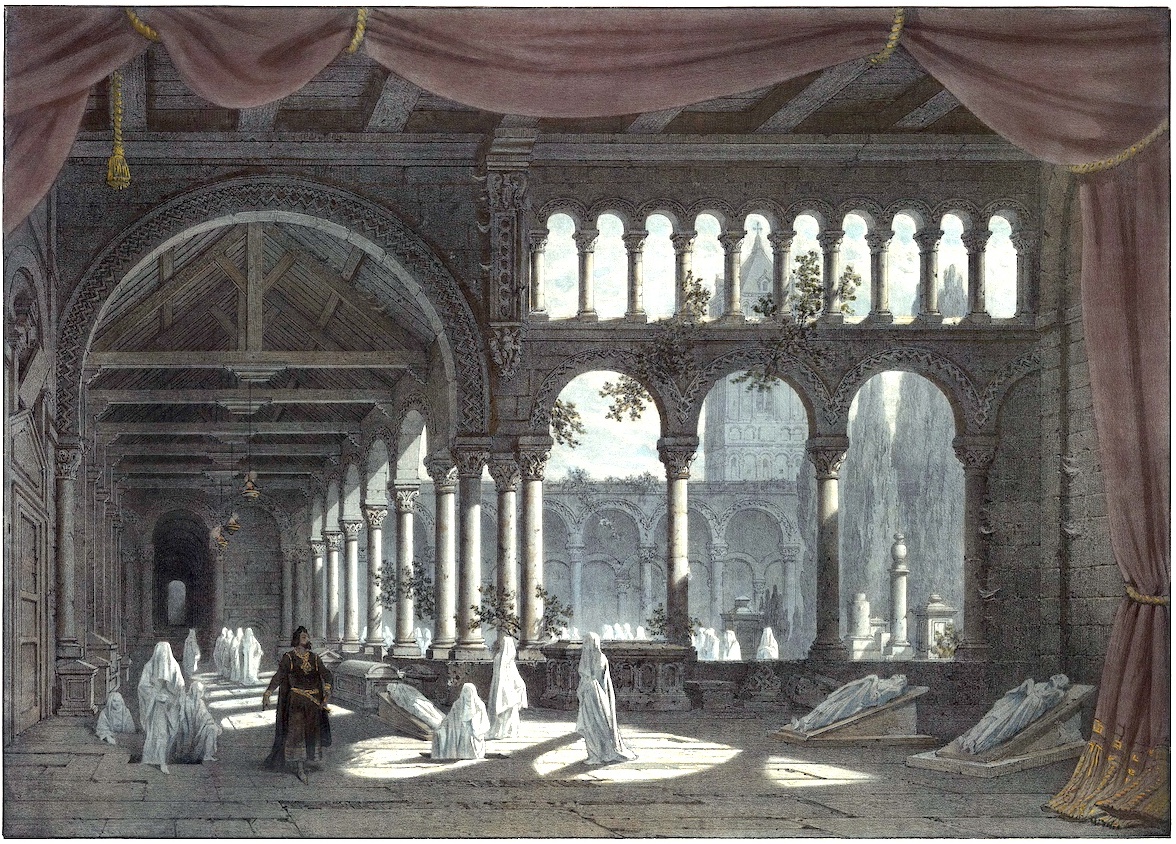
Rendering of cloister set for Paris Opera premiere.

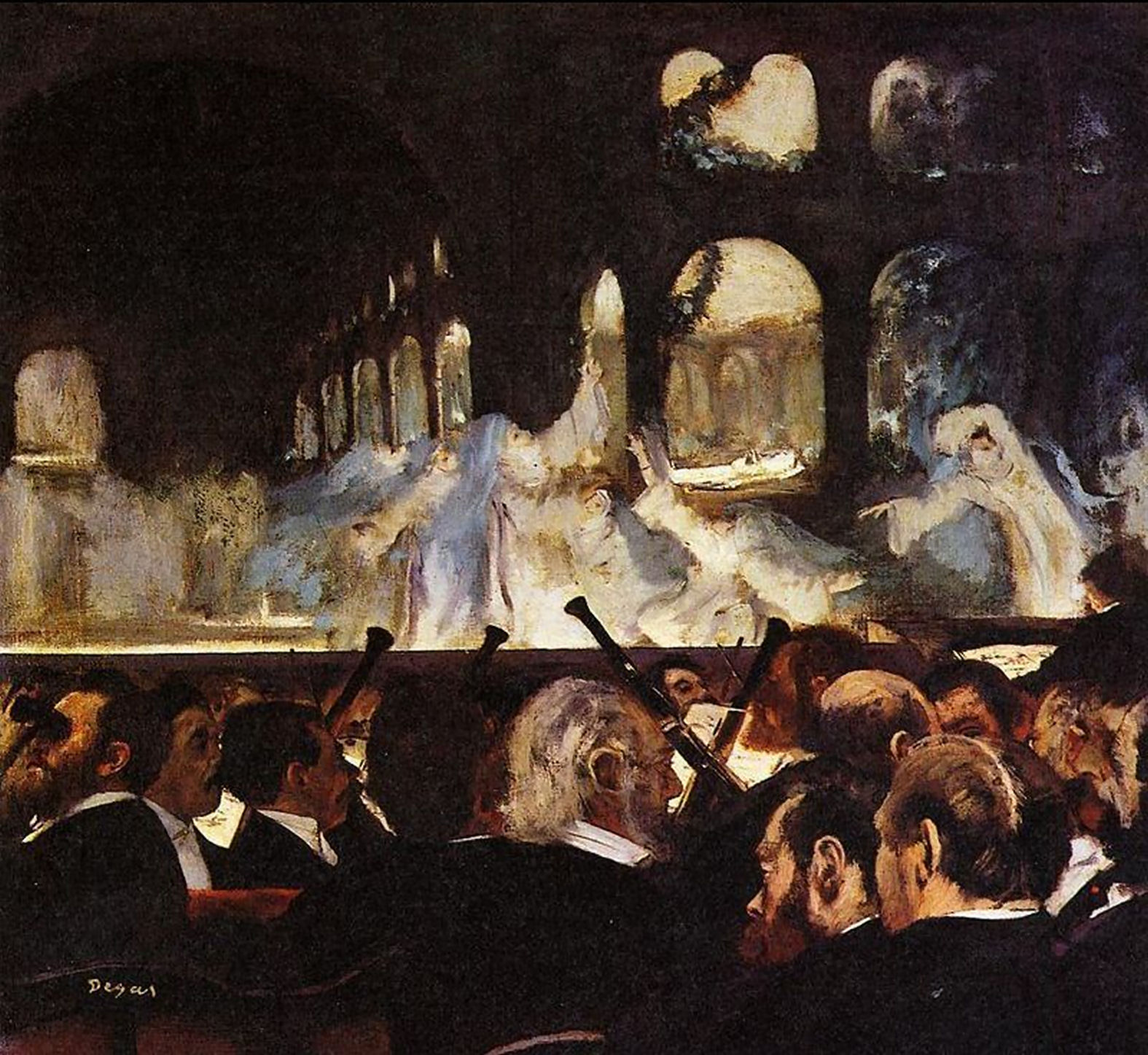
Along the way, we learn how Robert le diable helped save the financially imperiled Paris Opera after its royal subsidy had been withdrawn following the July Revolution of 1830.  Along with public curiosity about the scandalous ballet, ticket sales owed much to the 19th-century equivalent of special effects — flashy and innovative stagecraft (new gaslight design, trapdoors, floating will-o-the-wisps, etc.) and a spectacular set replicating a ruined gothic monastery. Hans Christian Andersen, George Sand and Frédéric Chopin lavishly praised the production. Honoré de Balzac and Alexander Dumas worked mentions of the opera into their novels. Edgar Degas painted not one but two renderings of the Ballet of the Nuns.

Edgar Degas’ rendering of the “Ballet of the Nins”

The opera also gave birth to a new style of ballet, one linked to Romanticism’s interest in the supernatural: ballet blanc, “white ballet” named for the innovative long, flowing skirts that lent themselves to wafting movements suggestive of misty wisps moving in the darkness. The opera’s 1847  London premiere was attended by Queen Victoria and featured superstar soprano Jenny Lind as Robert’s sister.  Traffic came to a standstill as unruly spectators mobbed the streets hoping for  glimpse of either celebrity.

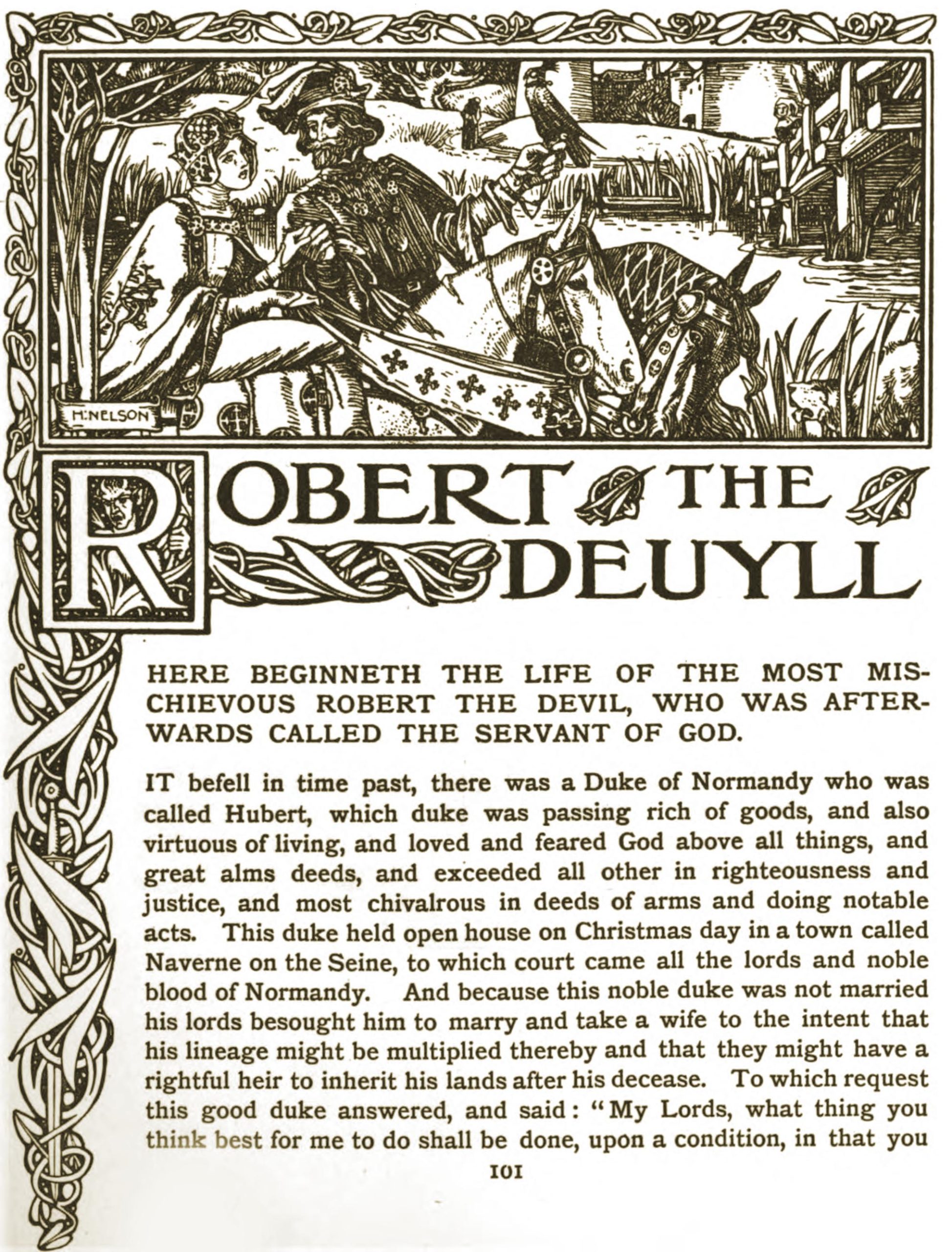
The second half of our episode tells the original story of Robert the Devil.  It first appeared around 1250, sketched out in short form by the Dominican monk, Étienne de Bourbon, in a collection of exempla, or moral tales intended to be used by priests in their homilies.  A couple decades later, details were filled out in a longer, anonymous  poem, preserved in France’s National Library. Then by the late 14th century, it was rendered as a miracle play in “Forty Miracles of Our Lady,” commissioned by a guild of Parisian goldsmiths. By 1500, the story had arrived in Britain. That year, Wynkyn de Worde, assistant to pioneering London printshop owner Thomas Caxton, issued a chapbook prose translation hewing close to the French 14th-century poem.

I found the Wynkyn de Worde text reproduced in a handsome 1904 volume complete with line illustrations, decorative initials, and borders reminiscent of the Arts and Crafts books of William Morris.  As promised in the episode, here is the link to that book: Robert_the_Deuyll.pdf.  (Visit the show notes on the Bone and Sickle website if you can’t click link).

As for the  story itself, it’s best you enjoy it without spoilers as told by Mrs. Karswell.  It’s full of demonic wrath, battles, court intrigue, miracles, pathos, and a very and prolonged peculiar penance.  All told in charming 16th-century language with all the little sound-design extras you’ve come to expect from Bone and Sickle.

Trolls in Medieval Literature

Trolls in Medieval Literature

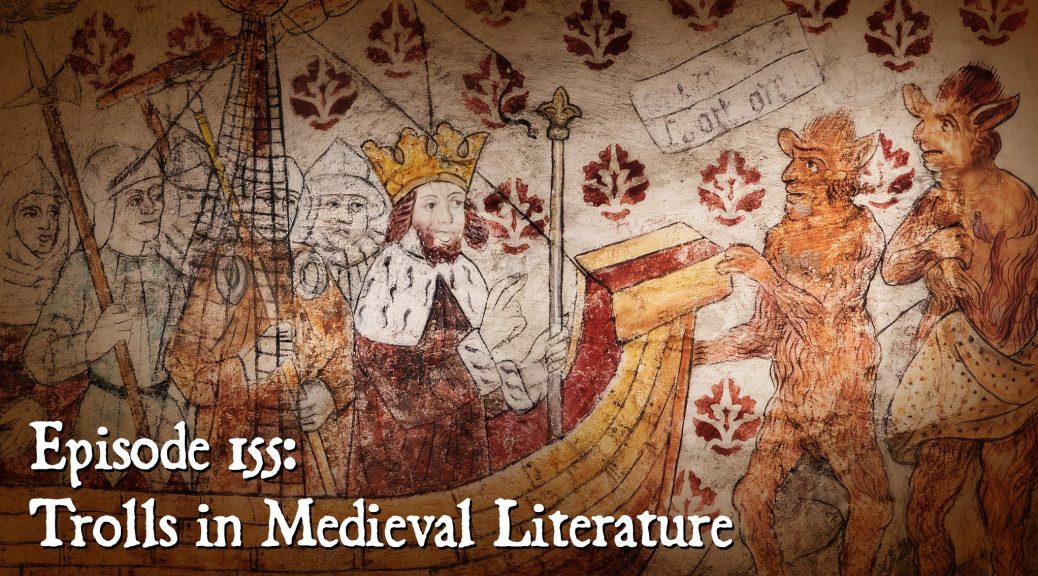
Trolls, as presented in medieval literature, are vastly different from the creatures we encountered in our last episode’s collection of 19th-century Norwegian folktales. These Viking Age trolls are more vividly and gruesomely described, and the “troll-women,” who frequently appear, are akin to witches.

We begin the show with a traditional song from the Faroe Islands, “Trøllini í Hornalondum,” telling the story of St. Olaf battling trolls on the coast of Norway. While the ballad presumably originated in Norway, it was first recorded by the Danish priest and historian, Anders Sørensen Vedel, in his 1591 publication, Hundredvisebogen, (the Book of 100 Ballads.”)

While St. Olaf (King Olaf II) is regarded as the saint who drove paganism from Norway, but this struggle was ongoing with trolls continuing to embody the old pagan world as belied by various tropes — their dislike of church bells, and fear of crosses. We’ll next look at an interesting case from Iceland presenting a direct conflict between a church and troll.  It was collected by the “Grimm of Iceland, Jón Árnason, a librarian and museum curator who published several collections of folktales, beginning in 1852. This one’s from his second volume of Icelandic Folktales, published in 1864.

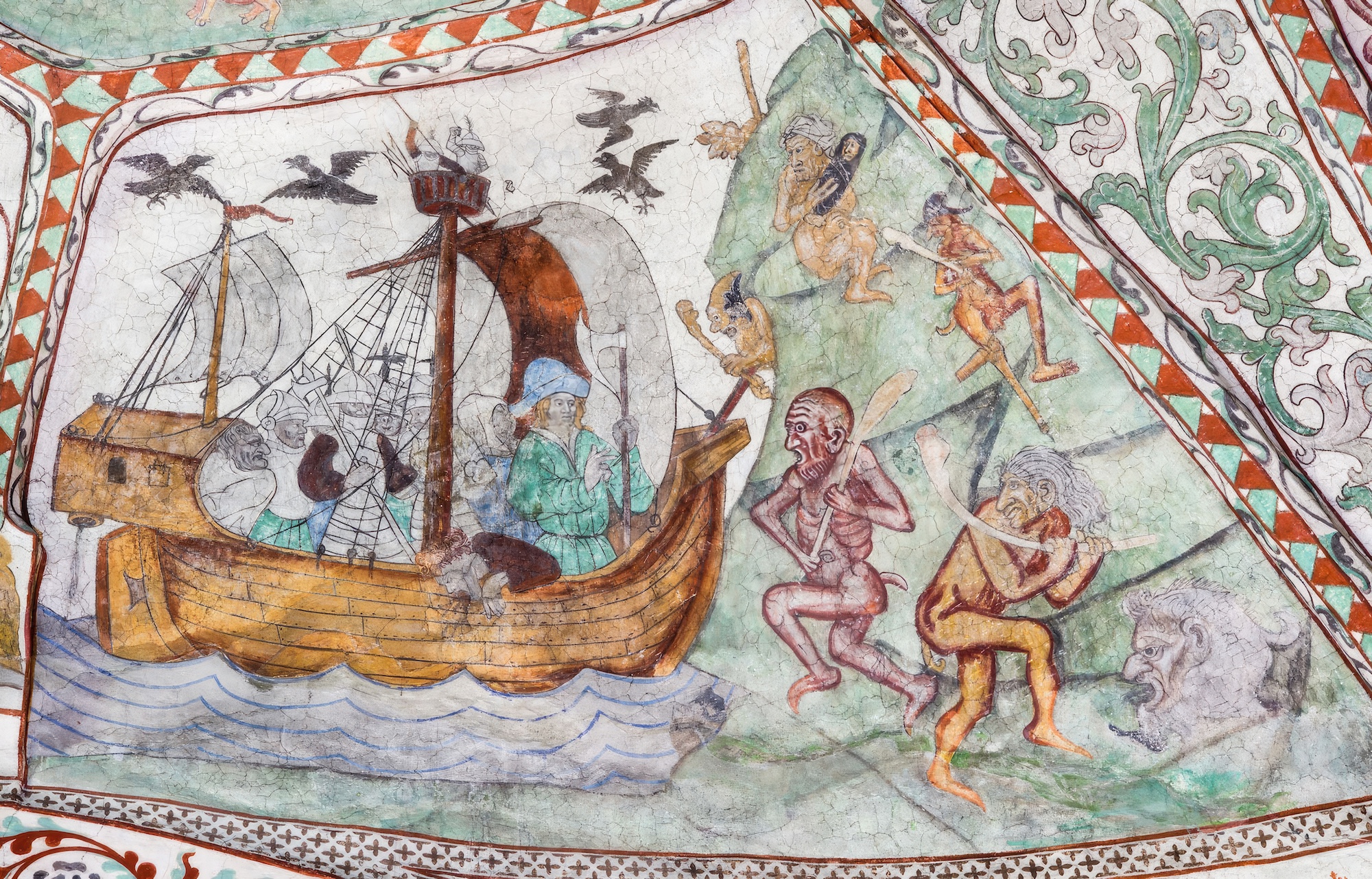
Encountering trolls -- St. Olaf's Journey, fresco by Albertus Pictor, ca 1470, Dingtuna Church, Västerås, Sweden
Encountering trolls — St. Olaf’s Journey, fresco by Albertus Pictor, ca 1470, Dingtuna Church, Västerås, Sweden

After this, we have some general comments on the historical relationship between trolls and giant (jötunn, Þurs and risi) as well as trolls and witches or sorcery (trollldom). Our remaining four stories (the medieval ones) present trolls of the Icelandic saga, epic stories written in Old Norse and relating the adventures of ancestral heroes or rulers, usually with some connection to history but with certain creative embellishments. A subset of the sagas, which take place in their own mythic timeline, the fornaldarsögur were simply written with entertainment in mind and more oriented toward magic and folklore – and trolls, so we’ll lok at a couple of those. And then there’s the þáttr, a sort of short story, sometimes folded into sagas, but often reproduced independently.

As this is a storytelling episode, we won’t spoil the tales with plot outlines, but the sources (in order) are:

  1. The 14th-century þáttr of Thorstein Ox-leg as translated in William Craigie’s 1896 compilation called Scandinavian Folk-lore: “The Trolls in the HeidarWoods.”
  2. A portion of the 16th-century Illuga Saga, translated by Philip Lavender of the Viking Society for Northern Research.
  3. The 14th-century Saga of Grim Shaggy-Cheek as translated by Peter Tunstall.
  4. The Saga of Orm Stórolfsson, as retold by William Craigie in Scandinavian Folk-lore – under the title: “The Giant on Sauðey” (Saudey).

We end with a song “Trøllini Trampa,” (“Trolls’ Tramp”) by the Faroese band, Spælimenninir

Trolls (Pt. 1)

Trolls (Pt. 1)

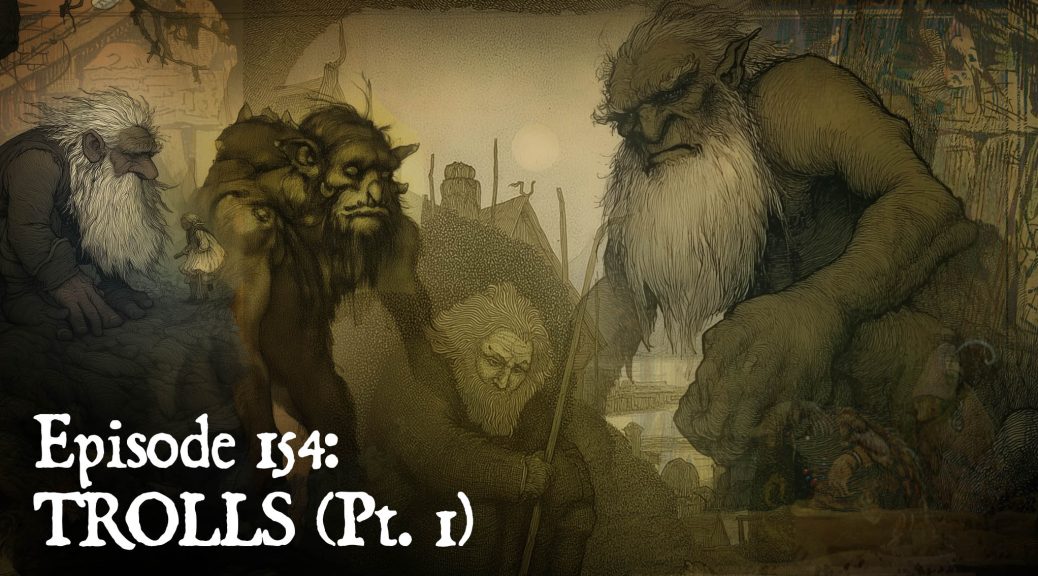
Trolls in Scandinavian folklore can be a little different from what’s imagined in the rest of the world.  We begin our show with a montage of clips from recent movies, Trollhunter (2010), Troll (2022), and Troll 2 (2025) — the latter two being Netflix productions that have rekindled interest in the subject while reimagining trollsin a way that does not always conform to the folklore. While all Scandinavian countries have their share of troll lore, this episode focuses specifically on Norway, the country with the most compelling collection of troll folklore.

The first portion of our show looks at the Norwegian writer Henrik Ibsen’s play along with  incidental music composed for the play by his associate Edvard Grieg. Introducing this topic is a clip from the 1970 musical Song of Norway, a fanciful Edvard Grieg biopic that garnered particularly bad reviews.  We learn a bit about why Grieg hated his well-known “Hall of the Mountain King,” a composition which accompanies Peer Gynt’s encounter with trolls inside a mountain in the Dovre mountain chain. We also learn what Ibsen hoped to achieve in telling the story of his antihero Peer Gynt, and how he wrestled with the movement known in Norway as Romantic Nationalism.

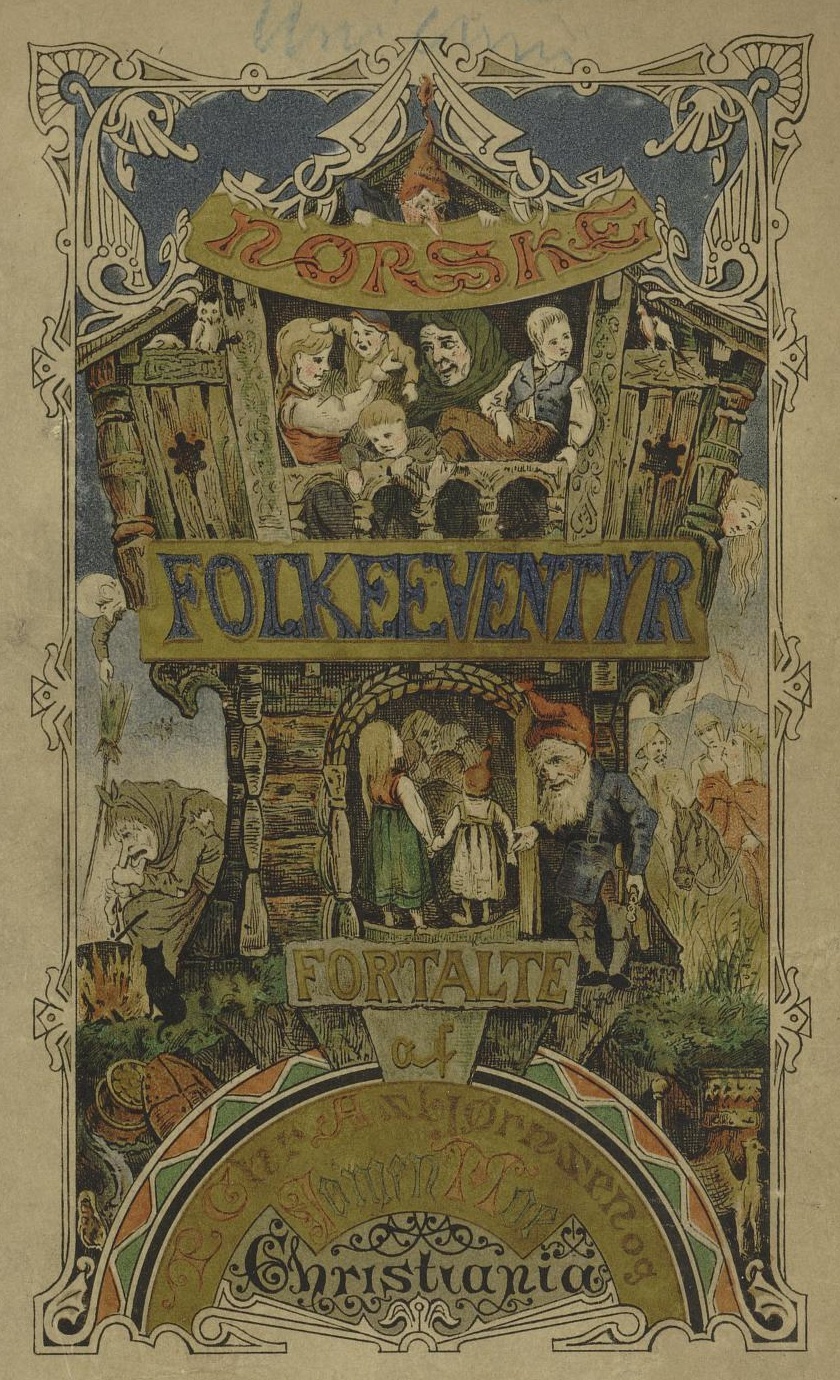
Next we look at two figures integral to this movement, Peter Christen Asbjørnsen and Jørgen Moe, a pair of folktale collectors often described as the “Brothers Grimm of Norway.”  Their 1841 publication, Norwegian Folk-Tales, along with updated volumes published in 1844, 1845, and  1871, provide most all the troll tales with examine in this episode. An exception to this is a book authored by Asbjørnsen alone, High Mountain Scenes, volume 2, Reindeer Hunt at Rondane. Published sometime before 1846, it’s the only volume referencing tales told about Peer Gynt, those being very loosely represented in Ibsen’s play.

Asbjørnsen & Moe’s “Norwegian Folk Tales”

The first of these we retell concerns a creature known as “the Bøyg,” something referred to as a type of troll in the story is described more  as a giant serpent of sorts. We follow this with more Peer Gynt episodes involving male trolls flirting with human females and a troll poking his enormous nose through a cabin window and suffering the consequences inflicted by Gynt.  The final story, “The Cat on the Dovre-Mountain,” takes place at Christmas, a time when troll encounters are particularly prevalent, and involves Gynt outsmarting a group of bothersome trolls via a peculiar stratagem.

Next, we run through some lesser-known details of the best-known troll tale “The Three Billygoats Gruff.”  We follow this with another well-known (in Norway) story, “The Boy Who Had an Eating Match with a Troll.” It involves a youth outwitting a troll with a particularly gruesome ruse It was familiar enough to Norwegian audiences to be referenced in Trollhunter.

Next we look at a character Askeladden, who is pitted against trolls in several of Asbjørnsen & Moe’s stories.  He’s usually describing the good-for-nothing youngest brother of a trio, an underdog who surprisingly achieves great things. His name (literally “ash lad”) referenes his stay-at home habits, in particular, sitting by the hearth playing in the ashes. We learn of several characters with related names and habits in Scandinavian literature and a more insultingly rude nickname for such characters, one which Asbjørnsen & Moe chose to censor from their stories.

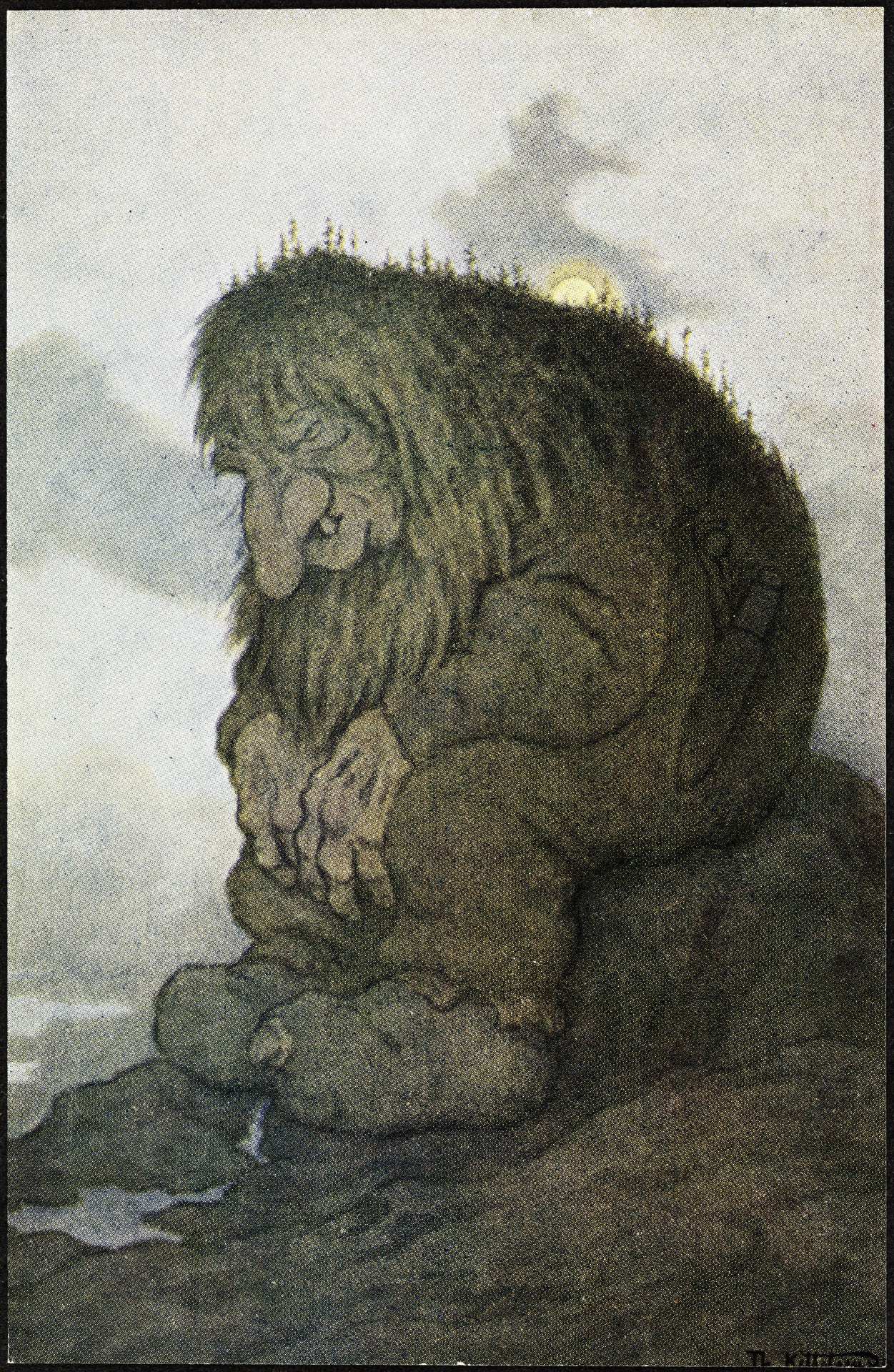
Theodor Kittlesen, “Troll Pondering How Old iIt Is” (1911)

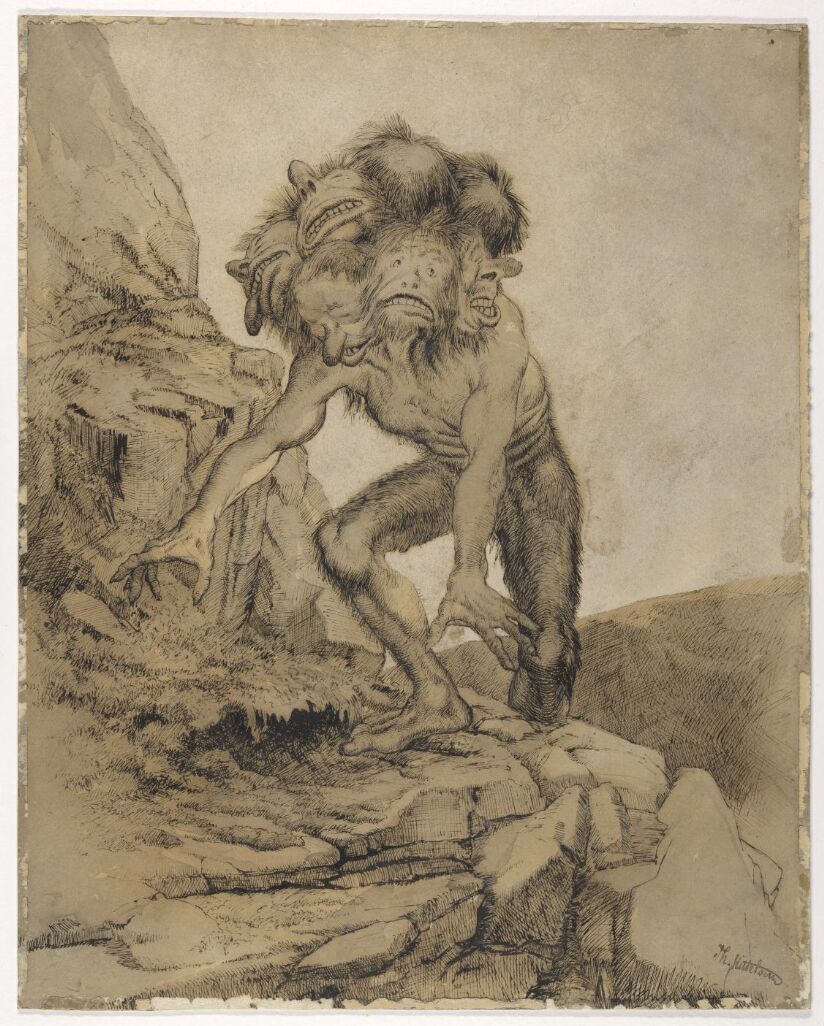
Our next troll tale, “The Lads who Met the Trolls in the Hedale Woods,” gives us particularly monstrous trio of trolls sharing a single eyeball.  While this is atypical, we also encounter here the common trope of trolls sniffing the air for “Christian blood,” a suggestion that their kind of an older pre-Christian order.  A reference to trolls using magic is also contained in this story, something we’ll run into in other tales.

We then hear some clips from a couple of Asbjørnsen & Moe-inspired films, the 2017 Norwegian film Ash Lad: In the Hall of the Mountain King and its 2019 follow-up, The Ash Lad: In Search of the Golden Castle.  The “Golden Castle” in Norwegian film title and  the title  of the relevant Asbjørnsen & Moe story is “Soria Moria Castle.” This one also features trolls, but in a peripheral role.  It’s a longer legend quest rather than a short folk tale in which we encounter three multi-headed trolls holding human women captive in three different castles.

Our last story, “The Hen is Trips in the Mountain,” takes its  weird title from a strange phrase uttered to open a door into a mountain, like “Open Sesame.” When a young woman enters theis particular mountain looking for a lost hen, she meets an unpleasant end, as does her younger sister, but when the youngest of the three enters, she manages not to repeat the mistakes of her two siblings and later discovers that trolls can explode when touched by the first rays of dawn (as well as turning to stone, another common folklore trope).

We wrap up the show with some interesting stats regarding the fascination trolls exert over the heavy metal subculture.

Theodor Kittlesen, “Mountain Troll” (1887)


Rhymes for Those Who Can Neither Read Nor Run

Rhymes for Those Who Can Neither Read Nor Run

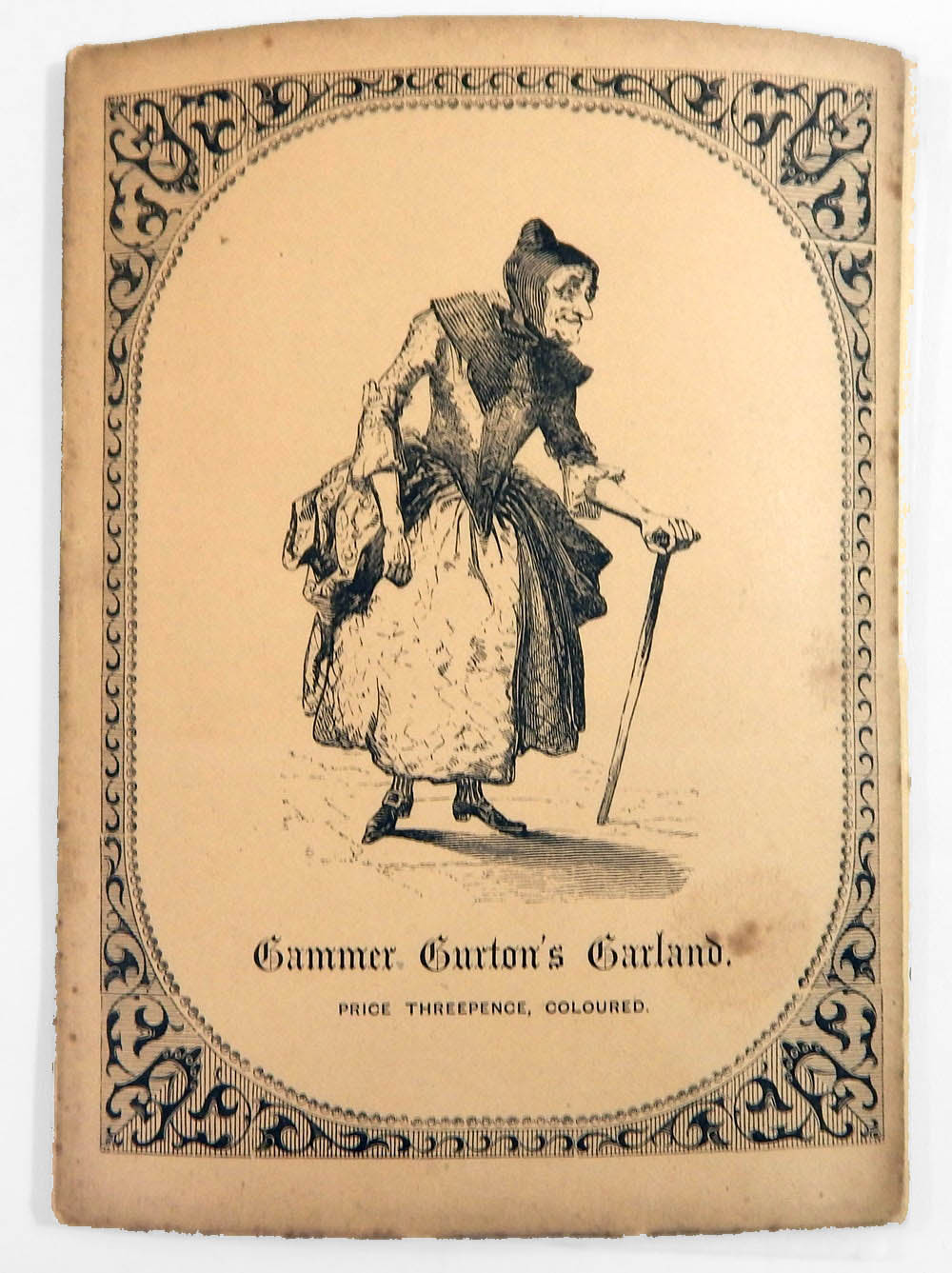
Gammer Gurton’s Garland, published in 1784, is one of the earliest collections of English nursery rhymes, and contains verses both familiar and alarmingly unsettling.

Intended to be read to toddlers (i.e., “children who can neither read nor run,” according to its subtitle) and named after a fictitious Grandma (“Gammer”) Gurton, who’d be analogous to Mother Goose, the volume were assembled by the eccentric scholar Joseph Ritson, who was known for his collecting of Robin Hood ballads, vegetarianism and ultimate descent into madness.

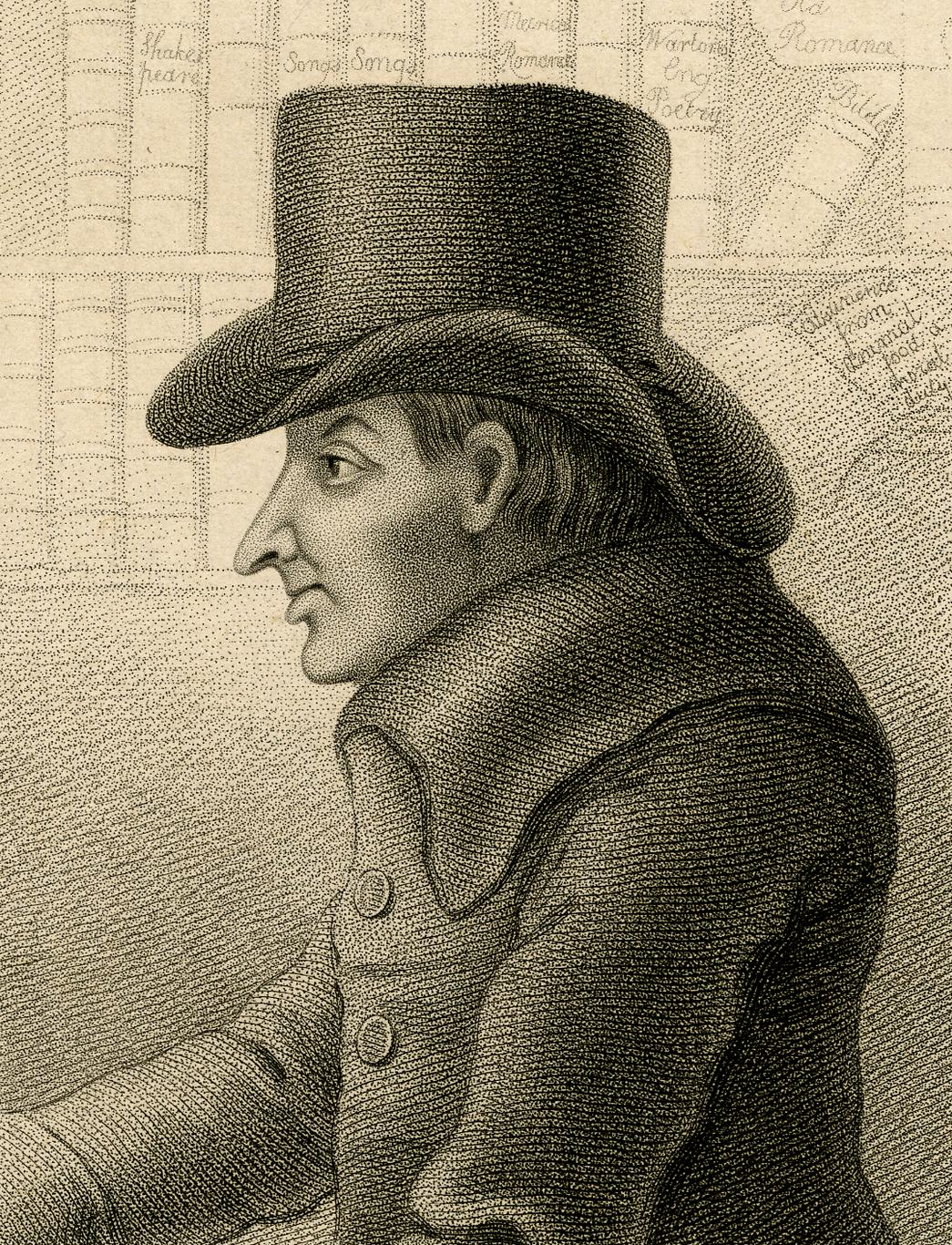
Portrait of Joseph Ritson by James Sayers, early 1800s.

We begin our episode with a snippet of a 1940s’ rendition of “Froggy Went a-Courting” by cowboy singer Tex Ritter. It’s a relatively modern take on Ritson’s “The Frog and the Mouse.” But like quite a few rhymes in the collection, this one had appeared in print earlier. Already in 1611, British composer of rounds and collector of ballads, Thomas Ravenscroft, had written out both lyrics and musical notation for “The Marriage of the Frogge and the Mouse,” a song he described as a folk song or “country pastime.”

While a few other rhymes in Ritson’s collection were borrowed from one of two earlier editions of nursery verses (both published as Tommy Thumb’s Song Book 40 years earlier), most of what he collected appeared for tge first time in Gammer Gurton’s.

We hear a bit about some of the familiar rhymes that premiered in this collection, including Goosey, Goosey Gander, Ride a Cock-Horse to Banbury Cross (with the “rings on her fingers and bells on her toes” lady), Bye, Baby Bunting, and There Was an Old Woman who Lived in a Shoe.” Ritson’s version of the last, however, takes a rather rude and unexpected turn.

1865 edition of Gammer Gurton’s

Many, if not most, of Ritson’s rhymes seem to have been weeded out of the gentile or sentimental collections we know today. Naturally, we devote attention particularly to these objectionable verses. Included are a handful of aggressively nonsensical rhymes, which could pass for 18th-century Dada and verses notable for their cruelty. The most alarming contain brutal slurs, threats, and playful references to assault, adultery, matricide, suicide, and animals going to the gallows.

The last third of our episode is dedicated to poems noteworthy for their survival as musical ballads. The first discussed is the basis for song “Lady Alice,” which later appears in James Child’s 1860 collection The English and Scottish Popular Ballads. Ritson’s version, “Giles Collins and Proud Lady Anna,” is a greatly simplified version of the ballad later cited by Child. While toddlers might appreciate the simpler storytelling, the subject matter — namely, doomed lovers — is not the normal stuff of healthy nursery rhymes. More surprising, is the fact that Ritson’s story begins with Giles Collins in the process of dying and Lady Anna dead (of heartbreak) within a few verses. After their deaths, a tentative suggestion of undying love, a lily reaching from Giles’ grave toward Anna’s, is destroyed – an unhappy turn on the not uncommon motif of a rose and briar entwining over lovers’ graves.

We close with a discussion of “The Gay Lady who Went to Church,” an innocuous-sounding rhyme, intertwined with the history of two rather gruesome folk songs popular around Halloween: “There Was an Old Lady All Skin and Bones” and “The Hearse Song” AKA “The Worms Crawl In.” Also discussed is a surprising link between Ritson’s nursery rhyme and a faux-historical ballad invented for the very first Gothic novel, Matthew Gregory Lewis’ The Monk.


INFORMATION RE. THE FOLK-HORROR GIVEAWAY DISCUSSED IN THE SHOW OPEN CAN BE FOUND HERE: https://www.boneandsickle.com/giveaway/

A Werewolf in Court

A Werewolf in Court

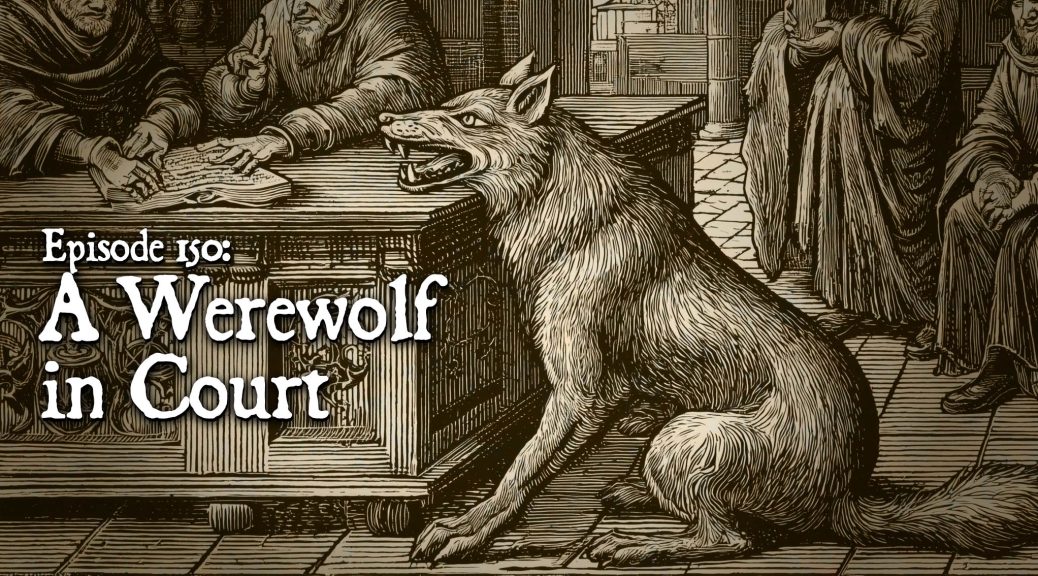
In our second short episode for November, we take a close look at a the 1692 trial of Thiess of Kaltenbrunn, a purported werewolf in the town of  Jürgensburg, in Livonia, (a Baltic region now divided between Estonia and Latvia). “Old Thiess,” as he was known, described himself as being a  particularly exotic form of werewolf — one who served God in Hell.  The testimony offered was so curious that we will be presenting the court transcripts verbatim, with nearly all exchanges between witness and judges included. Decide for yourself!

Urban Legend

Urban Legend

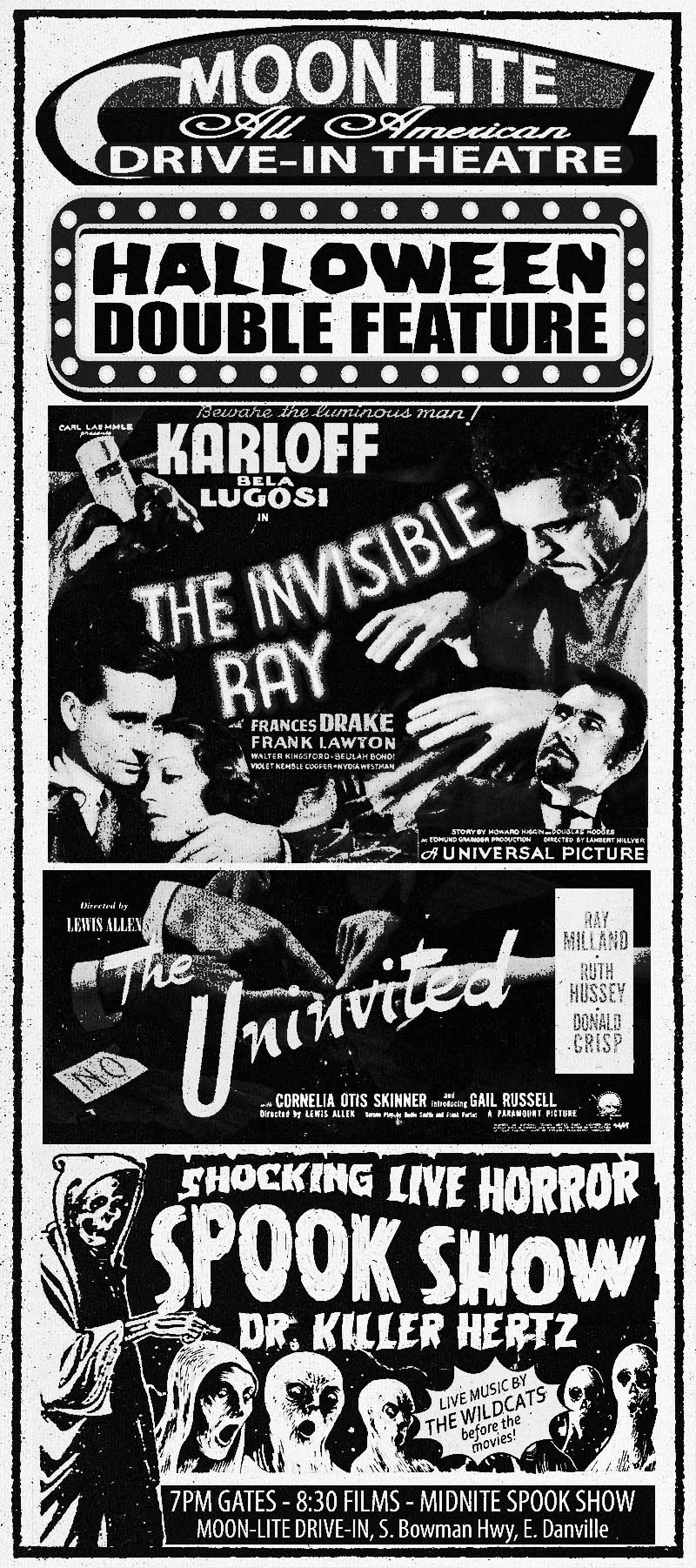
A 1968 Halloween “Spook Show” in the Midwest left an unsettling heritage of urban legends possibly rooted in even more unsettling facts.  What little is definitively known regarding this event comes from the newspaper archives of the Danville News-Gazette, in which we find a short October 28  promo piece in the “Entertainment” section featuring this photo presumed to be of the impresario behind it all, J. Jolly.

“Dr. Killer Hertz” will speak to “Space Spirits” (courtesy News-Gazette).

There is also this advertisement for the event:

Courtesy News-Gazette.

That’s all the story you need for now.  You can form your own opinions as we grope our way between fact and fiction. Headphones and lights out for best results!

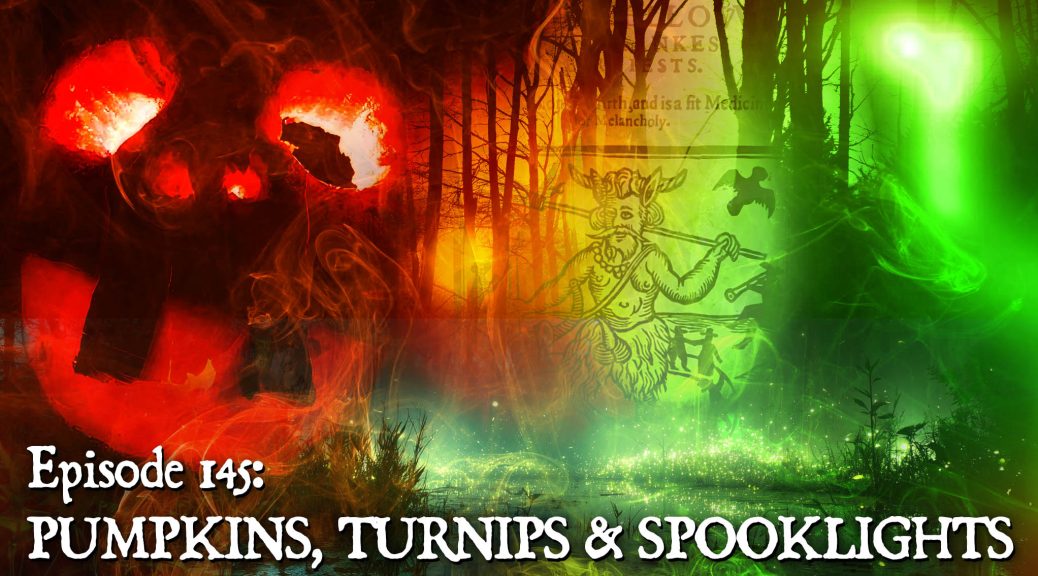
Pumpkins, Turnips, and Spooklights

Pumpkins, Turnips, and Spooklights

The Halloween Jack-o’-lantern, made from pumpkins in the US and originally turnips in the UK, began its existence as a wisp of glowing marsh gas or “spooklight.” We begin our episode with a montage of modern American spooklights including that of Oklahoma’s “Spooklight Road,” North Carolina’s Brown Mountain, and the flying saucers sighted in Michigan in 1966, famously identified by investigator Allen Hynek  as “swamp gas.”

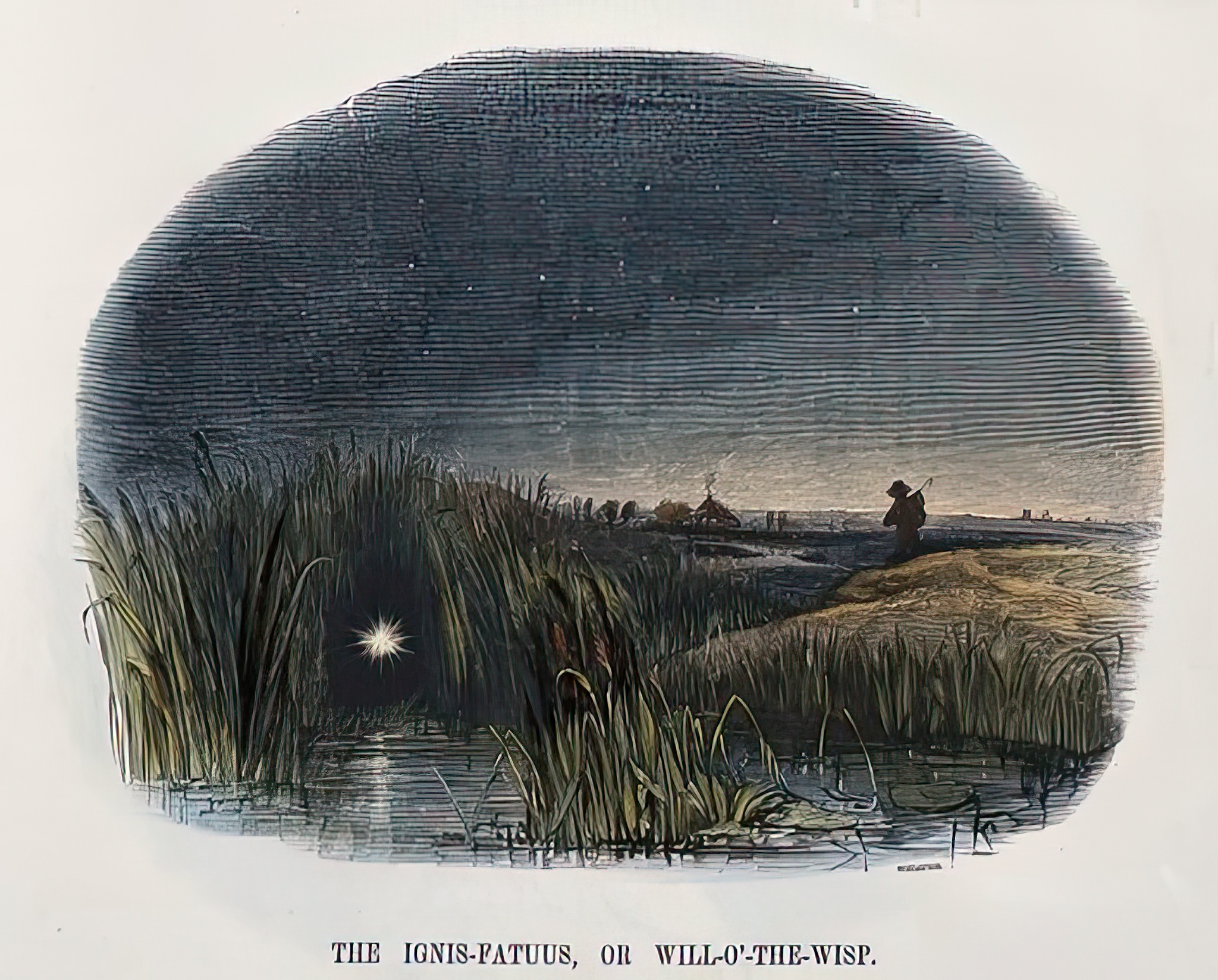
“Jack-o’-lantern”  was just another name given to what’s more widely known now as a Will-o’-the-wisp — a wavering, bobbing light seen in marshy places, understood as mischievous spirit intent on leading travelers off course and into their doom in muck and mire.  Flaming methane produced by rotting vegetation in such environments, is said to the the cause of the phenomenon, though the mode of ignition is still largely a matter of debate. The Latin name for such lights, ignis fatuus  (fool’s fire), was also applied to phenomena having nothing to do with swamps, as it’s been used interchangeably with “St. Elmo’s Fire” to describe electrical discharges seen on ships; masts and other rodlike protrusions when atmospheric conditions are right. We hear a dramatic first-person account from 1847, in which St. Elmo’s Fire (identified by antiquarian Henry Duncan as ignis fatuus) appears on a coachman’s whip during a storm.

A mirage in a marsh. Coloured wood engraving by C Whymper. Gas. Contributors: Charles H Whymper (1853–1941).

We then hear what scientists of the 16th and 17th century made of ignis fatuus, often relating it  unexpectedly to meteors or luminous insects, while mocking “the superstitions” who imagined it as wandering spirits alight with the flames of Purgatory.

Along with marsh spirits exlusively dedicated to misleading travelers, ignis fatuus could also be a temporary  form  taken by shapeshifting fairy folk like Puck or Robin Goodfellow.  We hear an example of this from  the 1628 pamphlet, Robin Goodfellow, his Mad Pranks and Merry Jests. We also see the term appearing in literature of the 16th and 17th century as a metaphor for treachery or deception, in works by John Milton and William Shakespeare.

We run through the variety of colorful regional names by which Will-o-the-Wisps were known: Bob-a-longs, Pinkets, Spunkies, Merry Dancers, Nimble men, Hinkypunks, and Flibberdigibbets, as well as some female variants including Peg-a-lantern and Kitty with the Candlestick. In Wales, these mysterious lights could be omens of death, also known as “corpse candles,” or “death lights.” Appearing around the home of the dying or at the deathbed, they were also called “fetch lights,” as they would arrive when required to fetch the soul to the other side. In Cornwall, fool’s fire is associated with the piskies, in particular Joan the Wad and her partner Jack-o’-the-Lantern, the former having acquired a mostly positive reputation in the 20th century as a luck-bringer. Mrs. Karswell also reads  some tales of ignis fatuus in the western counties, where the lights are called “hobby lanterns” (from hobgoblin) or  “lantern men.”

We then shift gears to discuss the pumpkin form of Jack-o’-lantern, beginning with a well-circulated Irish origin story. A quick summary: the light carried in a hollowed vegetable (a pumpkin in the New World or turnip in the Old) represents the spirit of a notorious sinner, “Jack,” or “Stingy Jack,” who upon death finds he is too wicked for Heaven and too troublesome for Hell. Consquently, he is condemned to wander the earth till Judgement Day, given the peculiar lantern to light his way.

This, at least, is the most recent version of the tale, but when it first appeared in print, in a 1936 edition of the Dublin Penny Journal, there’s no mention of any hollowed vegetable, much less of Halloween — meaning this “ancient legend” actually evolved as Halloween folklore in the second half of the 20th century.

We then do a bit more myth-busting on the other side of the Atlantic, checking in on Washington Irving’s Legend of Sleepy Hollow, which also turns out not to mention Halloween, nor a carved pumpkin representing the Horseman’s head.  When hollowed pumpkins first are mentioned by the 1840s, they are associated with Thanksgiving rather than Halloween, as in John Greenleaf Whittier’s 1947 poem, “The Pumpkin.”  The next  appearance of a Jack-o’-lantern, in an 1860 edition of a Wisconsin newspaper, is also not associated with Halloween but with an impromptu parade supporting Abraham Lincoln’s presidential run.  It seems that it was only by the end of the 19th century that the hollowed, lighted pumpkin was linked with Halloween, while retaining associations with Thanksgiving into the early 1900s.

In the UK, hollowed and lighted turnips (occasionally beets or rutabagas) seem to have been around since the early 1800s. Originally, they’re not necessarily associated with Halloween specifically but as something created by mischievous boys eager to scare their neighbors whenever the vegetables became available for such hijinks. A Scottish source, John Jamieson’s An Etymological Dictionary of the Scottish Language 1808), is the first to link them to Halloween pranks, and by the 1890s, we hear of lighted turnips being carried by costumed children (“guisers”) celebrating Halloween in Scotland.

Carved turnip used on the Isle of Man. Courtesy www.culturevannin.im

We then discuss the Jack-o’-lantern’s British evolution, namely, the replacement of  the turnip with the American pumpkin, beginning with their importation in the 1950s.  The process was slow, with both carved turnips and pumpkins used side-by-side in some regions, and the use of carved turnips longer retained in some regions.  Of particular interest here is the Isle of Man, where the Halloween celebration of Hop-tu-naa makes exclusive use of turnip lanterns in costumed door-to-door rounds during which children sing a largely nonsensical song punctuated by the rhyming syllables “Hop-tu-naa.”  An audio snippet of the song is provided courtesy of the Manx organzation Culture Vannin (https://culturevannin.im/).

We wrap up  with some speculations regarding the disappearance of the Will-o-the-Wisp and its evolution through different forms, including the glowing swamp gas theorized to have inspired the 1966 Michigan saucer sightings (and our closing song by Lewis Ashmore and the Space Walkers!)

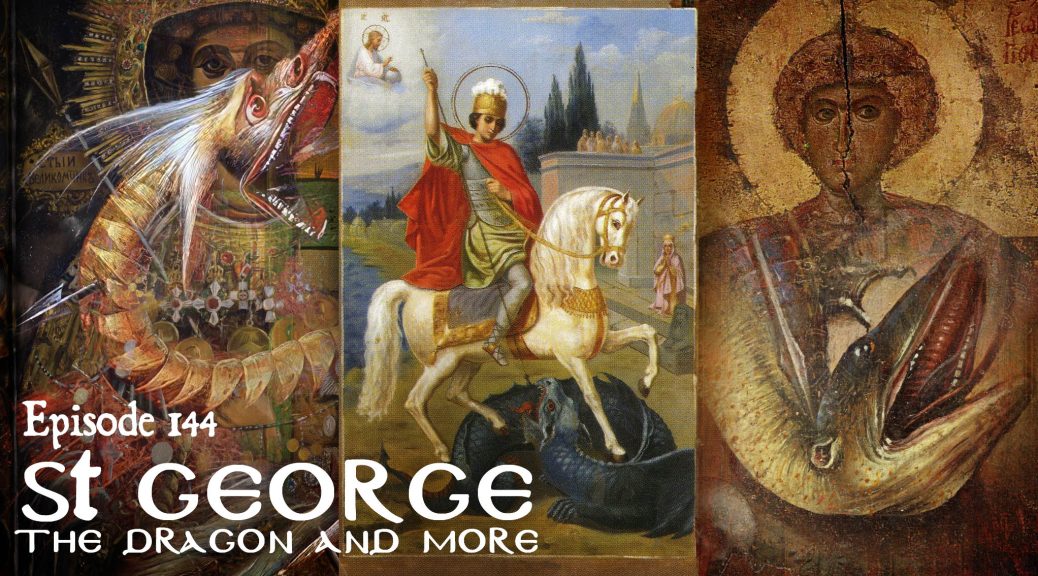
St. George, the Dragon, and More

St. George, the Dragon, and More

There’s so much more to the figure of St. George than his battle with a dragon. Legends also tell of his grisly martyrdom, capture of a demon, and postmortem abilities to cure madness through contact with his relics. In the Holy Land, there is even a tradition syncretizing St. George with a a supernatural figure of Muslim legend.

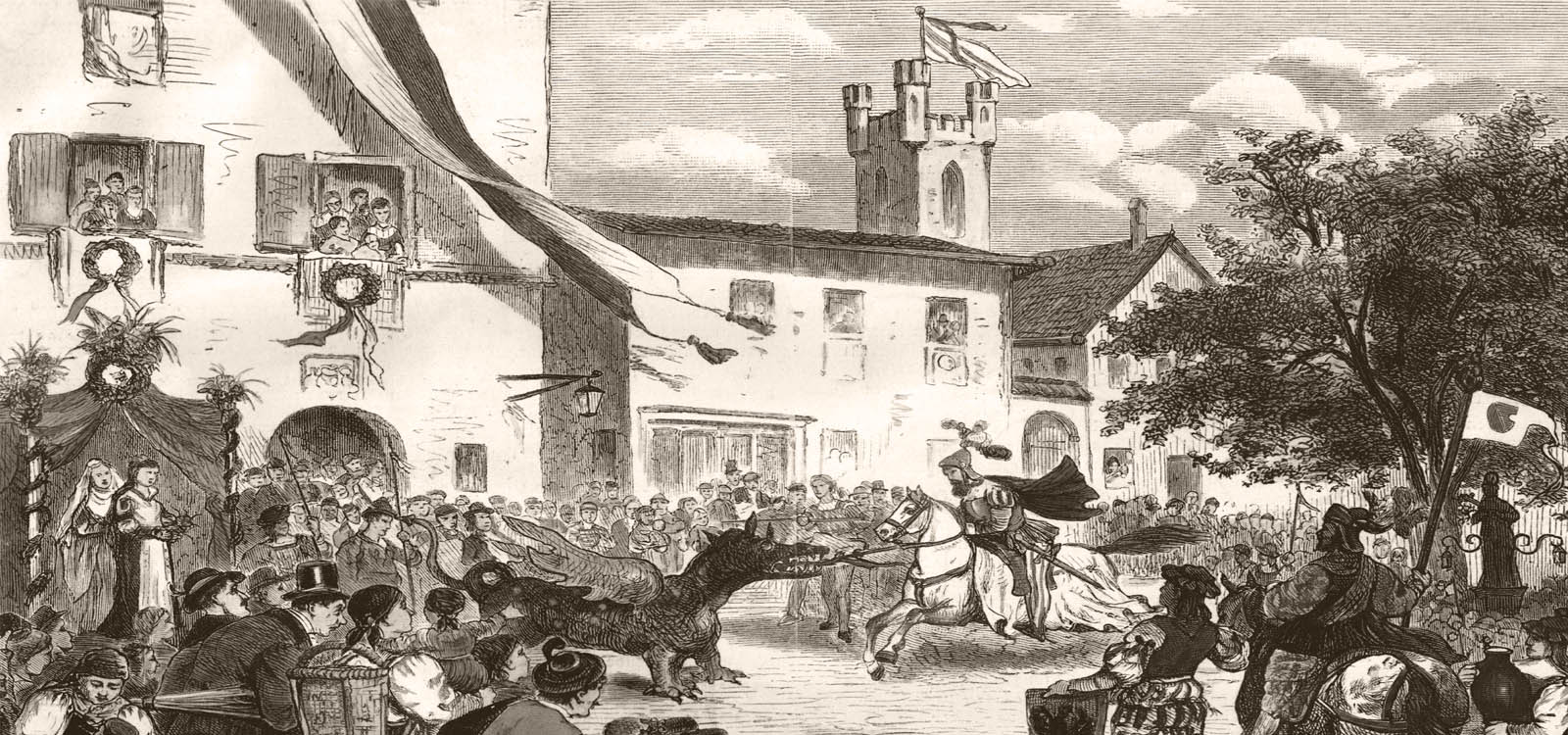
We begin with a look at a modernized take on the St. George legend, the annual Drachenstich, or “dragon-stabbing,” held in the Bavarian town of Furth im Wald. Beginning in 1590 with a performer representing the saint riding in a church procession, George was soon joined by a simple, canvas dragon, which over time evolved into the the world’s largest 4-legged robot used in the event today.

19th-century Drachenstich in Furth im Walld

Mrs. Karswell  next reads for us the primary source for the dragon story, Jacobus de Voragine’s collection of saint stories compiled around 1260, known as the Golden Legend. It popularized the tradition that George was a Christian soldier in in the Roman (Byzantine) army, born in Cappadocia, in central Turkey, and executed for refusing to bow to Imperial gods.  There is also a princes to be rescued from the dragon but no king gives George her hand in marriage, as you might expect.  Though Voragine set this episode in Libya, this setting  was not really retained i the  tradition.

As one of early Christianity’s “soldier saints,” George held particular appeal for soldiers of the Crusades. We hear of two incidents of George leading Crusaders to victory as recounted in the Golden Legend and the Gesta Francorum (deeds of the Franks).

When in 1483  William Caxton’s English translation of the Golden Legend appeared, anecdotes of British interest were added, including George’s connection to English knightood and The Order of the Garter. Elizabethan writer Richard Johnson featured George in his 1596 volume, Seven Champions of Christendom, elements of which were borrowed into mummers plays in which George became a hero.  We hear snippets of these.

Returning to Germany, we learn how George was also said to have encouraged the armies of Friedrich Barbarossa at the Battle of Antioch during the Third Crusade. We then delve a bit more into the history of the Drachenstich performances. Some folksy details from 19th-century newspapers documenting the tradition are also provided.

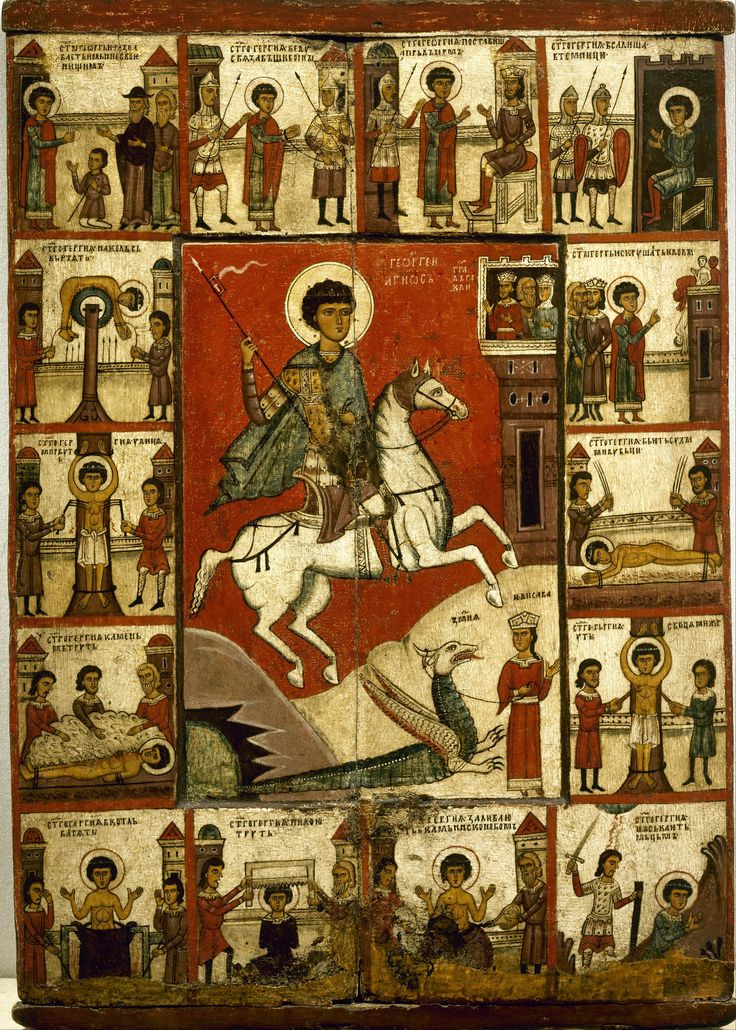
We then return to the Golden Legend for an account of George’s martyrdom.  The location of this episode is not specified, but George’s pagan nemesis here can be identified with Dacianus, the Roman prelate who governed Spain and Gaul. The tortures endured run the gamut from rack to hot lead, all of which are supernaturally endured until the saint is ultimately beheaded. Divine retribution in the form of fire falling from heaven is also included.

Next, we investigate earlier sources adapted into Voragine’s dragon story, the first known being an 11th-century manuscript written by Georgian monks residing in Jerusalem. George’s background as a soldier from  Cappadocia is identical, as is the endangered princess, though the victory over the beast lacks elements of swordplay and is largely accomplished through prayer.  In this version, George is also responsible for the founding of a church complete with healing well.

From the same manuscript, we hear a few more miracle stories, the “Coffee Boy” legend, George’s defeat of a loquacious demon, a cautionary tale of a murderous and greedy hermit ostensibly, and a charming story involving a unhappy boy, George, and a pancake.

We then take a look at the oldest St. George text probably written in Syria around the year 600. It’s known as the “Syriac Passion of St. George,” and details an extraordinary series of tortures so fantastical as to be declared heretical by the Church in the Decretum Gelasianum, probably within a century of the story’s composition.

14th-cent Russian depiction of St. George’s Martyrdom

Digging a little deeper, we then consider the Greek myth of Perseus and his rescue of the princess Andromeda, who is offered by her father as a sacrifice to a sea-monster. It’s certainly a striking parallel to the saint’s dragon legend, but the historical connections seem less profitable to trace than visual evidence found in a cave in George’s legendary homeland of Cappadocia.

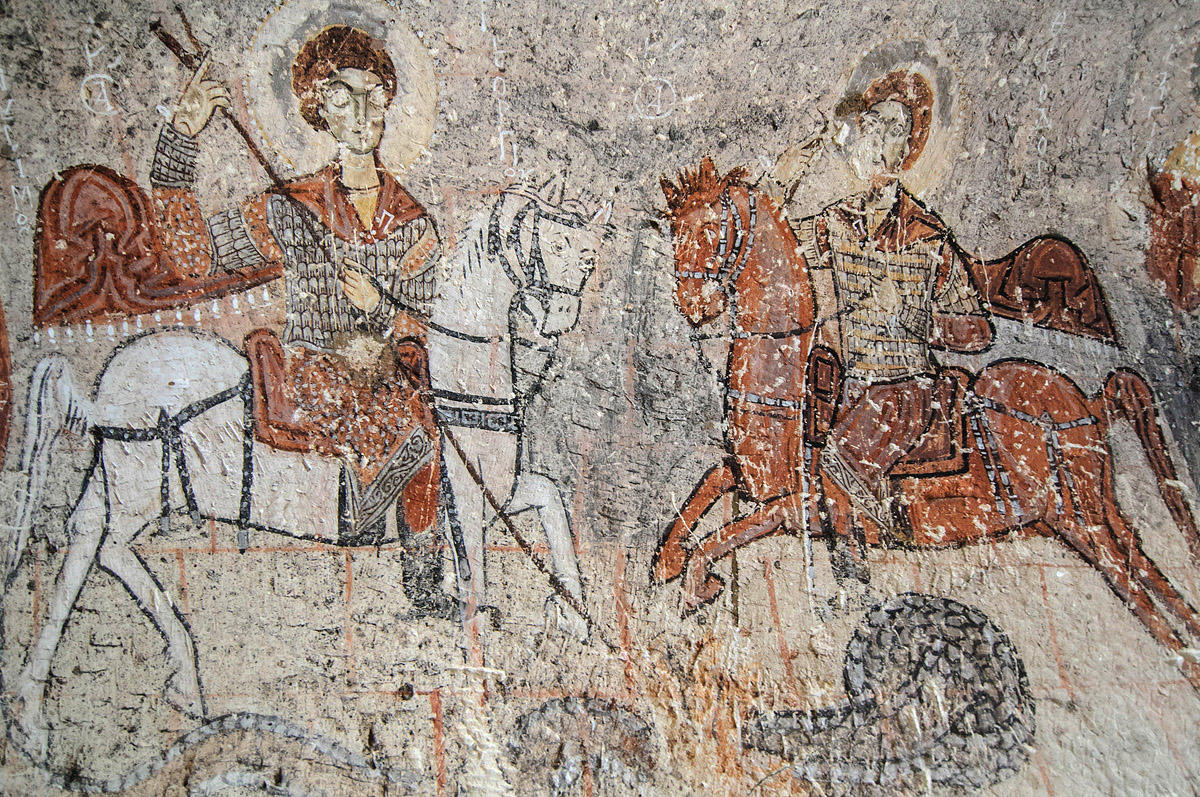
There, around the town of Göreme, one can find 9th- and 10th-century “cave churches” excavated by Byzantine Christians. One site known as the “Snake Church,” is named for its murals of serpents being speared and trampled by two soldiers on horseback. One rider has been identified as St. George. The other, St. Theodore, is another 4th-century martyr and soldier-saint with parallel story elements, including calling down fire on a pagan temple and destroying a dragon.  We then hear a bit more about Theodore and his connection to Constantinople and Venice.  The images of George and Theodore combatting dragons, significantly pre-date the earliest manuscript narrative of George and the dragon by perhaps a century, and it’s suspected that Theodore’s killing of a dragon may be an even older story. We also hear a bit about the St. Agapetus, whose legend offers further parallels and of the Christian mystic Arsacius, of which the same could be said.

Cave Church image

Visually, images of Christian soldier saints and dragons, such as those painted in Göreme, resemble an artistic motif of the Roman era known as the “Thracian Horseman” —  representations of a mounted warrior armed with a downward pointed spear. Under his horse’s legs is usually a boar, depicted as prey.  The image appears in various contexts, employed toward diverse magical purposes, which we discuss.

Also discussed is related iconography of a Byzantine (and later Carolingian) motif,  “Christ in Triumph”or“Christ Trampling the Beasts,” along with images of St. George on horseback slaying a human figure believed to represent his nemesis, a pagan ruler, who in the Syriac Passion is identified as “the dragon of the Abyss.”  As these predate the more literal dragon combat, an evolution from allegorical to more literal representation is suggested.

We end with stories of miracles associated with the relics of St. George, particularly chains said to have been worn by the saint in prison before his martyrdom.  Preserved in a convent church in Al-Kidr, a town on the West Bank, near Bethlehem, they are said to be particularly efficacious in curing madness in those who touch them — a belief held by local Christians and Muslims alike, We also encounter the supernatural figure of Muslim legend after whom the town is named. “Al-Kidr” — translated as the Green One — who has been syncretized in local tradition with St. George.


International Folk-Horror Film Round-Up

International Folk-Horror Film Round-Up

As a summer replacement for our regular episode: a round-up of non-English-language Folk-Horror films (here as audio but also available as video)

The presentation was created by Mr. Ridenour’s for the Rural Gothic conference hosted by The Folklore Podcast on 9/26/2020. The focus is on European folk-horror films, including Russian productions, and a few especially interesting Turkish films are also highlighted. It’s by no means comprehensive and naturally only  includes films made in 2020 or earlier.

You’ll hear the audio component if you continue listening here, but to watch the trailers, go to the Bone and Sickle YouTube channel (here: https://youtu.be/fJm6hgzaPV4). Or just Google “YouTube” and “Bone and Sickle” and you’ll find “International Folk-Horror Films” as a video.

These are the films discussed (English titles).

ANTHOLOGY FILMS: A Field Guide to Evil – Tale of Tales.

SPANISH LANGUAGE: Tombs of the Blind Dead – Macario – Poison for the Fairies – The Witches of Zugarramurdi – Errementari: The Blacksmith and the Devil.

GERMAN-LANGUAGE: Mark of the Devil – Laurin – Sennentuntschi.

SCANDINAVIAN: The White Reindeer- The Juniper Tree – Trollhunter – Rare Exports- Thale- Border.

POLISH-ESTONIAN: Witchhammer – November.

CZECH-SLOVAKIAN: Valerie and Her Week of Wonders – Morgiana- Beauty and the Beast – The Cremator- Kytice – The Noonday Witch – Little Otik.

RUSSIAN: Vasilisa the Beautiful – Kashchey the Immortal – Viy – Viy: The Forbidden Empire – The Night Before Christmas – Gogol: The Beginning – Gogol: Viy – Gogol: A Terrible Revenge – The Bride – Queen of Spades: The Dark Rite – The Mermaid: Lake of the Dead – Ghouls (Vamps).

TURKISH: Dabbe films – Siccin films.