The Christmas Eve ghost story is a fine old tradition associated with Victorian and Edwardian England, one that’s been making a comeback on both sides of the Atlantic. Since 2018, Bone and Sickle has enthusiastically embraced the custom.
Our offering for 2025, is “The Other Bed” written by E.F. Benson in 1912 and read for us by Mrs. Karswell.
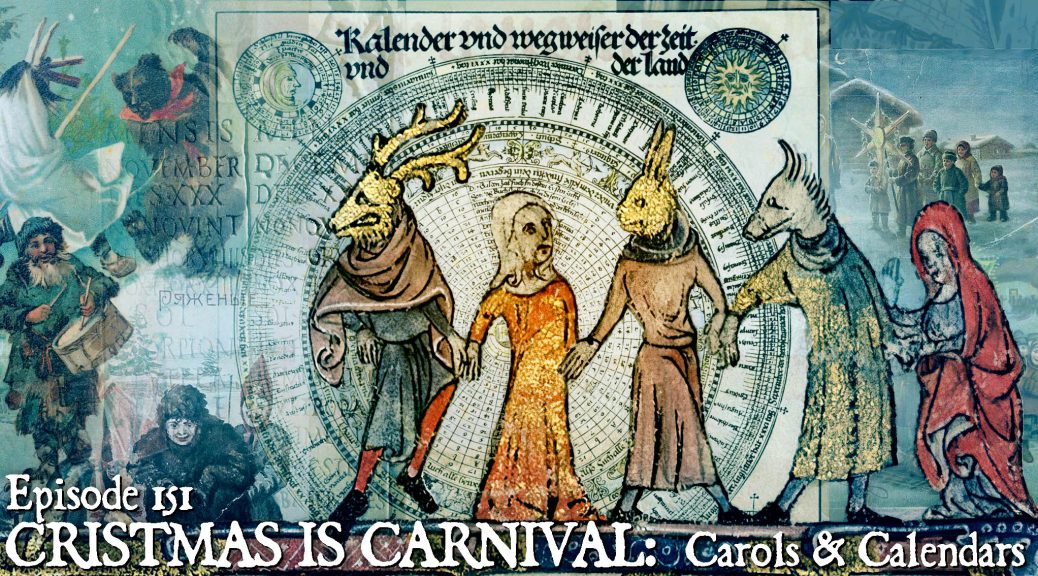
Historically, the celebration of Christmas and Carnival could overlap, and there is some reason to believe that customs associated with the former were inherited by the latter.
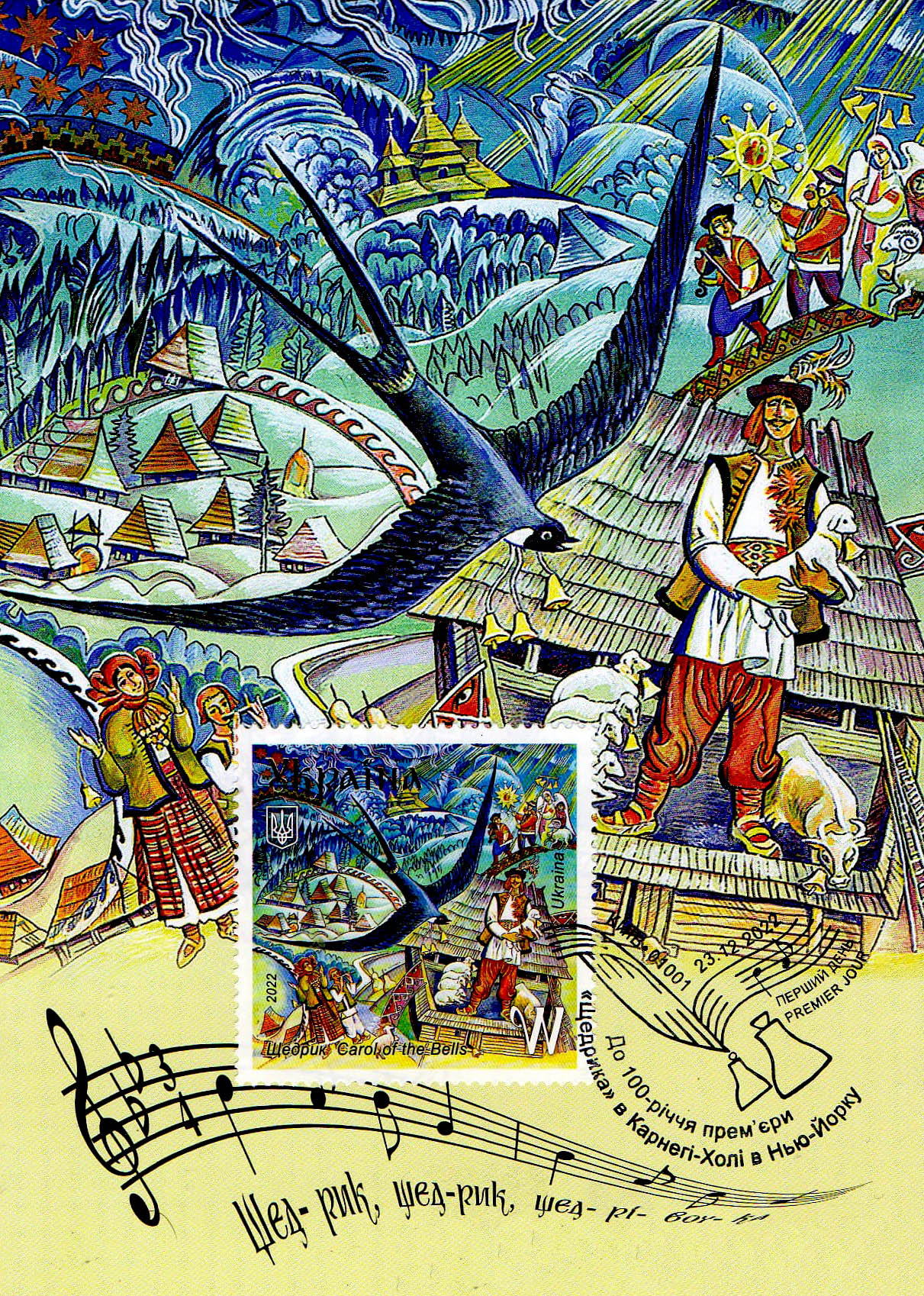
A clue to this calendrical shift is offered by the Christmas song, “Carol of the Bells,” which uses the melody of an old Ukrainian New Year;s carol, one which dates back to the era in which New Year was celebrated in March (hence the springtime imagery of its original Ukrainian lyrics).
Ukrainian postcard commemorating the folk song”Shchedryk” source of “Carol of the Bells”
After a brief look at the variable date chosen to celebrate the New Year throughout European history, we take some time to rethink our modern understanding of what constitutes the Christmas season. The common notion that the season ends on December 25 or January 1, possibly including the weeks leading up to those dates, in historical understanding, was reversed, with Dec. 25 representing the start of Christmastide, which at the very least ran until Epiphany (Jan. 6) or Candlemas (Feb. 2).
The merger of Christmas and Carnival is not only aided by the historically later end date of Christmastide, but also the variable start date for Carnival. A number of regional dates preferred for those festivities are discussed with Germany’s initiation of festivities on November 11 being the earliest.
Another reason to suspect that Carnival inherited some of its customs from Carnival is the carnivalesque quality of the Christmas Feast of Fools celebrated anywhere from Dec. 26 to January 6. The wild, and sometimes dangerous revels celebrated on those days (and discussed in Episode 100) were ended by local bishops at roughly the same time that Carnival celebrations in France and Germany emerged, suggesting re-channeling of anarchic impulses and customs.
Our discussion then turns to the Roman New Year, the January Kalends, which likely inspired chaotic elements around the Feast of Fools. Of particular interest here are accounts of celebrants dressing in animal hides and horns. a custom that seems to have survived in certain Carnival traditions, including a number discussed in my Carnival book. One of these, the Kurent of Slovenia, who happens to be rather similar to the Austrian Krampus across the country’s northern border.
In Western Bulgaria too, another Carnival figure, the Kuker, in western regions also makes use of animal hides and horns (as well as bells). Bulgaria also provides us with an interesting 20th-century case study of the merger of the traditions of Christmas (or “Surva,” the Bulgarian New Year) merging with springtime fertility customs of Carnival, both strands being associated with the Kuker.
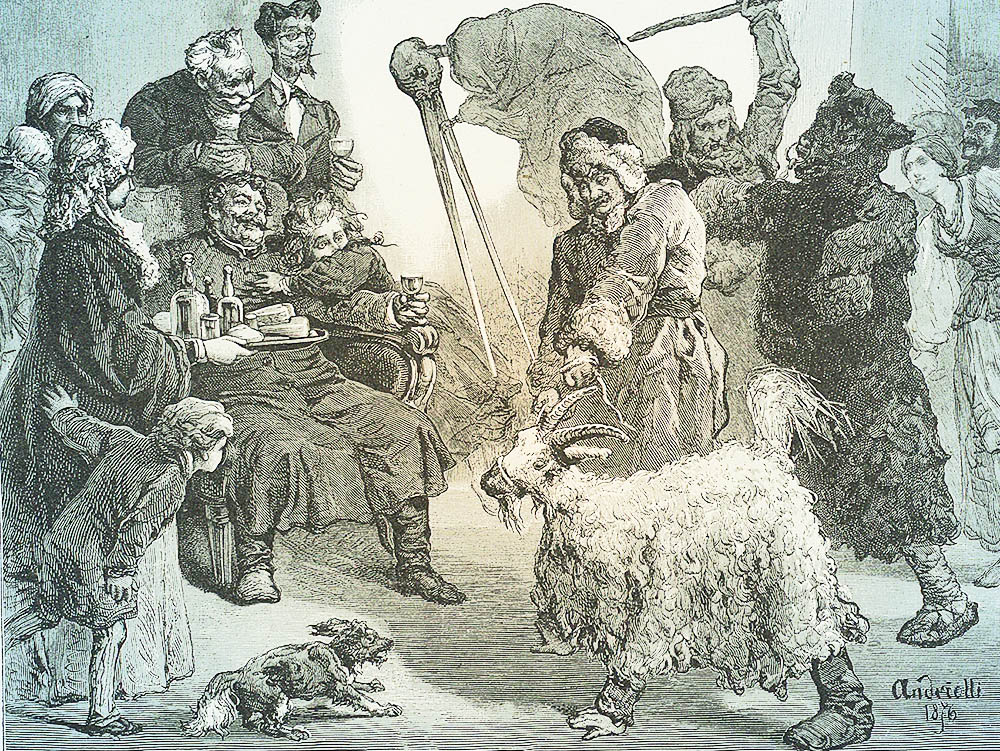
We wrap up with a brief look at Slavic celebrations of the Christmas cycle as Koliade (various spellings), a name for Christmastide and the customs associated with it, particularly door-to-door “good luck visits” incorporating short plays and songs, kolyadka in Ukrainian, the original of “Carol of the Bells” (Shchedryk/”Bountiful Evening”) being one of these songs
“New Year’s Carols” (Kolędnicy noworoczni) from “A Polish Year in Life, Tradition and Song” (1900).
The Victorian tradition of telling ghost stories at Christmas has been celebrated by Bone and Sickle since 2018. This year is no exception as we share two stories in this episode, one comic, and one frightening. We begin with the Introduction to the 1891 anthology, Told After Supper, by the British writer, Jerome K. Jerome, following this with “The Old Portrait” from Scottish writer Hume Nisbet’s 1900 collection Stories Weird and Wonderful. Pour a brandy, douse the lights, and enjoy!
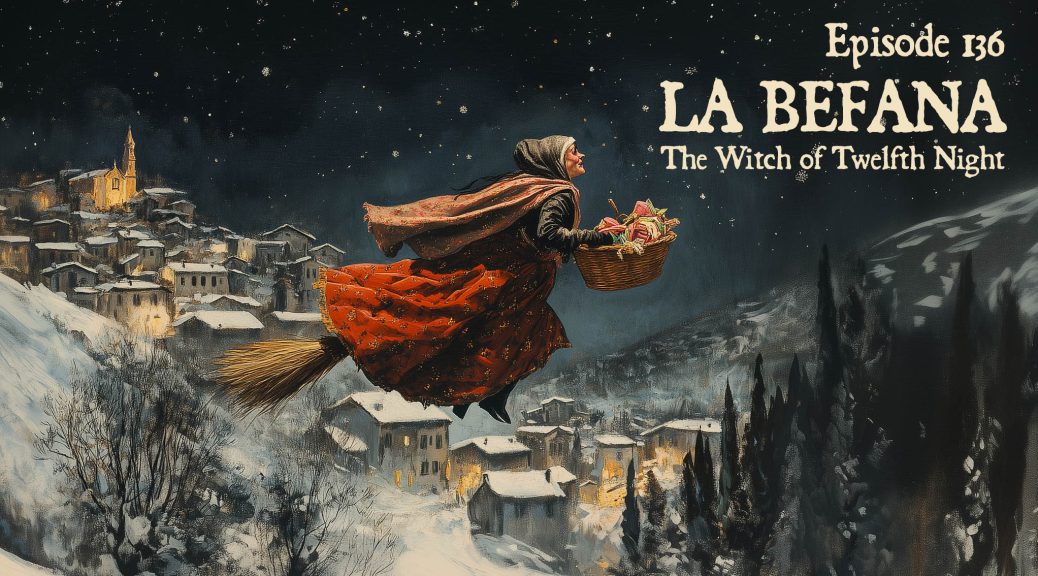
A short extra episode on Befana, the gift-bringing Italian witch associated with Twelfth Night, the end of the Christmas season. Included in the show is material from the book, “The Krampus and the Old, Dark Christmas,” traditional music of the season, audio from actual celebrations, and a few pop songs associated with la Befana.
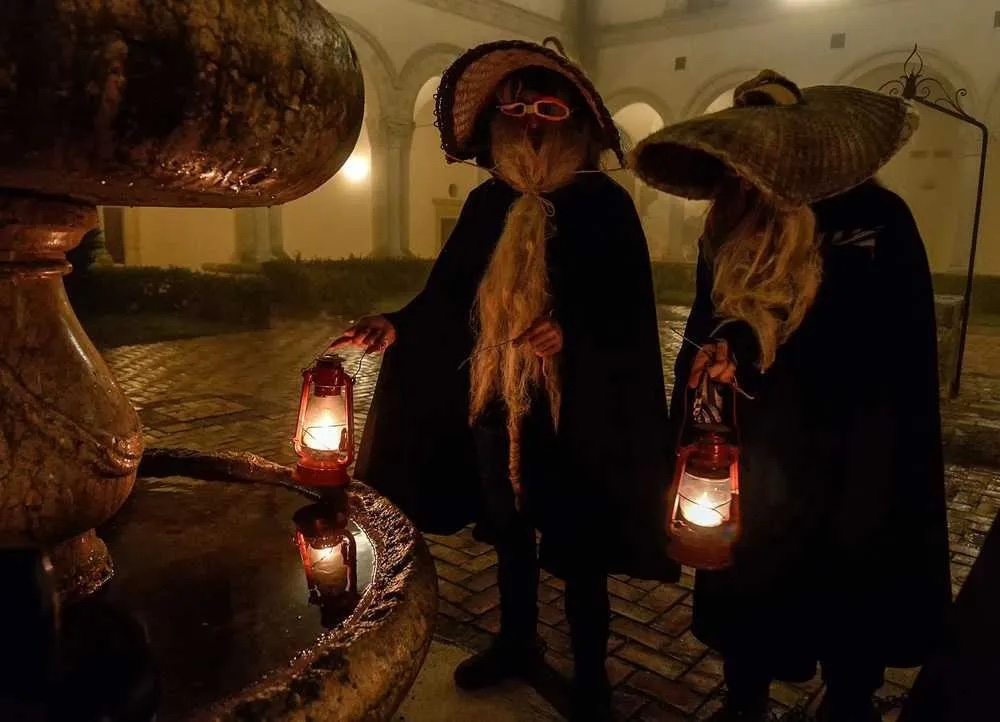
Befana on the Piazza Navona, Rome.The Cucibocca of Montescaglioso
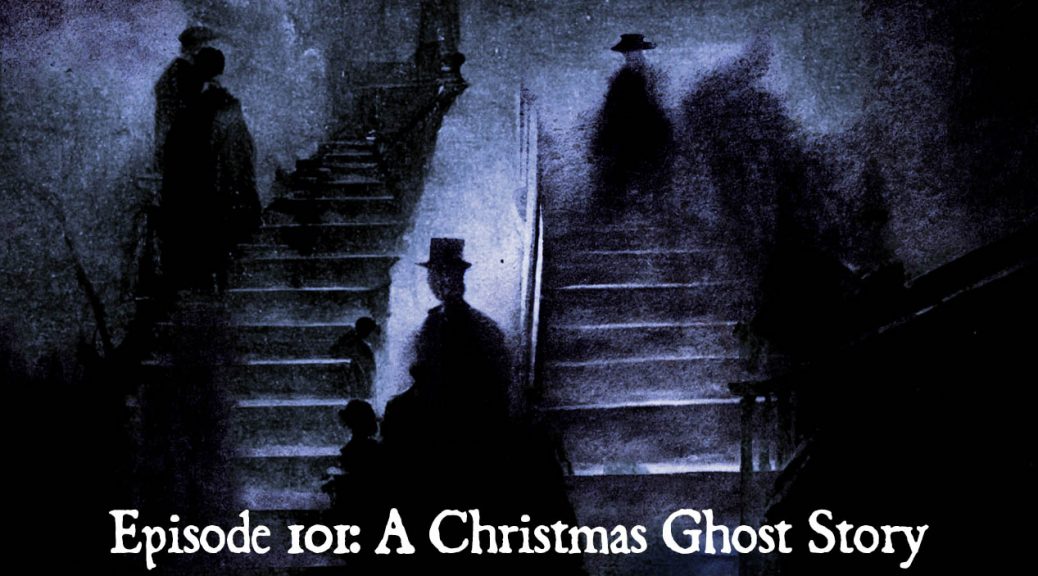
Tonight we bring you our sixth annual Christmas ghost story, a tradition particularly beloved in Victorian and Edwardian Britain. First published in 1908, and set in the days before Christmas, the tale is by British writer Algernon Blackwood (from whom we earlier heard “Ancient Lights“) and whom many listeners will know through his other works, particularly, The Wendigo or The Willows. Throw a log on the fire, refill the brandy, and settle back for Mrs. Karswell’s reading of “The Kit Bag.”
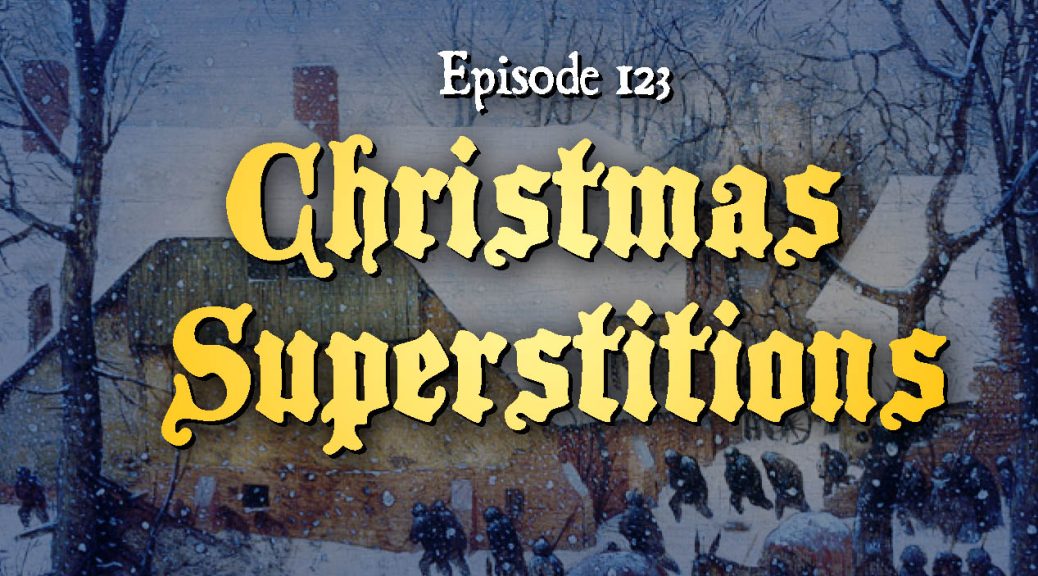
The Christmas season is rich in superstitions. The whole period from the beginning of Advent, through the day itself, and especially throughout the twelve days (and nights!) between Christmas and January 6 or Epiphany are, in a sense haunted, a time when spirits are afoot and behavior is hemmed in by restrictions upon normal activities. Recently I stumbled upon a good collection of these folk beliefs in a volume from 1903 entitled Encyclopaedia of Superstitions, Folklore, and the Occult Sciences of the World: (And subtitled, A Comprehensive Library of Human Belief and Practice in the Mysteries of Life). The book’s contents are indeed as comprehensive as that title, and from their section on Christmas, I’ll be sharing some of the more interesting examples.
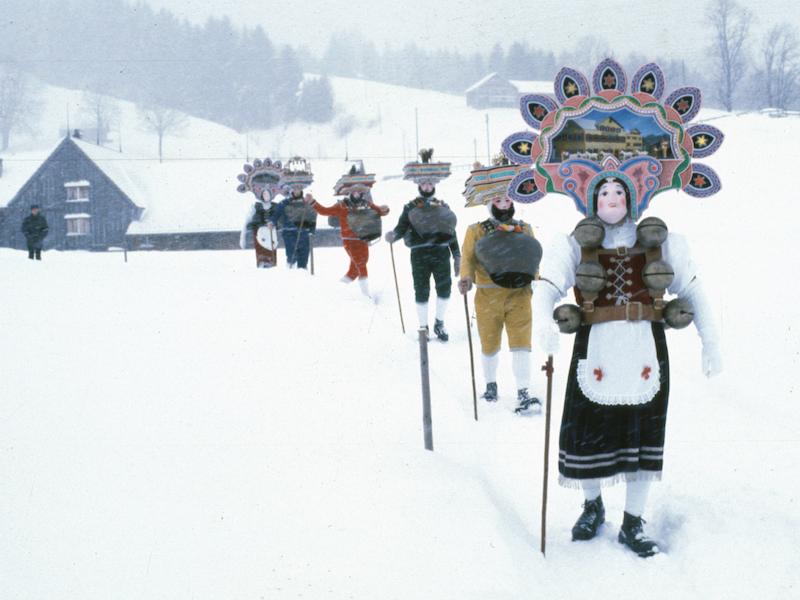
The show closes with a recording of a song sung by costumed Swiss holiday figures known as Silvesterchläuse. In the hinterlands of the Canton of Appenzell-Ausserrhoden, the se Silvesterchläus, groups of men and male youths wearing huge bells and ornate costumes, go door to door to offer seasonal blessings and sing songs like the one you will hear.
The Christmas Eve ghost story is a fine old tradition associated with Victorian and Edwardian England, one now making a comeback on both sides of the Atlantic. Since 2018, Bone and Sickle has enthusiastically embraced the custom.
Our offering for 2022, is “Smee” written by A.M. Burrage in 1931 and read for us by Mrs. Karswell.
Previous Christmas ghost stories are linked here in our website show notes (2018, 2019, 2020, and 2021).
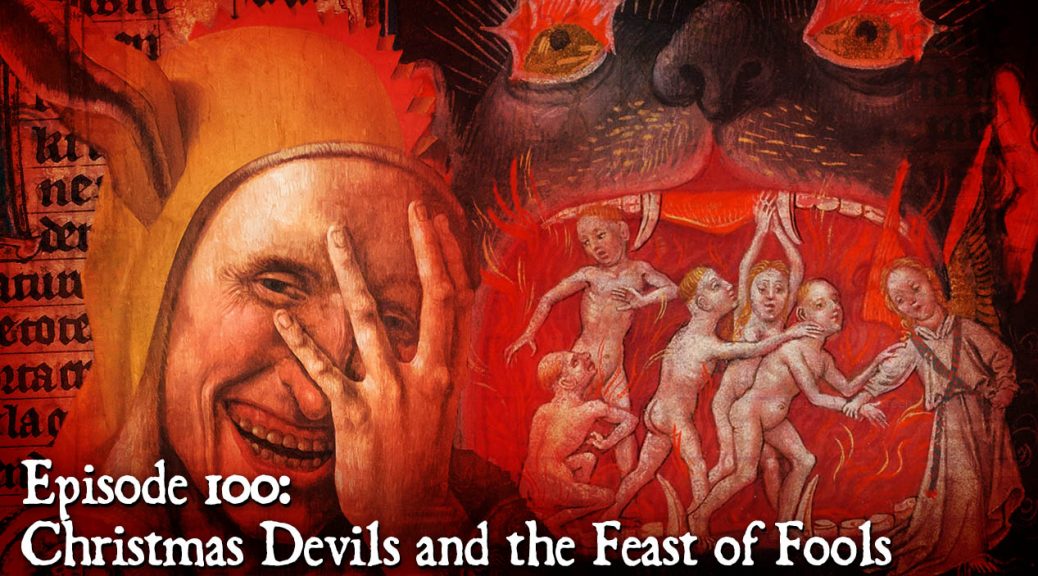
From St. Nicholas Day through Christmas, the Devil figured prominently in medieval plays, embodying a subversive seasonal element also celebrated in the Feast of Fools.
We enter the topic of medieval Christmas plays sideways through German composer Carl Orff’s 1935 composition “O Fortuna,” a piece much beloved in Hollywood soundtracks. The lyric Orff set to music happens to belongs to one of 24 11th-century poems preserved in a Benedictine monastery in the Bavarian town of Beuren, providing the collection with its name, Carmina Burana, a Latinized version of “Songs from Beuren.”
After a brief look at some of the rude and blasphemous poems, for which the collection is notorious, we switch to its poem on the Nativity, a much less scandalous composition which formed the basis of one of Europe’s first Christmas plays. We focus on the prominent role given Satan and his demons in that text as well as the comic portrayal of the Antichrist in Ludus de Antichrist, “Play of Antichrist,” preserved in a collection from a nearby monastery in Tegnersee.
From there we switch over to medieval portrayals of another sort of Antichrist, namely King Herod, whose role in the Christmas story is to order the execution of all infant males in his kingdom, hoping thereby to exterminate a potential rival, the “King of the Jews,” rumored to have been born in his kingdom. We discuss some fantastically grisly portrayals of this event from the medieval stage.
We next have a look at some of the stagecraft employed in portraying the Devil and his minions, discussing the fabrication of “Hellmouths,” a set element, which swallowed sinners and vomited up devils on the medieval stage. Alongside this, we examine costumes and pyrotechnics used to enhance the theatricality of demons and their realm.
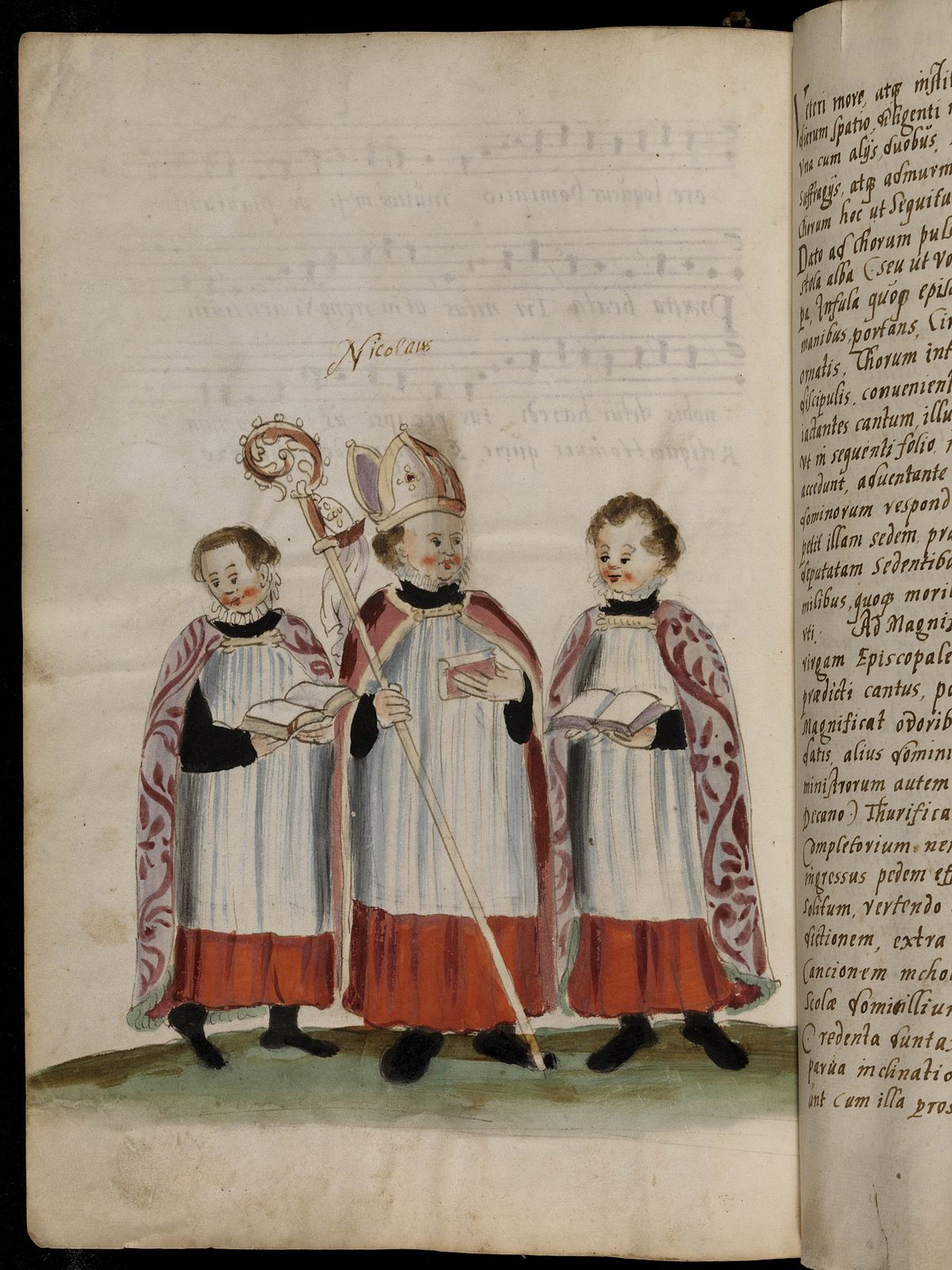
From there, we turn to another subversive, sometimes violent, undercurrent in holiday celebrations, namely that of the Boy Bishop. Beginning around the 10th century, the title was given to a youth elected to lead mass either on the Feast Day of St. Nicholas or on December 28, the Feast of the Holy Innocents. On the surface, the tradition may sound innocently charming enough, but as we learn from quite a few contemporaneous accounts of mayhem and violence involved in the festivities, this inversion of the hierarchies could quickly lead into Lord of the Flies territory.
16th-century depiction of the Boy Bishop tradition from Bamburg, Germany
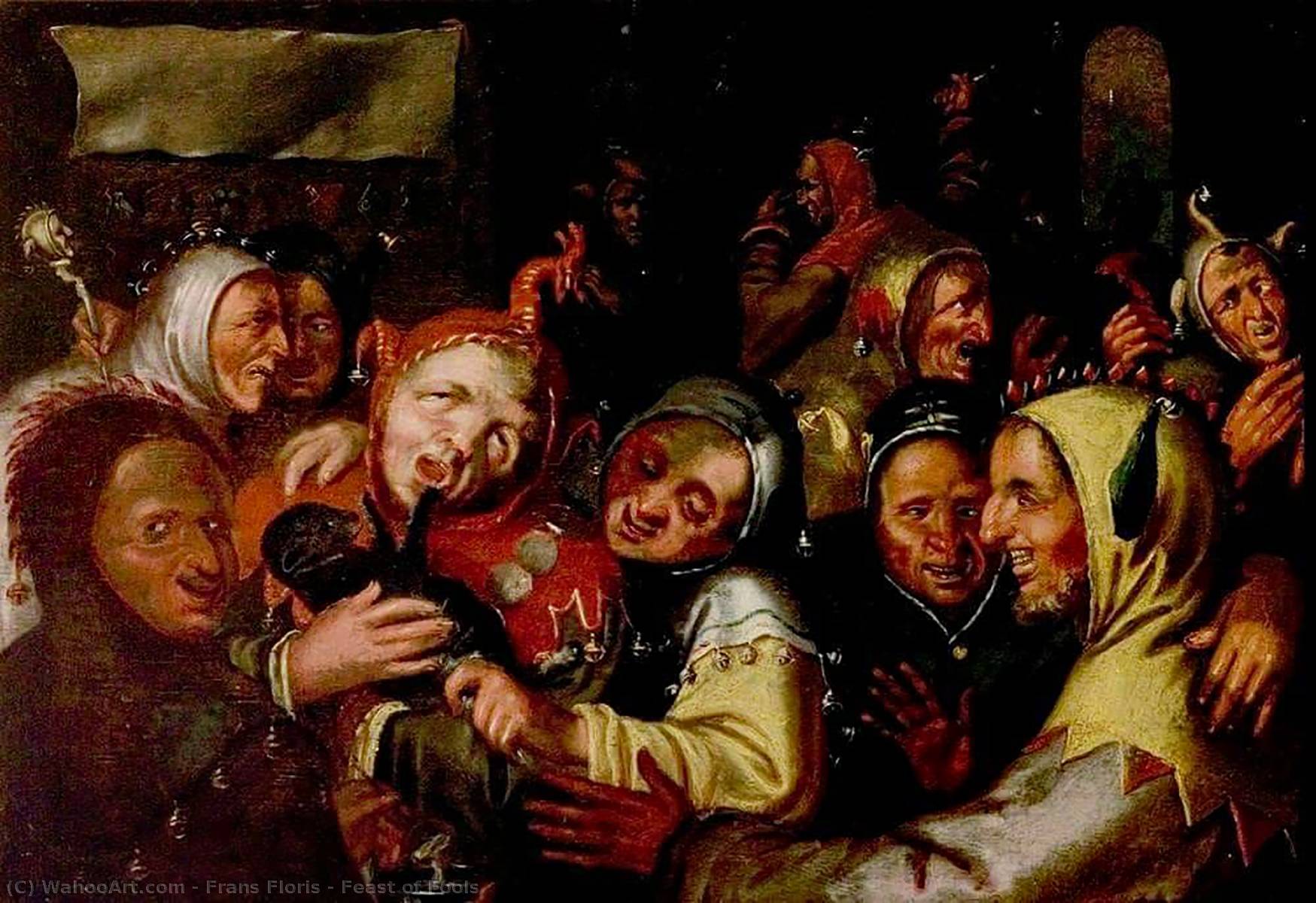
Related to the Boy Bishop tradition, is our next topic, the Feast of Fools. While many listeners will be familiar will be with the carnivalesque street parades, and election of a mock King, Bishop, or Pope of Fools, these chaotic elements were not limited to the secular world. Indeed, the festumfatuorum began within the church itself, consisting of a number of days in which lower clergy assumed roles usually belonging to those above them in the hiearchy (priests for bishops, etc.).
The “Feast” actually constituted of a number of different days during the Christmas season during which such inversions took place, a period sometimes extending all the way to January 14, on which the “Feast of the Ass” took place, a celebration honoring the animal which bore the Blessed Virgin to Bethlehem, and one involving the congregation in a litany of “hee-hawing.” Mrs. Karswell reads for us a number of historical accounts detailing the mayhem involved in these celebrations.
We close with a nod to the most the most famous literary reference to the Feast of Fools, one which novelist Victor Hugo imagined in his 1831 novel The Hunchback of Notre Dame, and in which the titular character is crowned “King of Fools,” (or “pope” in the original French.)
In keeping with the old tradition of whiling away the nights of Christmas telling ghost stories, we bring you a tale published in 1912 by E.F. Benson. Read by Mrs. Karswell, complete with sound FX and music as always.
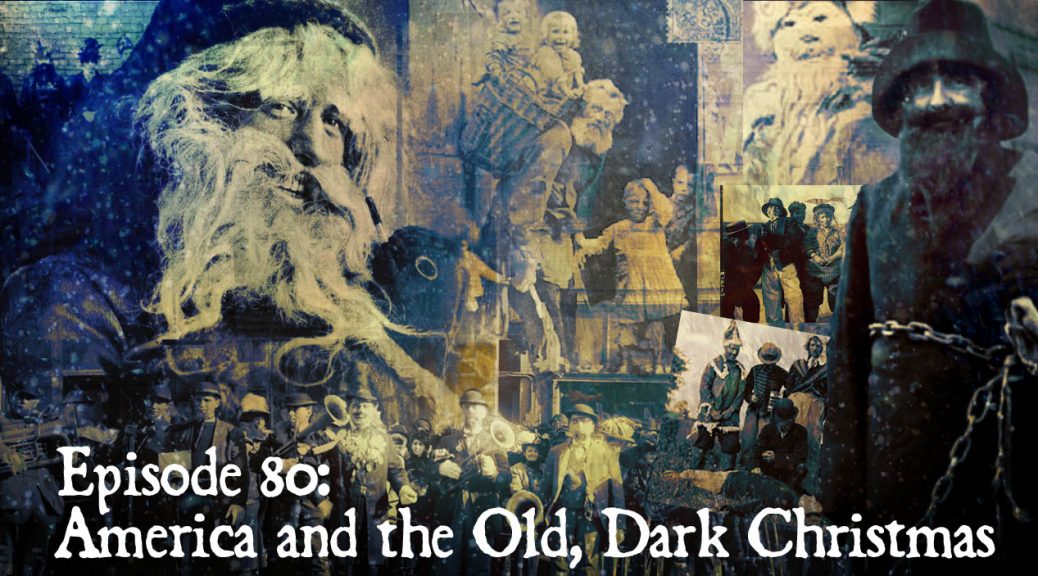
In earlier centuries, Americans partook in many of the same dark Christmas traditions that gave birth to Europe’s Krampus. This episode examines our untamed holiday history.
The most obvious example of this is the character of Belsnickel, (sometimes: Pelznickel, Belschnickle, Bells Nickel, etc.), who, like the Krampus, usually appeared on St. Nicholas Day, carrying a whip with which to threaten or strike naughty children. He was found particularly in German-settled areas of eastern Pennsylvania, but also in Appalachian West Virginia, Maryland, North Carolina, and Southern Indiana.
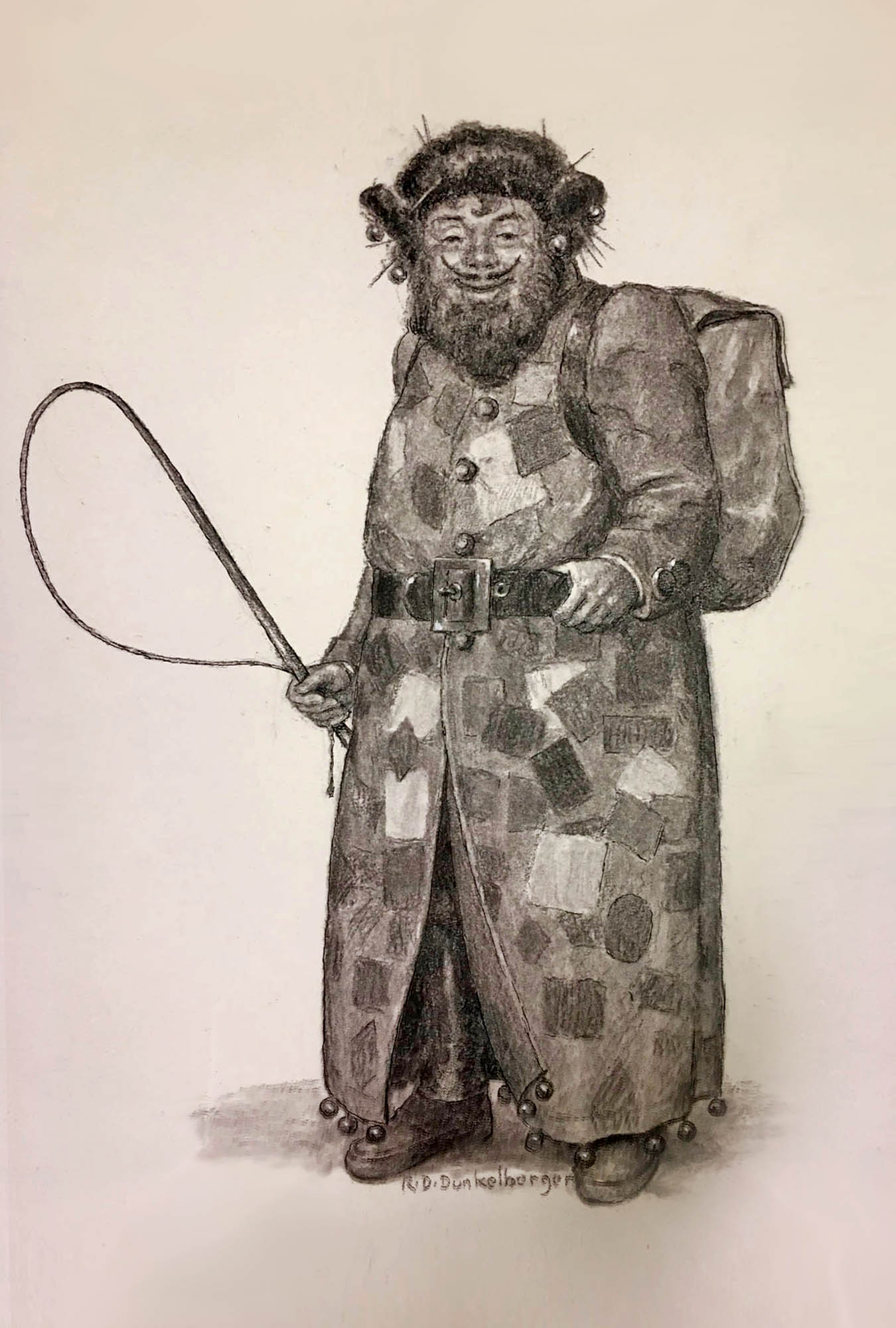
Belsnickel’s costume could vary widely depending upon what was available to the performer, but usually involved a long coat, hat, and almost always false whiskers — all chosen primarily to cover the actor and make him difficult to recognize. For that same reason, his face would also often blackened with soot or covered by any sort of mask available.
Belsnickel illustration by Ralph Dunkelberger (1959) in Berks History Center (PA)
Belsnickel often wore a fur coat or hat, a coat trimmed with fur, or a fur-lined coat turned inside out (to create a weird effect and make the garment less recognizable). The choice of fur probably had less to do with some essential attribute of the character and more to do with the season itself. Nonetheless, the name “Belsnickel,” which is a derivation of the German “Pelznickel,” has often been incorrectly interpreted as “Fur Nicholas.” In fact, the “Pelz” here derives from pelzen, meaning, “to beat.” Pelznickel (and Belsnickel) carried in his pocket or bag, small treats, which he would scatter over the ground. Naughty children trying to grab these would feel his whip.
Like Germany’s Knecht Ruprecht or the Krampus of Alpine Austria and Bavaria, the whip was the Belsnickel’s essential attribute. In fact, in the 1800s, Pelznickel/Belsnickel would probably not have been that different in appearance from the Krampus as the modern image we have of that creature was only standardized as such with advent of Krampus postcards and their imagery dreamed up by city-dwelling artists, along with growth of a competitive community of mask-carvers in the early 20th century.
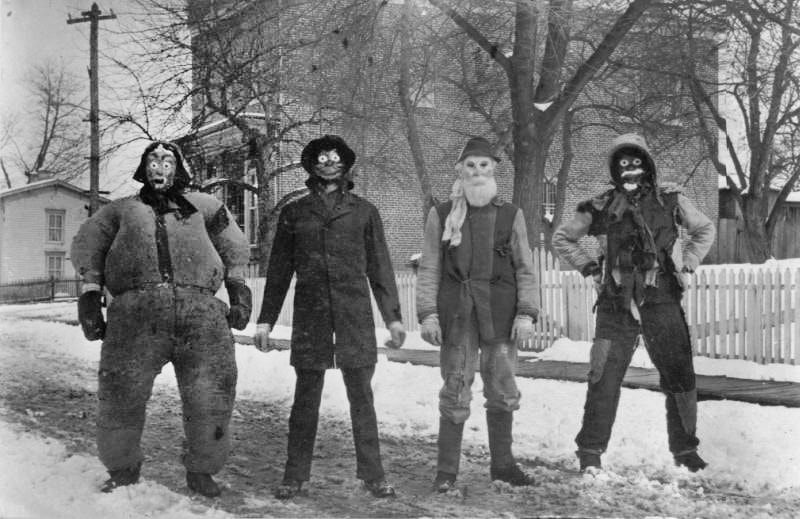
The popularity of the Belsnickel tradition soon saw it spill over from its original December 5-6 celebration to all the days leading up to Christmas and later New Year. As the tradition grew in popularity, Belsnickel was no longer represented as a solitary character but by groups of Belsnickels, whose behavior became increasingly rowdy and unwelcome. Rather than giving gifts or treats, these groups tended to ask for handouts from homes and businesses visited. Mrs. Karswell reads for us a number of American newspaper accounts documenting this trend.
Belsnickel appearing in groups. (photo: Museum of the Shenandoah Valley)
We also take a side-trip to South America, where the figure of Pelznickel arrived with German immigrants in the town of Guabiruba. Brazil. Unlike North America, where the Belsnickel had largely died out by the 1940s, Pelznickel events sponsored by the Sociedade dos Pelznickel continue to thrive – but with an interesting twist. There, the Pelznickel wanders about outfitted in moss and other tropical vegetation, accessorized with Krampus-like mask and horns.
Pelznickel in Guabiruba, Brazil.
The Belsnickel gangs were not the only groups of costumed youth carousing or begging on American streets during the holiday. Some of the earliest reports of this sort of thing come from Boston, where they were known as “Anticks” or “Fantasticals,” a name also used elsewhere. In Philadelphia, they might be called”Belsnickels” or simply “clowns” or “shooters” (thanks to the fact that these groups tended to carry noisemakers, including guns). In New York, these bands of noisemakers, often equipped with actual musical instruments played discordantly, were known as Callithumpians, or Callithumpian bands.
In Philadelphia, the rowdy costumed traditions of immigrants from Great Britain and Scandinavian melded with those of the Germans and were eventually domesticated by civil authorities into a more manageable form, the annual Mummers’ Parade.
In New York, no such solution was found, and Mrs. Karswell reads for us dramatic newspaper account from 1828 describing holiday chaos in that city.
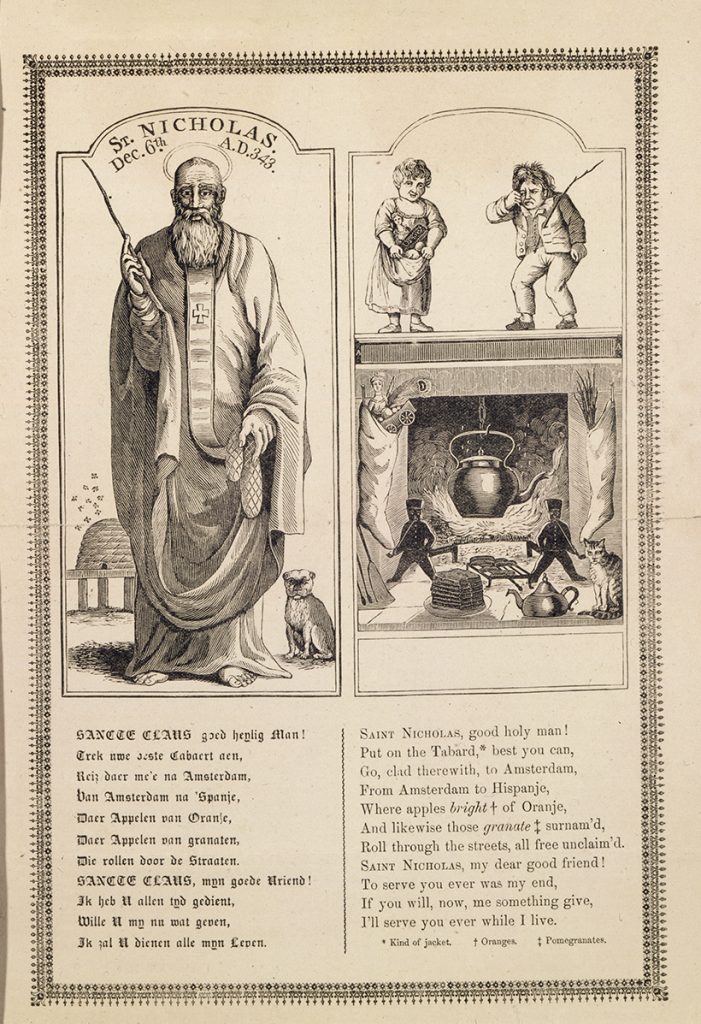
Eventually a remedy to New York’s seasonal turmoil was suggested by John Pintard, founder of the New York Historical Society, whose love for the traditions of “Old Amsterdam” suggested Holland’s patron Saint Nicholas as a distraction from the street carousing. His re-creation of pious domestic rituals involving the saint would eventually displace holiday activity from the street to the home, and refocus festivities from rowdy unmarried men to children rewarded for good behavior. Some peculiar twists and turns along the way are described.
St. Nicholas material Pintard commissioned for the New York Historical Society.
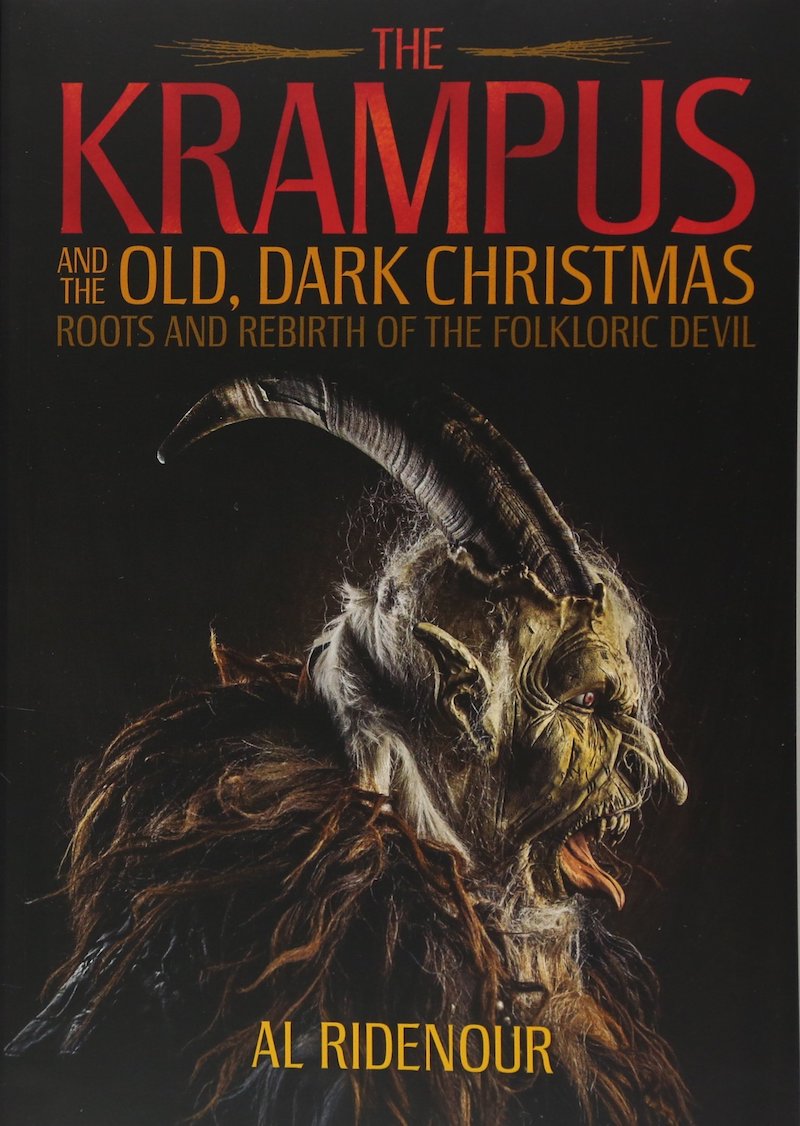
NOTE: This episode consists of material originally written for the book The Krampus and the Old, Dark Christmas, but excised due to page-count. Mr. Ridenour’s book, it should be noted, happens to make an outstanding gift for the holidays.